Last week’s economic news gave a fresh boost to the notion that long-term interest rates should be higher.
The 10-year Treasury yield surged upward on Thursday and Friday to close at just under 5.2%–the highest closed since June 14. The immediate catalyst was a week that, on balance, suggested a moderate bias for economic growth. A brief recap of the data that re-inspired the view that the economy’s still humming runs as follows:
* ISM Manufacturing and Non-Manufacturing indices each climbed in June to their highest levels since April 2006 (see chart below).
* Non-farm payrolls rose by 132,000 in June. That’s below the trailing 12-month average rise of 167,000 but it was high enough to convince the bond market that economic expansion remains intact.
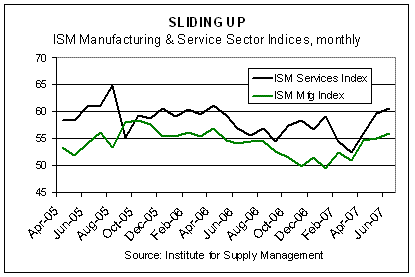
Pessimists can counter that last week’s numbers also gave us weakness in factory orders, which posted a 0.5% contraction for May. Meanwhile, initial jobless claims for the week through June 30 edged up to 318,000 from 316,000 previously. But tempering the negative aura in those gauges is the reasoning that factory orders reflect May activity vs. the more-recent measures portrayed in the ISM indices and non-farm payrolls. In addition, the downturn in factory orders was smaller than the consensus predicted. As for jobless claims, the 318,000 number was within the range of recent activity, making it easy to dismiss as a non-event for the moment, particularly in light of the payrolls and ISM data.
The bond market’s initial reaction to the news was to give the growth outlook the benefit of the doubt and elevate interest rates. But like so much of economic analysis of late, seeds of doubt can be found with a little digging. “The [June payroll] survey suggests that the job market is holding up well despite the housing downturn and the slowing” in the broad economy, Moody’s Economy.com chief economist Mark Zandi told USA Today via DelawareOnline. “Hiring remains sturdy and compensation growth firm.”