In the wake of today’s 25-basis-point cut in interest rates by the Federal Reserve, the not-so-subtle message is that the economy will weaken. But the cut comes just hours after the Bureau of Labor Statistics told us that economic growth was higher than expected in the third quarter at a respectable 3.9%. Not only is that slightly faster than the annualized real 3.8% growth in the second quarter, that’s the fastest pace since Q1 2006.
Of course, no one expects that the 3.9% is a prelude to something better, or even the standard for the foreseeable future. The Fed, to cite one source, expects the economy to slow. If a downshift is coming, diminished consumer spending will be the reason, probably due to the ongoing fallout from housing.
But there was no sign of that in today’s GDP report. In fact, personal consumption expenditures, which are GDP’s driving force, jumped 3.0% in Q3. What’s more, consumer purchases of durable goods rose at an even faster pace, ascending 4.4%–well above the economy’s overall rate of expansion.
Monthly Archives: October 2007
BACK FROM THE GRAVE
Actually, beta never died, as many have proclaimed over the years. In fact, beta’s never been more influential.
As yours truly detailed in the November issue of Wealth Manager, beta’s very much alive and kicking. What’s more, beta’s at the heart of a number of cutting-edge of a number of portfolio applications in the 21st century.
Beta, of course, is a risk measure that’s pivotal in the Capital Asset Pricing Model, which lays much of the foundation for indexing. Although CAPM is more than 40 years old, this durable theory continues to inspire innovation in portfolio management.
CAPM isn’t perfect, of course. The world is a complicated place, and no one theory can capture all the nuances that collectively define the global capital markets. Yet CAPM does a pretty good job of delivering the goods when its lessons are translated into indexing. Meanwhile, creative minds in finance keep trying to improve CAPM as a tool for the real world. Witness the ongoing love affair with ETFs, which speak volumes about the market’s enduring embrace of beta. But ETFs are just the tip of the iceberg in the evolving story that is beta.
For a closer look at why you should care, read on…
THE TROUBLE WITH SUCCESS
It’s an ancient problem, although as “problems” go it’s one of the better ones to have since it implies that you have money to manage. But it’s a problem nonetheless, and it becomes increasingly obvious as an investment portfolio grows.
Reviewing the nest egg of yours truly over the weekend revived the challenge anew of how to keep the growth relatively high in relative terms without assuming an imprudent amount of risk. Like many investors, your editor has done quite well since 2002. So it goes when bull markets bloom like weeds. Buy now what? The portfolio’s bigger, and so is the hurdle to keep up the momentum.
It should come as no shock to learn that growing a fund of, say, $100,000 at 10% per annum is far easier than keeping a $1 million fund rising at the same rate. Yes, it can be done, but it requires increasing amount of skill, luck or both.
The problem is further compounded at this juncture in the investment/economic cycle, or so we believe. There are more than a few risks swirling about the capital markets these days. The fact that most markets are at or near all-time highs suggests one or two things to the jaded mind producing the text before you.
The point being that reaching for the extra return at this point may be dangerous, perhaps more so than usual. Yet the incentive for reaching today is probably higher than it’s been in some time. Given the capacity for bull markets to lift all boats and raise expectations, most investors have portfolios that are materially larger compared to, say, five years previous. Some of that can be attributed to skill, but most of the growth was no doubt spawned by the genius of a bull market.
VOLATILITY & CORRELATION UPDATE
The last few months have been a roller coaster if you look at the markets through the prism of return. But what’s the view if we survey the investment landscape via volatility and correlation? Has the world really changed all that much by these metrics?
Let’s start with volatility, which we define as the standard deviation of monthly total returns for the trailing 36 months. Graphing that measure of risk on a rolling basis for each of the major asset classes over time reveals that the great decline in volatility in recent years remains intact, as our chart below illustrates.
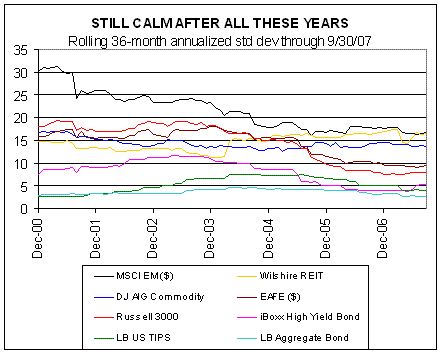
Yes, volatility has in fact spiked if we calculate volatility on a daily or weekly basis. But the spikes have yet to show up in any meaningful way on longer-term measures of volatility, as you can see in the chart above. That doesn’t mean that long run vols will stay low, although they might. But for the moment, the jury’s still out on whether market volatilities generally have entered a new era, which is to say a higher plateau.
Meanwhile, what’s the trend been for diversification of late? We’re defining diversification here as correlation between monthly returns for the trailing 36 months. Looking how several asset classes stack up on that measure on a rolling basis against U.S. equities (Russell 3000), it’s clear from our second chart below that recent history is a mixed bag (1.0 is perfect positive correlation; 0.0 is no correlation; less than zero is negative correlation).
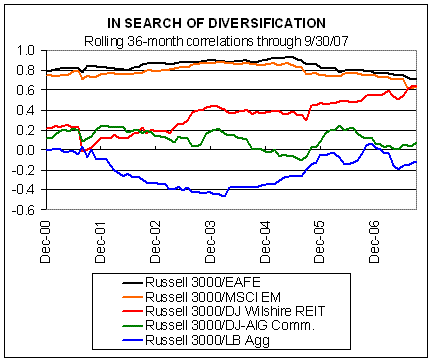
Bonds (LB Aggregate) and commodities (DJ-AIG) are still potent diversification tools relative to U.S. stocks, but less so these days than in the past. The trend of rising correlation is especially strong between REITs and U.S. stocks. Meanwhile, foreign stocks (EAFE and MSCI Emerging Markets) continue to provide slightly more diversification compared to domestic equities.
The good news is that risk-adjusted returns are enhanced by adding asset classes with less than perfect correlation to a portfolio’s existing holdings. By that standard, owning a broad array of the major asset classes still makes sense. Alas, diversification isn’t quite what it used to be. On the other hand, beggars can’t be choosy.
REFLECTING ON RISK
Last week’s stock market swoon reminds that there’s no shortage of worries to distract investors. For some pundits, the rising anxiety appears excessive. The economy still looks healthy in general. One widely read columnist over the weekend noted that consumers are still lining up to buy various luxury goods in his hometown. As a result, the odds of anything more than a mild slowdown look remote, he reasoned.
Yes, the risk of expecting the apocalypse is almost always a poor bet. The world always seems to muddle through even the worst disasters. War, terrorism, high inflation, misguided government policy, and so on are events forever hanging over the economy. Meanwhile, the ebb and flow of capitalism has been known to push markets to excess. Yet life goes on and patience usually pays off in the long run. Such are the virtues of looking past the headlines of the moment and on to the opportunities of the future.
We couldn’t agree more. Strategic-minded investors should maintain perspective and keep emotions in check. But that includes recognizing that a perennially sunny disposition harbors risk too. That includes the recognition that even if the long term works out, which it usually does, the short term can try investors’ souls and push the best-laid plans of mice and men to do unproductive and even self-destructive things.
It’s easy to proclaim allegiance to the long term when markets are rising, as they’ve been doing for the better part of the past five years–at least until last week. But how many of those who champion strategic virtue will hold true to the vision when the hour is darkest?
IT WAS 20 YEARS AGO TODAY…
For those of us who were watching that day, October 19, 1987 is forever seared into the memory banks. One doesn’t easily forget a 20% correction in the stock market that arrived in a matter of hours.
This reporter, working at a small trade magazine at the time, remembers the day vividly. The daily routine at the office began as usual, but as the morning gave way to afternoon all ears turned to the radio (the medium of choice for breaking news in those days). By 2 p.m, no one was working; all gathered in the conference room, listening to the updates on the spectacular collapse in stock prices. The selling grew more intense as the minutes ticked by. By the close of trading, we could only guess at what a 20% drop meant for the weeks and months ahead.
The obvious analogy was the crash of 1929 and the Great Depression that followed. Would history repeat itself in 1987 and beyond? Fortunately, the answer was “no.” The massive selling of October 19, 1987 was an isolated event, virtually unrelated to the economy. The Federal Reserve played a pivotal role in stopping the chaos in the market from infecting the general economy. Rather than squeezing credit supply, as the central bank did in the early 1930s, the Fed learned its lesson and instead pumped huge amounts of liquidity into the system in the days and weeks after the ’87 crash. By most accounts, that timely act was crucial in containing the carnage.
Twenty years on, what have we learned as investors? Buy on the dips. That has become the mantra for many, and the lesson was forged in 1987 and several times since. The latest example has come in the last several months. Reacting to the subprime woes of August, Bernanke and company dispatched an aggressive 50-basis-point cut in interest rates last month. The medicine worked its magic once again. The late-summer correction in U.S. stocks has since reversed, and the Fed’s timely injection of liquidity has figured prominently in the renaissance.
ANOTHER WARNING SIGN?
Sometimes the numbers send out a warning, sometimes not. Deciding which one prevails and when is part of what makes the dismal science interesting–and frustrating.
The challenge presents itself anew today in the wake of this morning’s update on initial jobless claims. What, if anything, are the numbers telling us? Taken at face value, the answer’s clear: the number of workers filing for unemployment benefits jumped last week to the highest level since late August. That could signify nothing more than the usual give and take that accompanies this volatile data series when measured in seasonally adjusted terms, as our chart below shows.
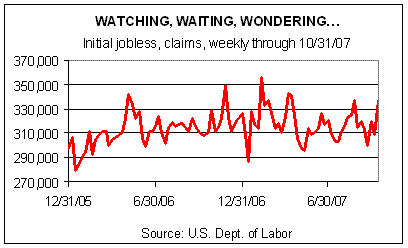
Statistically, we’re still within the “normal” range, based on a reading of recent history. But until and if initial claims move materially higher, it’s still an open question if there’s an early warning sign brewing here in terms of the economy’s future path.
Traders, of course, are an impatient bunch and so they aren’t inclined to wait for additional context. Consider trading in Fed funds futures, which have already read this morning’s news and decided that it’s best to assume that the economy is weakening on the margins. Such thinking has inspired buying in the November ’07 contract to the point that the crowd’s becoming increasingly convinced that the Fed will cut rates again by 25 basis points at the next FOMC meeting on October 30/31.
Whether another rate cut will keep the bulls happy generally is another question. Judging by this morning’s slide in stocks, it’ll take more than 25 to keep the train rolling.
INFLATION UP, HOUSING DOWN.
As economic reports go, this morning’s updates don’t easily lend themselves to positive spins.
On the inflation front, the government today advised that pricing pressures are again bubbling. As a result, consumer prices rose at an annual pace of 2.8% through September. That equals the previous annual peak (set back in March of this year) and is the highest since August 2006.
Meanwhile, new housing starts continued tumbling last month, the Census Department reported. The annualized total of starts in September dropped more than 10% from August. Measured over the past year, the annualized level of September’s housing starts was down nearly 31%. The bottom line: September’s tally of new housing starts is the lowest in absolute terms since the early 1990s.
Today’s vision of more housing weakness while inflation appears to be picking up a head of steam should encourage no one. The spin meisters, it seems, have their work cut out for them. Then again, as we’ve all learned anew in recent weeks, it’s best not to jump to conclusions. The data are subject to revisions and so today’s truth could be tomorrow’s statistical casualty.
Perhaps, although it’s still hard to overlook the latest set of numbers and think that all’s well. Anything’s possible, but the prospect of future data revisions won’t save the deteriorating state of the housing market. Indeed, September’s darkness is just another extension in a long line of housing ills.
AND EMERGING MARKETS DEBT MAKES TEN
It’s been a long time coming, but it’s finally arrived.
Investors can now buy the betas for all the major asset classes. The latest arrival is PowerShares Emerging Markets Sovereign Debt ETF (Amex: PCY), which was launched last week. As a result, all ten of the major capital and commodity asset classes are now available for the first time in index-tracking exchange-listed securities (see our nearby ETF list in the left-hand column under Standard Betas).
PCY is notable for the fact that it’s the first time that emerging markets debt has been indexed for the U.S. investing public. But as with any new index fund, the first question is always: What’s the underlying benchmark?
PCY tracks DB Emerging Markets USD Liquid Balanced Index. In deference to the regulatory and trading demands for ETFs, the benchmark sacrifices scope in exchange for a relatively selective approach that focuses on “the most liquid” dollar-denominated emerging markets debt. A similarly narrow approach is used for profiling the respective asset classes targeted by SPDR Lehman International Treasury Bond ETF (Amex: BWX) and iShares iBoxx $ High Yield Bond ETF (Amex: HYG).
ANOTHER ROUND OF WARNINGS ON PRICING PRESSURE
No, we’re not going to jump to conclusions. But neither can we dismiss this morning’s producer price report for September.
PPI last month rose by an aggressive 1.1%, the highest since February’s 1.2%. Yes, looking at recent history it’s clear that PPI’s monthly pace has been higher as well as lower. And, of course, PPI is a volatile data series and subject to dramatic revisions. (Gee, where have we heard that one before?).
Nonetheless, it’s hard not to notice the worrisome trend in PPI now unfolding, as our chart below illustrates.
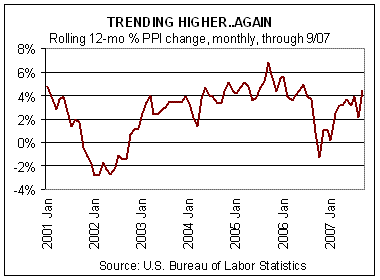
On a 12-month rolling basis, the annual pace in PPI is moving up (again) too. The 4.4% rise for the year through last month is the highest in more than a year. The recent reprieve in wholesale pricing pressure appears, for the moment, to be over.