Let’s get right to the point: the American consumer isn’t easily distracted. A recession may be looming, the housing market may be swooning, but Joe Sixpack isn’t easily discouraged from indulging in the great American pastime otherwise known as shopping.
As he has so many times in the past, Joe’s keeping the economy bubbling in 2007, as this morning’s update on personal income and spending reminds. In fact, the extraordinary staying power of the American consumer is that much more amazing as it comes in the face of lesser personal income last month. In theory, income and spending are joined at the hip. If you earn less, you spend less; earn more, spend more. No explanation needed. But that seemingly iron law only applies in the long run, and even then there’s room for debate in a world of easy loans and a myriad of innovations to keep shopping habits alive and kicking. And once you turn to the short term, well, let’s just say that logic and mathematical certainty are as ephemeral as the wind.
Consider the latest reading on consumer spending, which accounts for the lion’s share of GDP. The government today reported that personal consumption expenditures (PCE) rose 0.56% in August vs. July. As our chart below illustrates, that’s the highest monthly pace since April. Last month’s rise is all the more impressive considering that it was accompanied by a lesser rate of increase in disposable income.

The notion that the economy may be bubbling more than some think also finds support in yesterday’s initial jobless claims report. Last week’s new filings for unemployment benefits fell to a four-month low, which implies that the outlook for economic momentum still looks healthy. Then again, this encouraging news was tempered by Thursday’s report on new home sales for August, which confirmed what was already obvious: the housing market remains mired in a slump. Indeed, sales of new homes fell in August to the lowest annualized rate in seven years.
Monthly Archives: September 2007
THE GATHERING FORCES OF WEAKNESS
In search of economic signs confirming or denying the gathering weakness, this morning’s durable goods report for August extends fresh support for the fear that the forces of darkness are indeed approaching. As our chart below shows, August witnessed the biggest monthly drop in percentage terms since January. It’s also the first decline since May. If you ignore defense orders, new orders dropped by an even steeper 5.9% last month.

It’s hard to put a positive spin on the latest durable goods report. The aura is that much gloomier when you couple today’s news with yesterday’s update on existing home sales, which tumbled more than 4% last month to the slowest annualized rate in five years.
It would be folly to dismiss the signs that the economy’s weakening. On the other hand, all’s not lost, at least not yet. Consider our second chart below, which puts today’s weak durable goods report into broader historical context. As you can see, the latest dip, while troubling, is hardly definitive proof that recession is imminent. We’re still within the range of volatility that’s prevailed in recent years.

But let’s be clear: the pressures are building and from the evidence in recent weeks it’s only prudent to expect that the news will get worse before it gets better. That, at least, is our guess. But the economy is still standing and, despite all the hits continues to hold up, as far as we can tell at this point. If there’s a deciding factor that will tip the balance one way or the other, that will probably be consumer spending, which accounts for more than 70% of GDP.
OPTIMIZING COMMODITY INDICES
Commodities have enjoyed a renaissance in recent years as a strategic tool in portfolio design. The allure boils down to the low correlation between the prices of raw materials and stocks and bonds. Adding commodities to a conventional investment portfolio enhances the overall expected risk-adjusted returns. But what looks good in an optimizer can get messy in the real world. Yes, there are a number of mutual funds and exchange-listed securities that offer investors one-fund solutions to owning commodities broadly defined. But when you buy one of these funds you’re buying commodities futures rather than raw materials proper. There’s nothing wrong with futures, and in fact they’re a reasonable proxy for commodities. Then again, futures contracts are quirky animals and they introduce an additional layer of risk as well as opportunity over and above those dispensed by the underlying commodities.
A recently launched ETN seeks to exploit those risks and opportunities while still providing broad, passive exposure to the asset class. On the surface, the S&P GSCI Enhanced Commodity Total Return Strategy Index (NYSE: GSC) looks like one more fund tracking the Goldman Sachs Commodity Index. And to an extent, it’s just that, considering that GSC stays true to its benchmark by weighting the various components as per the underlying index. Where GSC differs is in its management of the futures contracts. The idea is that GSC will outperform GSCI by taking a more proactive approach to exploiting opportunities and minimizing risk inherent in futures. Will it work? Kochis Fitz, a San Francisco wealth management shop, thinks so. In fact, the firm, which partnered with Goldman Sachs in GSC’s design, initially invested $70 million in the new fund as a vote of confidence. Is the bet likely to pay off? In search of an answer, your editor recently interviewed Jason Thomas, chief investment officer at Kochis Fitz. To learn more, read on….
INFLATION…OR DEFLATION???
It’s probably just coincidence but it’s a striking one just the same.
Frederic Mishkin, a voting member of the Federal Open Market Committee, has a new research paper that considers the evidence that monetary policy has become more science than art over the past generation. By Mishkin’s reckoning, nine “key principles” form “a set of basic scientific principles, derived from theory and empirical evidence, that now guide thinking at almost all central banks and explain much of the success in the conduct of monetary policy.” First among the nine he cites: Milton Friedman’s widely repeated observation that inflation is always and everywhere a monetary phenomenon.
Against that backdrop we turn to the latest money supply numbers from the Fed, which brings us through September 10. Considering the 50-basis-point cut in Fed funds earlier this week it comes as no surprise to learn that a bull market prevails in M2 money supply, the broadest measure published. In fact, in late August, the 52-week percentage change in M2 topped 7% for the first time in nearly four years, as our chart below shows. Although the surge pulled back in the last two weeks, the ascent remains intact. Until and if the Fed gives reason to think otherwise, a prudent observer of monetary trends would do well to assume M2’s pace will go higher still.

No one should be shocked. M2’s flight skyward has had a long and steady takeoff over the past several years and the Fed’s now operating on the assumption that the economy’s slowing. Trying to juice growth, as a result, is priority one and the weapon of choice is pumping up liquidity.
The question is what a strategic-minded investor should do? Some are opting for a hedge by voting with their wallets and converting paper into gold, the traditional store of wealth and insurance policy against the inherent risks of fiat money. Indeed, the precious metal yesterday had another big day, rising nearly $14 to almost $736 an ounce. That’s the highest price for gold since the early 1980s.
In a related move, the dollar plumbed new lows. The historic inverse relationship between gold and the buck is alive and kicking, feeding off one another like gasoline and fire.
Ironically, the clear inflation warning emanating from the gold and currency markets finds no sympathy in the official inflation statistics published by the United States government. On Wednesday, the Bureau of Labor Statistics reported that consumer prices fell in August by 0.1%. Rarely has gold run up so quickly and sharply in the face of officially stated deflation. For the moment, at least, this divergence is in the running for the mother of all statistical disconnects in the field of economics and finance.
It requires no great insight to realize that someone’s wrong about future inflation. CPI and gold can’t both be right. One side or the other’s headed for a massive dose of attitude adjustment. No one can be sure who’s going to get stuck, or when, but we have our suspicions.
DOES THE DIP HAVE LEGS?
The August employment report, which posted the first monthly job loss in four years, is considered the leading smoking gun that convinced the Federal Reserve to cut interest rates on Tuesday. The worry, of course, is that a recession’s coming. Why, then, is there no confirmation in the initial jobless claims so far this month?
This morning’s update on new filings for unemployment benefits through September 15 shows that the trend through September’s first half has been unmistakably down. As our chart below illustrates, new filings fell to 311,000 last week. That’s the lowest since late July and slightly below the year-earlier level of 322,000.

It’s too soon to declare that the risk of recession has passed, but today’s jobless claims report raises another clue suggesting that maybe, just maybe, the Fed acted a bit too hastily. Indeed, you don’t have to look too far to find a dismal scientist to argue that jobless claims in the low 300,000 level is considered normal in the context of an expanding American economy in 2007.
Of course, it would be foolish to read too much into this one number. Next week’s report could deliver a stinging reversal of fortunes. Jobless claims are volatile, which is why the smoother four-week moving average offers a somewhat better picture of the larger trend. But as you can see from the above chart, the four-week average is trending down as well.
Ultimately, the true state of the economy can only be known ex post, which is to say after the data’s published, scrubbed and confirmed. As such, the definitive word on the economy today will arrive some months down the road. For those who can’t wait, the alternative is to look at every number as it comes off the statistical assembly line while trying to keep the big picture in mind. Good luck.
In sum, observers of the economic scene must choose either timeliness or accuracy, but you can’t have both simultaneously. Yes, the choice is a thankless task for mere mortals– and perhaps central banks too.
BULL MARKET WORRIES
Maybe the cut was justified, maybe not. But now that it’s a done deal, investors are left with the job of deciphering the implications.
The immediate reaction on Wall Street: yee-hah! Stocks across the board surged in the wake of the Fed’s bold 50-basis-point cut yesterday. The S&P 500 jumped 3% by Tuesday’s close.
But there’s more than one bull market unfolding, and therein lies the potential for trouble down the road. Indeed, it’s hardly irrelevant that crude oil closed at a new high yesterday. Ditto for the ascent of gold prices, which climbed to over $720 on Tuesday.
But not every market’s celebrating. The beleaguered buck took another hit on the news that the Federal Reserve lowered the price of money. The U.S. Dollar Index slumped half a percentage point yesterday, leaving it at a record low.
The falling dollar’s not-so-subtle implication: higher inflation. One only has to look at the bull market in oil to understand the risk. The United States is the world’s biggest importer of crude. It’s safe to assume that foreign exporters of oil aren’t insensitive to receiving payment in a currency that’s falling in value. One way to offset the forex risk is to charge more for oil in dollar terms.
Yes, oil’s a global commodity and its price is set internationally and so price-fixing is difficult if not impossible. But the next best thing is limiting production. OPEC will no doubt give that prospect serious consideration if the dollar keeps dropping.
Part of that consideration includes the issue of investing today to lift oil production tomorrow. Most if not all OPEC members are in need of technological upgrades to boost production to keep pace with rising global demand for the years ahead. But that takes money, and lots of it. Suffice to say, it’s a hard choice. Will a sinking dollar make the choice easier to delay such investment? If so, how will that affect the price of oil?
Then again, the man who heads the Federal Reserve has a paper trail arguing that a bull market in oil doesn’t necessarily bring higher inflation. The rationale is that oil prices are largely statistical noise and so they should be ignored when making monetary policy choices. Our guess is that notion will be put to the test big time in the coming months and years. The Fed, in short, will be proven right or wrong on the issue of whether higher oil prices can bring higher inflation. The question for strategic-minded investors then becomes: Is the potential risk worthy of hedging? That’s another way of ask: How much confidence do you have in the central bank? Judging by the dollar’s descent of late, there’s no doubt where forex traders stand.
THE THANKLESS BUSINESS OF FORECASTING
On the eve of what may be the launch of the next big thing in monetary policy, we humbly ask: What have we learned this year?
One lesson is that while the future’s always unclear, clues about what’s coming are occasionally dispatched. Alas, those clues are often far more compelling in hindsight than they are in real time.
A case in point: Mr. Market snookered us back on June 13 of this year, when the 10-year Treasury yield briefly traded at 5.3%. Yes, that now looks pretty good when it’s lined up next to the 4.46% yield at Friday’s close. Back in June, your editor had an idea that something was bubbling in the credit markets, but we were less than convinced that buying 10-year Treasuries at a 5.3% was a no-brainer.
Three months later, it’s clear that we should have been leveraging ourselves to the hilt to snap up the now-obvious rich payouts guaranteed by our friends in Washington. Indeed, bonds have outperformed stocks handily in the last three months by a robust margin. The iShares Lehman Aggregate Bond ETF is up around 4% on a total return basis through Friday’s close from June 13 vs. a 1.5% loss for the S&P 500 Spider ETF.
ANOTHER LOOK AT TIMING
Asset allocation is widely accepted as one of the most important, if not the most important decision for strategic-minded investors. But even if you accept the premise–and there are many reasons why you should–there’s still the question of how to manage the asset allocation strategy. The default choice is letting Mr. Market run the show, which follows a strict interpretation of modern portfolio theory. That is, own the world’s stocks and bonds in their market-weight proportions and let the market rebalance the weights from there. Deviating from that approach embraces active-management risk, which of course comes in a rainbow of choices. One that caught our eye recently is a momentum-based tactical asset allocation (TAA) strategy designed by Mebane Faber of Cambria Investment Management in Los Angeles. His paper on the strategy appears in this year’s Spring issue of The Journal of Wealth Management. No, we’re not necessarily recommending the strategy, nor are we dismissing it. Readers will have to make up their own minds on its merits. That said, a closer look at Faber’s strategy provokes worthwhile debate about how portfolios work and what investors can expect when it comes to second-guessing Mr. Market’s global asset allocation. We recently interviewed Faber in the September issue of WM. You can read the conversation here….
THE TROUBLE WITH TOMORROW
With all eyes increasingly focused on employment trends, this morning’s update on new filings for jobless benefits was a disappointment–a disappointment in the sense that it didn’t tell us anything new that wasn’t already apparent.
Initial jobless claims rose a slight 4,000 to 319,000 (see chart below) for the week through September 8, the Labor Department reported today. Yes, that’s not the direction the optimists are looking for. But as smoking guns go, it’s mostly a dud.

Further complicating the search for clarity, the four-week moving average of jobless claims declined slightly through September 8, as the second chart below illustrates.
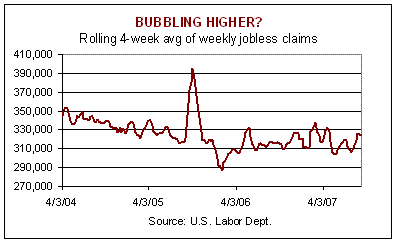
What can we distill from the latest numbers? Not much. Yes, the reported trend in jobless claims gives no compelling reason to think that a stealth boom is about to explode. On the other hand, the pessimism that reverberates from last Friday’s August employment report isn’t yet confirmed in the initial jobless claims. That doesn’t mean that confirmation isn’t coming. But for the moment, there’s no obvious statistical sign in this morning’s report that the labor market’s poised for an imminent and dramatic turn for the worse. The future, it seems, may take its own sweet time in arriving, frustrating those of us in need of instant satisfaction.
WILL HIGHER OIL PRICES FORCE A REASSESSMENT OF CORE INFLATION?
The only thing worse than a slowing economy is a slowing economy harassed by rising oil prices.
That unpleasant combination seems to threaten at the moment. The U.S. economy shed jobs on a monthly basis in August for the first time in four years while a barrel of crude oil has made a fresh run upward to just under its all time high of $78-plus.
The powers that be at the latest OPEC meeting have just agreed to raise production quotas in a bid to keep crude prices stable, but the effort is expected to be a marginal solution, if that, for containing the ongoing bull market in oil. “The outlook is for the oil market to continue to tighten all the way through the fourth quarter and that’s exactly what you are seeing reflected in the price,” Kevin Norrish of Barclays Capital told Reuters today. “What happened at the OPEC meeting doesn’t alter that perception one bit. The [production] increase was relatively modest.”
The implications of a slowing U.S. economy and oil prices that remain high are many, and not necessarily encouraging. One issue that arises is the prospect of the energy market exacerbating the economic slowdown. The odds of this risk may be rising to the extent that the U.S. economy is decoupling from the global economy.
Exhibit A in the decoupling argument is China’s economy, which continued roaring higher by a real annualized 11.9% in the second quarter vs. 1.9% for the U.S. If China and other “emerging markets” are increasingly driving the price of oil, a bull market in energy may prevail for longer than a U.S.-centric view suggests.