Optimists will seize on today’s news that the unemployment rate slipped last month for the first time in more than a year. Good news, to be sure, if only because it breaks the formerly nonstop rise in the monthly jobless rate. But the modest decline to a 9.4% unemployment rate in July from 9.5% masks the ongoing job destruction that roars beneath this otherwise encouraging exterior.
Nonfarm payrolls were lighter by a still hefty 247,000 last month, the U.S. Bureau of Labor Statistics reports. That’s reassuring only by the dire standard of the far deeper monthly losses between September 2008 and June 2009. Relatively speaking, the labor market appears to be healing, or bleeding less profusely, to be precise. But equating this with good news is a bit like discovering that your boat has only nine leaking holes instead of 12. Your still taking on water, albeit at a slower rate, but the end result will be the same unless the trend changes: the boat sinks.
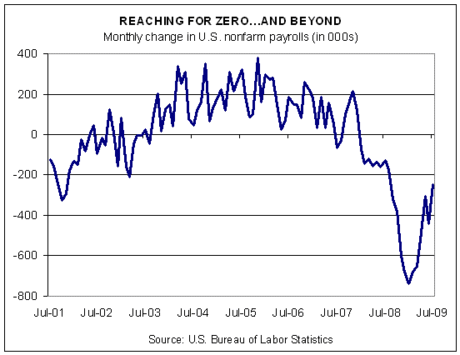
Indeed, virtually every corner of the labor market was taking on water last month, including the major sectors of goods producing industries (which lost 128,000 positions in July) and the all-important services sector (which shed 119,000 jobs last month). Perhaps we should keep the buckets handy for a bit longer.
Monthly Archives: August 2009
THE LONG & WINDING ROAD AHEAD
The trend is still our friend when it comes to initial jobless claims, a valuable leading indicator for assessing turning points in the business cycle. (For some background, see our analysis published in March.) But increasingly it’s the lagging indicators that worry us. Topping the list of concerns is the trend in nonfarm payrolls, which continues to sink at an unhealthy pace. Will tomorrow’s update on the employment picture for July tell us different?
Before we consider the possibilities, let’s review today’s good news. New filings for jobless benefits slipped by 38,000 to 550,000 for the week through August 1, the U.S. Labor Department reports this morning. And not a moment too soon. Recall that new filings rose last week, prompting worries that perhaps the trend was reversing, which could indicate that the recession might roll on longer than previously thought. In light of today’s update, we can rest a bit easier, although we’re still a long way from repairing the damage that has unfolded in the economy over the past year.

Indeed, even an optimistic reading of recent economic trends should recognize that the bulk of the good news, such as it has been lately, suggests the economy has hit bottom, which is something quite different than declaring that growth has returned. In fact, the jury’s still out on whether we have truly reached the trough in the business cycle. There are a growing number of reasons for thinking that we have, including the downward trend in jobless claims, which have a long history of peaking concurrently or just ahead of the end of the recession. But let’s be clear: Full and complete confirmation of the expectation that the recession has ended will only come after the fact. We’ll simply have to wait and see. For now, however, it’s still reasonable to think that the worst of the contraction is behind us.
MORE GOOD NEWS/BAD NEWS
The recession continues to take its toll on the American consumer, new government data released today advises. Disposable personal income dropped a hefty 1.3% in June, reports the Bureau of Economic Analysis. On the other hand, consumer spending rose 0.4% in June. Alas, the pop in Joe Sixpack’s willingness to spend is less than it appears.
But first, a closer look at the fall in personal income. One reason for the retreat was the fading of the one-time government stimulus checks (American Recovery and Reinvestment Act of 2009) sent in May. In fact, the loss wasn’t nearly as steep once you ignore the government stimulus factor for the last two months. Excluding the checks from Uncle Sam reveals a far more modest 0.1% drop in personal income for June vs. the month before.
More troubling, however, is the ongoing decline in wages and salaries, which fell again in June vs. May by 0.4%. Indeed, it’s been falling nonstop since last November. Therein is the frontline attack on the economic outlook. Ok, we all know that the labor market is critical for economic growth. Why, then, is consumer spending up 0.4% for June? One reason is that spending on gasoline rose for the month, thanks to a generally ascending price for fuel. Indeed, consumer spending on energy goods and services jumped a dramatic 8.3% in June, vs. just 0.2% for May, BEA advises in today’s update.
THE GREAT RELIEF RALLY ROLLS ON
The financial gods were kind again to the major asset classes in July. Everything was up, and mostly with strong gains.
As our table below shows, it was hard to lose money last month, a.k.a. a refreshing change from the recent past. Of course, if you were sitting mostly in cash, there was little to celebrate with a virtual zero to the month’s total return for 3-month T-bills. Inflation-linked Treasuries didn’t do much better, but everything else did.
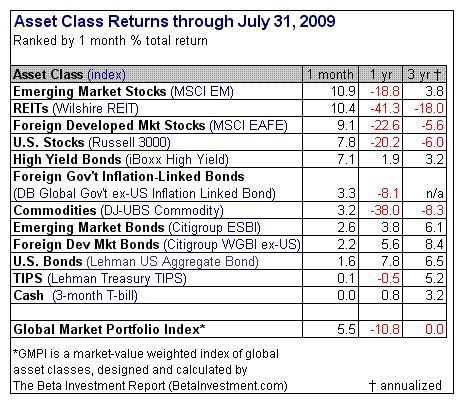
Emerging market stocks were the big winner, closely followed by REITs, foreign developed market and U.S. equities. Risk, in other words, paid off quite handsomely in July. With such widespread gains of more than modest means, our Global Market Index—a passively allocated mix of the major asset classes—also posted a strong total return of 5.5% last month.