Explaining the Demise of Value Investing
Baruch Lev (NY University) and Anup Srivastava (U. of Calgary)
August 25, 2019
The business press claims that the long-standing and highly popular value investing strategy—investing in low-valued stocks and selling short high-valued equities—lost its edge since 2007. The reasons for this putative sudden demise of value investing elude investors and academics, making it a challenge to assess the likelihood of the return of value investing to its days of glory. Based on extensive data analysis we show that the strategy has, in fact, been unprofitable for almost 30 years, barring a brief resurrection following dotcom bust. We identify two major reasons for the demise of value: (1) accounting deficiencies causing systematic misidentification of value, and particularly of glamour (growth) stocks, and (2) fundamental economic developments which slowed down significantly the reshuffling of value and glamour stocks which drove the erstwhile gains from the value strategy. We end up by speculating on the likelihood of the resurgence of value investing, which seems low.
Monthly Archives: October 2019
Macro Briefing | 18 October 2019
Turkey agrees to temporarily halt military operations in Syria: WSJ
UK Parliament expected to reject Johnson’s new Brexit deal on Saturday: CNBC
China’s Q3 annual economic growth slows to 6.0%–lowest in decades: CNBC
A variety of financial risks from climate change are lurking: SF Fed
Housing starts in the US fell in September after reaching 12-year high: MW
US jobless claims continue to predict labor market expansion: CNBC
Philly Fed’s mfg index shows modest growth for October: Philly Fed
US industrial output’s 1-year trend was negative in Sep–first decline since 2016:

Is Your Investment Strategy Making Unintentional Factor Bets?
Factor investing has become a core part of the investment zeitgeist over the last decade or so, but as a practical matter investors sometimes have a hard time exploiting these risk factors in portfolios. That’s the conclusion of a recent study by BlackRock that analyzes 10,000 portfolios.
Macro Briefing | 17 October 2019
House passes broadly supported resolution rebuking Trump over Syria: The Hill
Northern Irish party casts doubt over possible Brexit deal: Reuters
China’s commerce ministry hopes to reach trade deal soon with US: Reuters
Fed’s Beige Book reports “slight to modest” economic growth: MW
Atlanta Fed’s business inflation outlook slips to 2-year low: AFed
Revised GDPNow model estimates 1.8% Q3 GDP growth, slightly below Q2: AFed
US homebuilder confidence rises to 2-year high in October: CNBC
US retail sales fell in Sep, but 1-year growth is still moderate: CNBC

US Bond Market’s Resilience Shines On
The long-running bull market in bonds continues to defy bearish forecasts, as shown by a set of exchange-traded funds. Positive year-to-date performance in all the major corners of fixed income continues to offer a stark counterpoint to analysts who expect trouble.
Macro Briefing | 16 October 2019
Warren is focus of attacks at Democratic debate: CNBC
VP Pence, Sec. of State Pompeo in Turkey today to push for Syrian ceasefire: Fox
US indicts Turkey’s 2nd-largest bank on evading Iran sanctions: NY Times
China criticizes House bill that focuses on Hong Kong: Reuters
Doubt hangs over China’s promise to buy more US farm products: WSJ
Brexit talks stall over familiar stumbling blocks: CNBC
Upbeat corporate earnings help raise US stock market to 3-week high: MW
IMF forecasts global growth will slow to weakest pace since financial crisis: BBC
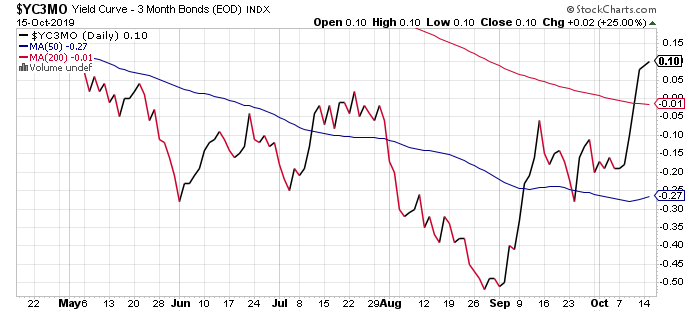
10yr-3mo Treasury yield curve remains positive for 3rd day after run of inversion:
Estimating Recession Risk Isn’t Getting Any Easier
Every recession is different and the next one, whenever it strikes, will likely continue the tradition. As a Bloomberg column reminded last week, the risk factors that may be aligning to deliver the next contraction are an unusual mix.
Macro Briefing | 15 October 2019
Trump announces sanctions on Turkey, demands Syria ceasefire: Reuters
VP Pence headed to Turkey for negotiations: MW
Doubts follow Trump’s trade deal with China: The Hill
EU’s chief negotiator: Brexit deal ‘still possible’: BBC
Turkish lira rises despite Trump’s new economic sanctions on Turkey: CNBC
China’s factory deflation ticked deeper into the red in September: Bloomberg
German investor sentiment remains weak in October via ZEW survey: Bloomberg
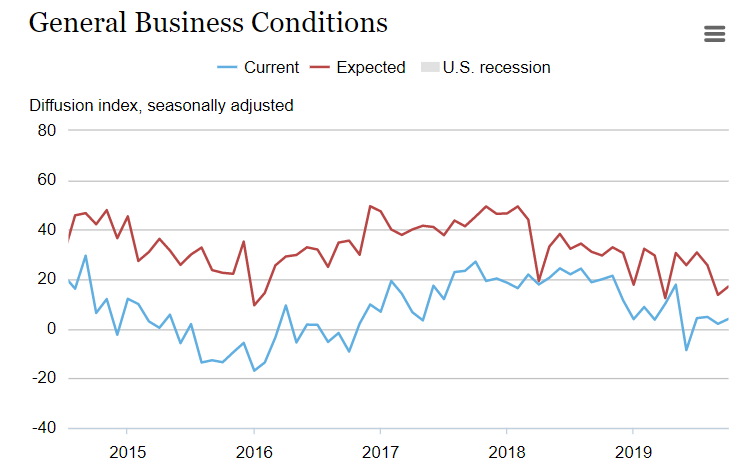
NY Fed Mfg Index edges up in Oct, middling growth vs. recent history: NY Fed
Commodities And Foreign Stocks Led Global Markets Last Week
Commodities prices rebounded last week after a run of declines, posting the strongest weekly performance for the major asset classes, based on a set of exchange-traded funds. Foreign stocks were in close pursuit for the performance leadership during the trading week ended Oct. 11.
Macro Briefing | 14 October 2019
Trump expected to impose new sanctions on Turkey for Syria invasion: Reuters
China requests more talks before signing latest trade deal with US: BBG
Will the latest US-China trade truce boost global growth? Maybe not: WSJ
China will be a factor in Q3 earnings that are starting to roll in: MW
House intel chairman: whistleblower testimony may not be needed: The Hill
Eurozone industrial output rebounded in August: Reuters
Brexit deal remains long shot as Oct 31 deadline nears: CNBC
China’s exports/imports fell more than forecast in September: CNBC
US consumer expectations for real income rises to two-decade high in Oct: UoM
