China reports 140 new cases of Sars-like virus: CNBC
Supply disruptions in Iraq and Libya lift oil prices: Bloomberg
White House plans to keep pressure on Iran: WSJ
Hundreds of migrants are trying to cross Mexico’s southern border: Reuters
Venezuela’s Guaidó defies travel ban, attends counter-terrorism meeting: BBC
Global survey: Capitalism doing ‘more harm than good’: Reuters
Palladium’s extraordinary surge is expected to continue: Bloomberg
New US housing construction surged in December: MW
US industrial production continued to fall in December: MW
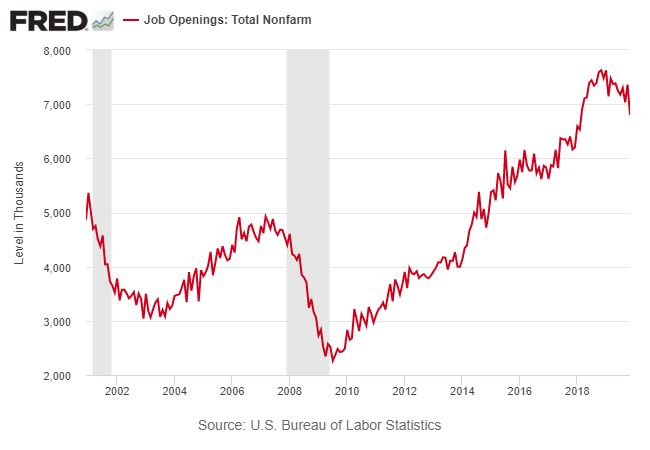
Job openings in US fell in November to 1-1/2-year low: Reuters
Monthly Archives: January 2020
Book Bits | 18 January 2020
● A World Without Work: Technology, Automation, and How We Should Respond
By Daniel Susskind
Review via The New York Times
If humans’ fears that technology would replace them have been unfounded in the past, this time is different. So argues Daniel Susskind, a fellow in economics at Oxford, in his new book, “A World Without Work: Technology, Automation, and How We Should Respond.” Susskind declares that machines are getting so smart that they’ll soon replace humans at a growing list of jobs, potentially including doctors, bricklayers and insurance adjusters, thus ending what he calls the “Age of Labor.” Without some sort of intervention, he says, the inequality inherent in today’s economy will metastasize into an even greater divide between the haves and have-nots.
Continue reading
Research Review | 17 January 2020 | Volatility
Macro News and Long-Run Volatility Expectations
Anders Vilhelmsson (Lund University)
December 10, 2019
I propose a new model-free method for estimating long-run changes in expected volatility using VIX futures contracts. The method is applied to measure the effect on stock market volatility of scheduled macroeconomic news announcements. I find that looking at long-run changes gives qualitatively different results compared to previous studies that only look at realized variance and the VIX. I further find that FOMC announcements on average resolve uncertainty, but only during times when policy uncertainty is higher than average. Real side macro announcements increase long-run volatility during times of low policy uncertainty, but the effect is reversed during times of high policy uncertainty.
Continue reading
Macro Briefing | 17 January 2020
Trump impeachment hearing begins in Senate: WSJ
Second death reported in new SARS-like virus in China: CNN
China’s GDP rose 6.1% in 2019, slowest gain since 1990: CNBC
Worrisome decline in UK retail sales continued in December: Bloomberg
US jobless claims continue to fall, indicating strong labor market: CNBC
US home builder confidence slips in January but remains bullish: CNBC
Trend growth in US import prices remained subdued in December: Reuters
Philly Fed Mfg Index rose sharply in January: Philly Fed
US retail spending accelerated in Dec to annual 5.8% increase — 1-1/2 year high:
Are Current Risk Levels For The US Stock Market Extraordinary?
Earlier this month we reviewed how recent performance for the S&P 500 Index stacked up relative to history. Let’s extend the analysis to risk. As we’ll see, deciding if risk is unusual, or not, depends on how you’re defining risk. As a result, there’s quite a bit more subjectivity in this corner or market analytics.
Continue reading
Macro Briefing | 16 January 2020
US and China sign trade deal that eases tensions: WSJ
A closer look at US goods that China pledged to buy in trade deal: CNBC
Key part of trade deal is already in doubt: Bloomberg
Senate begins to consider removal of President Trump: Reuters
Russia’s gov’t resigns, paving way for Putin to consolidate power: CNBC
Fed Beige Book: ‘modestly favorable’ outlook for 2020: MW
NY Fed Mfg Index ticks up, reflects modest growth in Dec: NY Fed
Business inflation expectations are steady at +1.9% in Jan: Atlanta Fed
VIX Index falls back to level that’s near 2-year low after recent increase:
It’s Been A Good Year So Far For (Most) Equity Markets
The broad upside momentum for most slices of the world’s equity markets has spilled over into 2020, at least so far. But the distribution of performance, as usual, is uneven. Here’s a quick look at how the bull run stacks up so far (through Jan. 14) for US and global stock markets, based on a set of exchange-traded funds.
Macro Briefing | 15 January 2020
Trump set to sign trade deal with China on Wednesday: Bloomberg
Expectations are muted for new US-China trade deal: CNBC
Senate prepares for impeachment trial: CNN
Iran rejects prospects for a new ‘Trump deal’ on nuclear capability: Reuters
Eurozone industrial output rebounded in Dec but trend still negative: FT
Softer-than-expected UK inflation suggests BoE will cut rates: Bloomberg
US Small Business Optimism fell in Dec but remains ‘historically strong’: NFIB
US core consumer inflation (s.a.) ticked down to +2.2 annual pace in Dec:
Will This Week’s Data Derail Moderate US Economic Optimism?
Economic pessimism for the US has had a rough ride in recent years. The macro trend has wobbled several times since the last official recession ended in 2009, but each time the economy righted itself and the expansion rolled on. But new doubts emerged in the second half of 2019 and the long knives of dark predictions returned anew. For now, the pessimists have been proven wrong, again. In fact, there are hints that growth may be picking up a bit. Key data releases later this week will stress test the case for optimism. Here’s a quick review of what’s on the docket for economic reports in the days ahead.
Macro Briefing | 14 January 2020
US Defense Sec: US has right to strike Iranian proxies in Iraq, Iran: NPR
US Treasury ends ‘currency manipulator’ label for China ahead of trade deal: BBC
GOP senators not likely to dismiss Trump charges ahead of trial: Reuters
US-Eurozone trade talks in focus next week: Bloomberg
US budget deficit topped $1 trillion in 2019–seven-year high: CNBC
India’s inflation spikes to five-year high due to food prices: Reuters
BlackRock: climate change at center of firm’s investment strategy: Fortune
Economic woes deepen in Iran as public’s tolerance wears thin: NY Times
US Dollar Index’s downside bias appears to be strengthening:


