Tomorrow’s preliminary estimate of third-quarter GDP is expected to show a strong acceleration in U.S. economic activity from the second quarter, underscoring the economy’s resilience despite elevated interest rates and persistent geopolitical uncertainty. While stronger growth is a positive signal for corporate earnings and labor market conditions, it could also complicate the inflation outlook.
A stronger-than-expected GDP reading could reinforce concerns that underlying price pressures remain sticky while raising expectations for near-term Federal Reserve rate hikes. With those issues in mind, investors will be closely watching the Federal Reserve today, which is widely expected to leave interest rates unchanged.
That leaves Fed Chairman Warsh facing a delicate balancing act at today’s press conference, where he will likely be pressed on the decision to hold rates steady despite his comment last month that “the plain fact is that inflation is too high and has been for too long.”
Earlier this month Michelle Bowman, the Fed’s vice chair for supervision, said “Inflation remains above our goal,” but “We have some time to wait and see how financial conditions evolve before we take more action.”
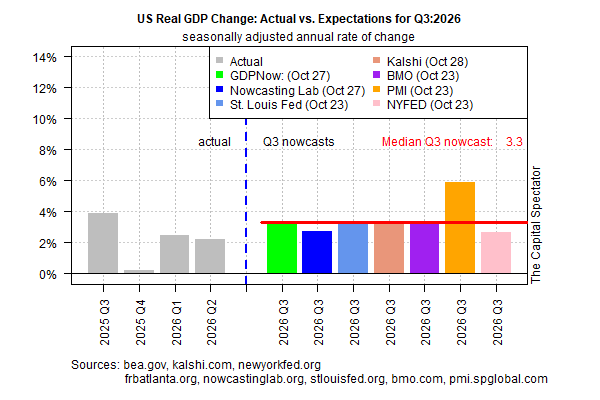
Meanwhile, tomorrow’s Q3 GDP report still appears set to show a solid pickup in growth, based on the median estimate for a set of nowcasts compiled by The Capital Spectator. Output is projected to increase at a 3.3% annualized pace during the July-through-September period, a notable improvement from Q2’s 2.2% gain.
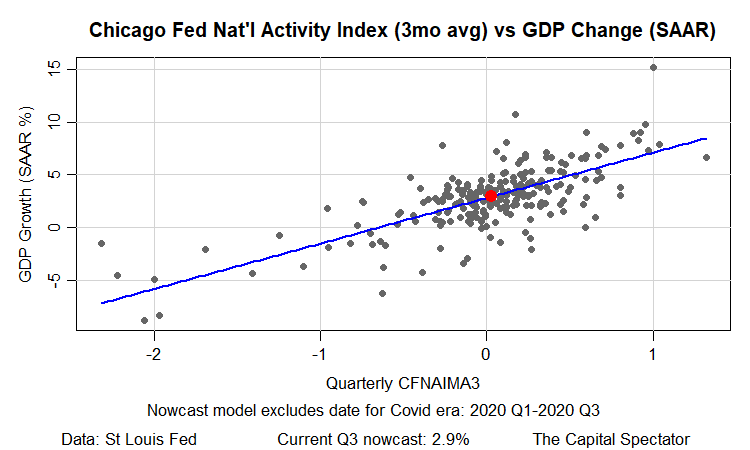
This week’s release of September data for the Chicago Fed National Activity Index (CFNAI) supports the case for anticipating a roughly 3% GDP growth in the third quarter. Based on 85 indicators spanning production, employment, consumption, housing, and business activity, the index provides a broad, hard-data snapshot of the economy.
Third-quarter growth appears to have been driven by AI infrastructure spending, healthy consumer demand, and strong business investment in areas such as software and equipment. The details will matter as much as the headline number since broad-based gains in consumer and business spending would signal a healthier expansion than growth driven mainly by trade or inventory swings.
Even so, the headline GDP figure may overstate the economy’s underlying momentum. Investors should look beyond the top-line number, especially as real wages have softened and growth remains uneven across households and businesses.
Another key part of tomorrow’s report will be the inflation data embedded in the GDP release. A strong growth number combined with firmer-than-expected price pressures would reinforce concerns that inflation remains stubbornly elevated, complicating the Fed’s policy outlook. By contrast, solid growth alongside cooling inflation would strengthen the case that the economy can continue expanding without igniting a renewed inflation problem.
