The Federal Reserve is expected to hold interest rates steady in tomorrow’s policy announcement, but a recent rebound in inflation has left markets unsettled about the possibility of further rate hikes in the months ahead.
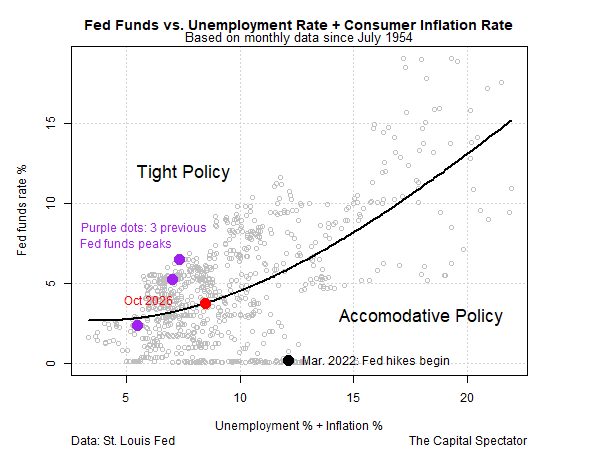
A simple model that uses unemployment and consumer prices to estimate a neutral federal funds rate suggests that the Fed’s current 3.75%-4.0% target range is appropriate for current conditions. The question, however, is whether the central bank should act more proactively to address the risk that inflationary pressures will continue to build in the near term.
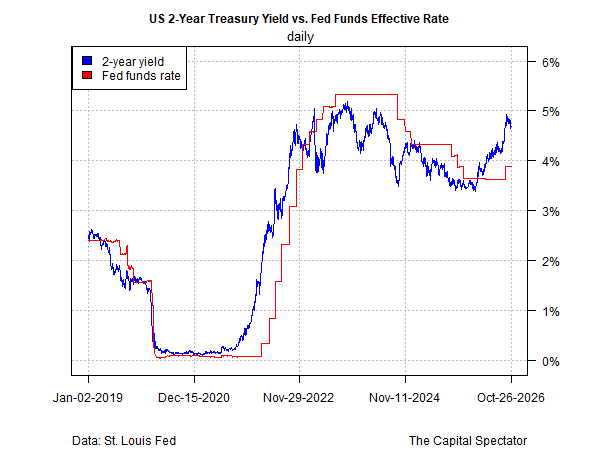
Fed funds futures are pricing in high odds for no change tomorrow. Meanwhile, the policy-sensitive 2-year Treasury yield, even after a moderate decline this month after spiking higher in September, continues to reflect hawkish sentiment by trading well above the Effective Fed Funds rate.
Lurking in the background is recent Fed history and the memory of its slow response to the 2021-2022 inflation surge, which lifted year-over-year consumer inflation from roughly 3% in early 2021 to a peak of 9% by June 2022. The central bank did not begin raising rates until March 2022, prompting critics to argue that policymakers were asleep at the switch. That delay arguably allowed inflation to accelerate and reach a substantially higher level than might otherwise have occurred had the Fed moved sooner to contain price pressures.
Rightly or wrongly, that experience continues to loom over policy decisions in 2026, a year marked by a relatively modest but increasingly noticeable increase in inflation.
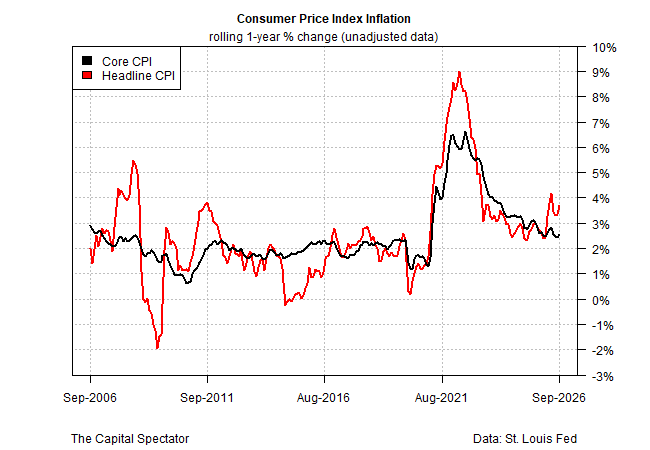
Earlier in the year, the prevailing view was that rising prices largely reflected the economic fallout from the war with Iran. Under that framework, additional rate hikes appeared premature, if not misguided, on the grounds that monetary policy should generally look through temporary geopolitical shocks.
The challenge is that the energy supply shock triggered by the February attack on Iran is beginning to look less like a short-lived disruption and more like a sustained feature of the economic landscape. Energy markets have adjusted to heightened Middle East volatility and the possibility that oil and gas exports from the region will remain unreliable. One can reasonably argue that the resulting increase in energy prices has already been incorporated into market expectations and that policymakers should avoid confusing higher price levels with an ongoing acceleration in inflation.
There’s some truth in that argument, but it is becoming increasingly difficult to embrace as crude oil prices move higher once again. West Texas Intermediate crude has trended upward in recent weeks and appears poised to retest its recent high.
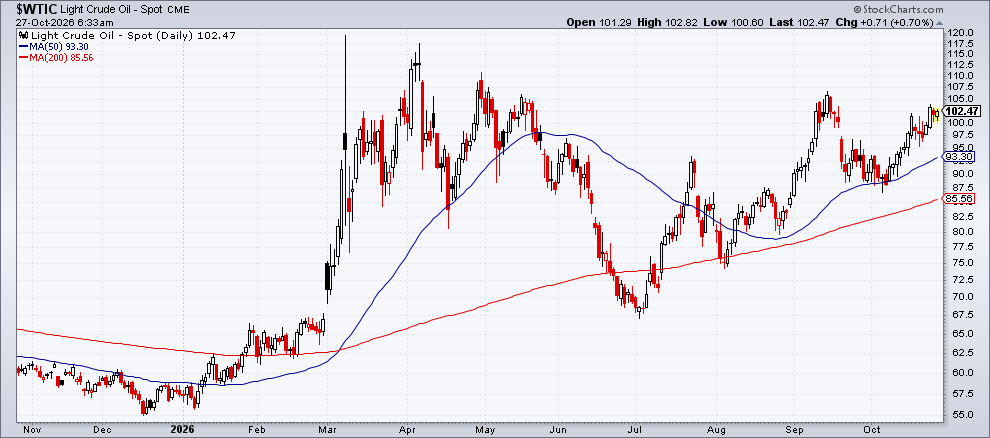
After eight months of conflict in the Middle East, with no obvious off-ramp in sight, the risk that energy prices continue climbing from already elevated levels invites uncomfortable comparisons with the policy backdrop of 2021-2022. The pushback is that if energy costs rise further, the increase will trigger demand destruction by weighing on economic activity. But the timing is unclear. Indeed, Thursday’s initial estimate of third-quarter GDP is expected to report a substantial acceleration in economic output. The Atlanta Fed’s GDPNow model estimates Q3 growth will strengthen to 3.5% from Q2’s 2.2% — a nowcast that undercuts the argument that the economy is vulnerable and so rate hikes should be avoided.
The near-term prospect of stronger economic growth shifts to focus primarily to prices. With inflation remaining stubbornly elevated, Fed Chair Kevin Warsh faces growing pressure to reconcile his hawkish rhetoric with expectations that interest rates will remain unchanged.
Loretta Mester, former president of the Cleveland Fed, tells The New York Times that “the economics support another rate increase.”
Others disagree, arguing that the Fed should remain patient and avoid responding aggressively to war-related inflation that could reverse if tensions with Iran ease. Even a prolonged stalemate could allow headline inflation to moderate in the months ahead.
The problem is that variations of the “wait-and-see” argument have been circulating since the initial attack, yet inflation at the headline level is turning up. Meanwhile, recent developments suggest the Middle East conflict is broadening, including reports that Yemen’s Houthis have expanded attacks on Saudi Arabia, the region’s dominant energy producer.
The problem is that variations of the “wait-and-see” argument have been circulating since the initial attack, yet headline inflation remains sticky at a relatively elevated level. At the same time, recent developments suggest the Middle East conflict is broadening, including reports that Yemen’s Houthis have expanded attacks on Saudi Arabia, the region’s dominant energy producer.
For Fed Chair Kevin Warsh, the challenge is no longer simply deciding whether inflation warrants another rate hike. It is explaining how a decision to leave rates unchanged remains consistent with his repeated commitment to restoring inflation to the Fed’s 2% target.
At Jackson Hole in August, Warsh warned that “we must be confident that underlying inflation is moving to our objective, clearly and at sufficient speed. Otherwise, we have work to do.”
If policymakers stand pat while inflation risks continue to build, investors may conclude that additional policy tightening is merely being postponed rather than avoided, potentially fueling renewed upward pressure on Treasury yields. In that sense, tomorrow’s decision may be less important than Warsh’s ability to convince markets that the Fed remains firmly committed to price stability despite choosing not to act.
