Investors appeared poised to refocus on rising interest rates last week and related fallout for stocks. Then came Meta’s latest AI unveiling, which helped revive the market’s preferred mantra: strong AI-driven earnings growth can overcome virtually any macro challenge.
Yesterday’s catalyst centered on Meta and its new Muse AI agent, which could reshape the enterprise tech landscape, fueling fresh optimism about the company’s growth prospects. “Lots can and will change in the future, but the key, simple point is that Meta has a hit on its hands with Muse,” Evercore ISI analyst Mark Mahaney said in a research note.
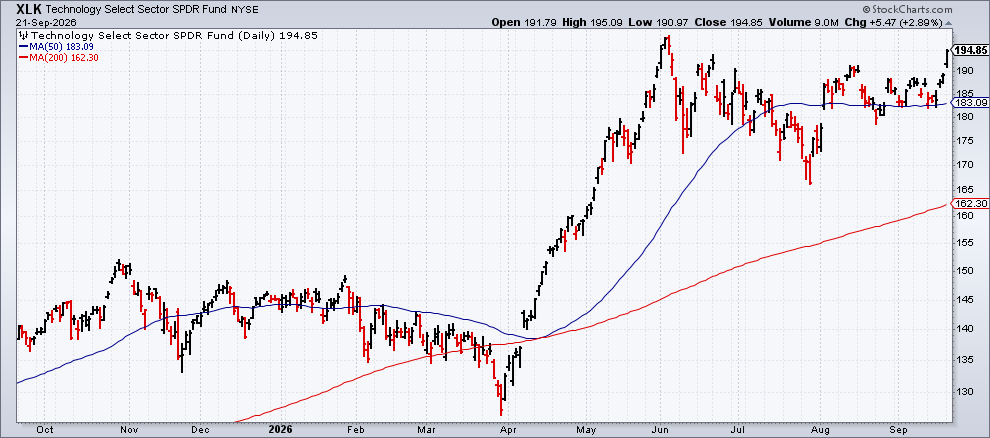
Whatever the reason, tech stocks soared yesterday. The SPDR Technology Select Sector ETF (XLK) roared above its recent trading range, putting it close to its record high in early June.
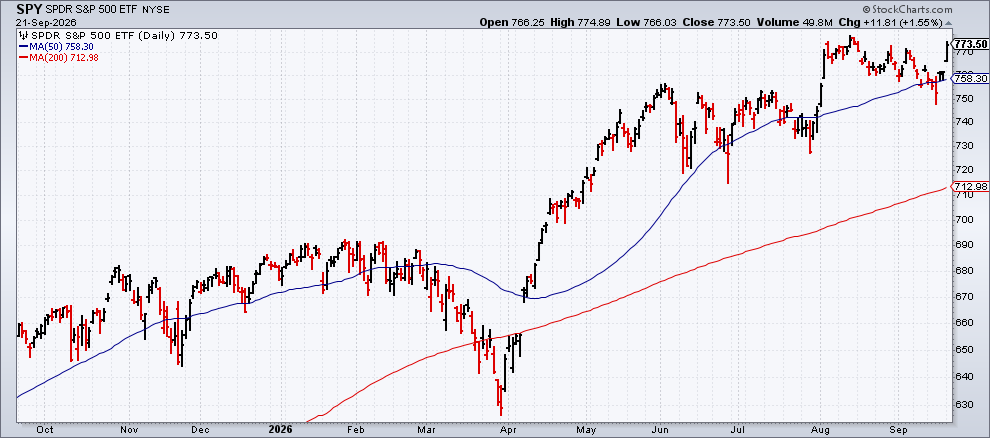
Monday’s AI-fueled optimism spilled over to stocks generally. The SPDR S&P 500 ETF (SPY), for example, rallied to just below its record close from early August.
Treasury yields and oil prices cooperated by pulling back yesterday after rising for three straight weeks.
The bulls can point to strong AI-driven earnings growth as the force still propelling the market higher. FactSet estimates that S&P 500 earnings are on track to rise nearly 29% in Q3 from a year earlier. If correct, the gain will mark the third straight quarter of annual earnings growth exceeding 25%.
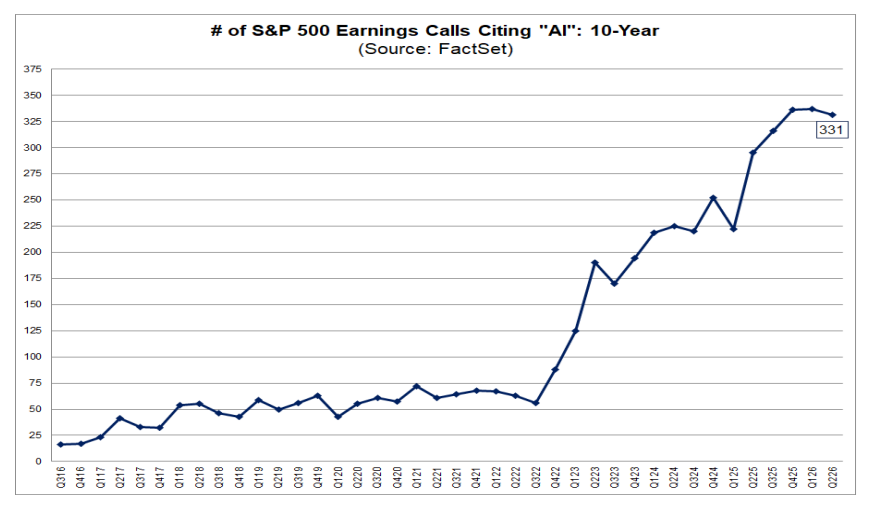
FactSet also notes that Q3 “marks the third consecutive quarter that the term ‘AI’ was cited on more than 65% of the earnings calls conducted by S&P 500 companies,” adding that “S&P 500 companies that have cited ‘AI’ on Q2 earnings calls have also seen a higher average price increase compared
to S&P 500 companies that have not cited “AI” on Q2 earnings calls” recently.
Despite Monday’s revival of AI enthusiasm, the macro headwinds that cooled bullish sentiment haven’t disappeared. Concerns about inflation and Fed rate hikes, which have lifted Treasury yields, are still lurking, as are the energy-supply challenges linked to the Middle East conflict and the Russia-Ukraine war.
AI can offset some of these risks, but it probably can’t neutralize them indefinitely, although the market’s wager seems to be that AI can outrun inflation. Yet the biggest risk is that inflation forces interest rates higher before AI delivers the productivity gains investors are counting on.
Next week’s report on the Fed’s preferred inflation benchmark, the Personal Consumption Expenditures (PCE) Price Index, could provide a new stress test of AI optimism. Economists expect PCE inflation to remain stubbornly above the Fed’s target, echoing the hotter-than-desired CPI data released earlier this month. Investors will be looking for evidence that rising energy costs are beginning to spill into broader inflation pressures, a development that could challenge the Wall Street’s increasingly optimistic outlook for growth and AI-driven earnings.
Fed funds futures are pricing in another rate hike by the end of the year, and follow-up increases may be brewing for early 2027.
Austan Goolsbee, president of the Chicago Fed, said on Monday that if incoming data show inflation is being driven by factors beyond the surge in energy prices, the central bank would need to embrace a more “aggressive” policy response.
“The only way to bring inflation down is to raise rates and narrow the gap between supply and demand,” he said in prepared remarks. “Forcing inflation back to target in the short run means pushing employment below target. … In the short run, supply shocks force a difficult trade-off” between the Fed’s goals of low inflation and maximum employment.
One proxy for tracking the risk that rising energy prices could spread into the broader economy is diesel, which has surged to a record high this month. Unlike gasoline, the price of diesel is a key input across supply chains. Higher diesel costs raise transportation, manufacturing, and agricultural expenses, making them more likely to feed through to the broader economy and keep inflation elevated.
Although Monday’s market action suggest otherwise, energy costs, Treasury yields, and inflation metrics remain key risk factors, and the jury is still out on whether the AI narrative can fully immunize the bulls from these threats.
