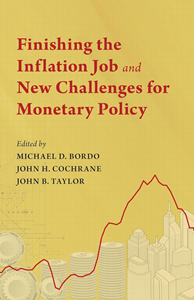
 ● Finishing the Inflation Job and New Challenges for Monetary Policy
Michael D. Bordo (editor), et al.
Summary via publisher (Hoover Institution Press)
How should the Fed finish the inflation-reduction job and prepare for the changing world ahead? And exactly how did one of Hoover’s most influential living economists assist scholars in thinking about where we go from here? Finishing the Inflation Job and New Challenges for Monetary Policy collects essays and discussions from the annual Hoover Institution Monetary Policy Conference, held on May 9, 2025, exploring these themes and considering other big-picture issues that affect monetary policy in this volatile international environment. Each year, the conference brings together academics, policymakers, media members, and others to consider the issues affecting monetary policy, both in the United States and worldwide. In the chapter sharing her welcoming remarks to the conference, Hoover Director Condoleezza Rice sets the tone, stating that the United States is “experiencing an avalanche of uncertainty,” with everything about the international order in question, including the United States’ role in it.
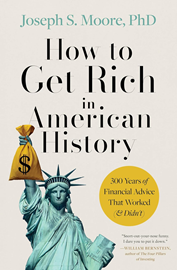 ● How to Get Rich in American History: 300 Years of Financial Advice That Worked (& Didn’t)
Joseph S. Moore
Review via Publishers Weekly
“Getting ahead has never been easier than it is today,” contends historian and investor Moore (Founding Sins) in this sweeping history of financial advice in the U.S. Moore takes readers through case studies of financial success and failure, debunking commonly held beliefs and extrapolating lessons that can be applied now. Demonstrating that “the story of a cash-only, debt free, rugged-individualist America is entirely fictional,” he describes how Benjamin Franklin got his start in the printing business by going thoroughly into debt. Elsewhere, he demonstrates that supposedly new phenomena have historical precedents. Women, for example, have always been active investors; Abigail Adams, wife of the second U.S. president, began buying government bonds after the American Revolution and ultimately achieved a lifetime annualized return of 18%, almost equaling that of billionaire Warren Buffett.
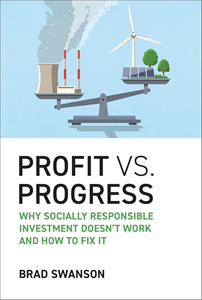 ● Profit vs. Progress: Why Socially Responsible Investment Doesn’t Work and How to Fix It
Brad Swanson
Summary via publisher (MIT Press)
Wall Street thrives by telling investors that clever financial strategies can reverse the trade-off between corporate profits and social progress. But the link between greater corporate social responsibility and improved financial performance is an illusion. Profit vs. Progress dissects the massive $30 trillion “socially responsible” or “sustainable” finance industry—and finds the emperor has no clothes. At best, sustainable investing typically delivers average rates of financial and social returns. But it makes social and environmental crises harder to overcome, by using financial gimmickry to distract our attention from real solutions. Author Brad Swanson argues that corporations in competitive markets act without moral values, and ethical investment can’t prod them to take greater social responsibility. The only way to change the outcome of the game is to change the rules. The solutions will have to come from legislatures, not corporate boardrooms.
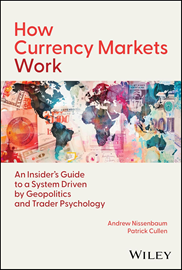 ● How Currency Markets Work: An Insider’s Guide to a System Driven by Geopolitics and Trader Psychology
Andrew Nissenbaum and Patrick Cullen
Summary via publisher (Wiley)
In How Currency Markets Work, a veteran currency trader and a geopolitical risk analyst deliver a comprehensive and street-smart guide for understanding currency markets. The authors combine insights from the worlds of trading, economics, and geopolitics to create an eye-opening and original new take on how currency prices are determined. This book bridges the gap between how currency markets are taught and how they actually trade, using character-driven narratives built on real-world market events and data to explain currency trading successes and failures in intuitive and practical ways.
Please note that the links to books above are affiliate links with Amazon.com and James Picerno (a.k.a. The Capital Spectator) earns money if you buy one of the titles listed. Also note that you will not pay extra for a book even though it generates revenue for The Capital Spectator. By purchasing books through this site, you provide support for The Capital Spectator’s free content. Thank you!