There was a time when economists argued that housing was not only a key component of the economy, but also the primary driver of the business cycle. That relationship appears far more tenuous these days, and for now that’s good news given the weakness in residential construction and home buying.
Housing remains a weak spot, but it has not posed a meaningful recession threat, at least not yet. Part of the reason is that, compared with past cycles, housing accounts for a smaller share of economic activity, while consumer spending and services play a larger role.
Fixed residential investment as a share of GDP fell to 3.6% in this year’s second quarter, the lowest level in more than a decade. Meanwhile, personal consumption expenditures have remained relatively steady in the upper-60% range.
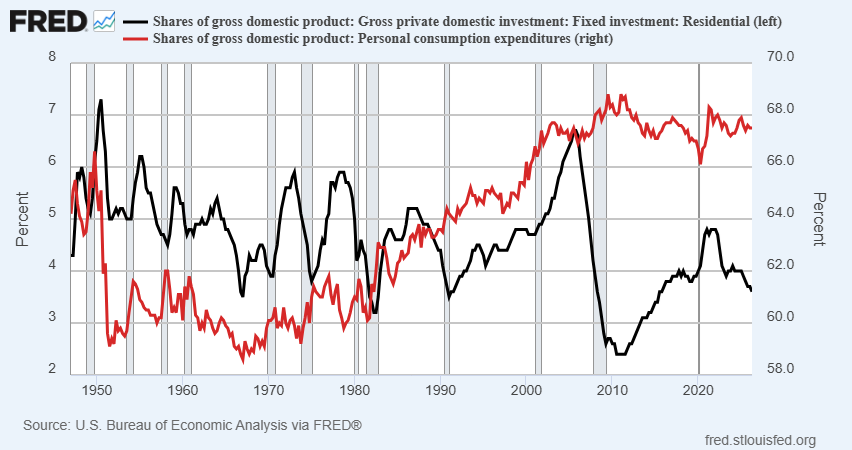
In addition, most homeowners are locked into low-rate mortgages, limiting the financial stress that typically amplifies housing downturns. If this trend persists, it may suggest that housing exerts less influence on the business cycle than it once did. The caveat is that the recent rise in Treasury yields has lifted mortgage rates, removing a key tailwind for housing, raising questions about the possibility of stronger headwinds ahead as financing costs increase.
Another factor helping the economy offset housing’s softer contribution lately is strong investment in AI and related technologies. Robust spending on data centers, software, and other AI infrastructure has supported overall growth, further reducing the economy’s sensitivity to housing-related weakness.
The durability of these changes is unclear, but for now the shift appears to be helping keep the economy expanding. Next week’s third-quarter GDP report is expected to show a robust acceleration in growth, based on the Atlanta Fed’s GDPNow model. If correct, the estimated 3.5% annualized increase (as of Oct. 20) would mark the strongest quarterly advance in a year.
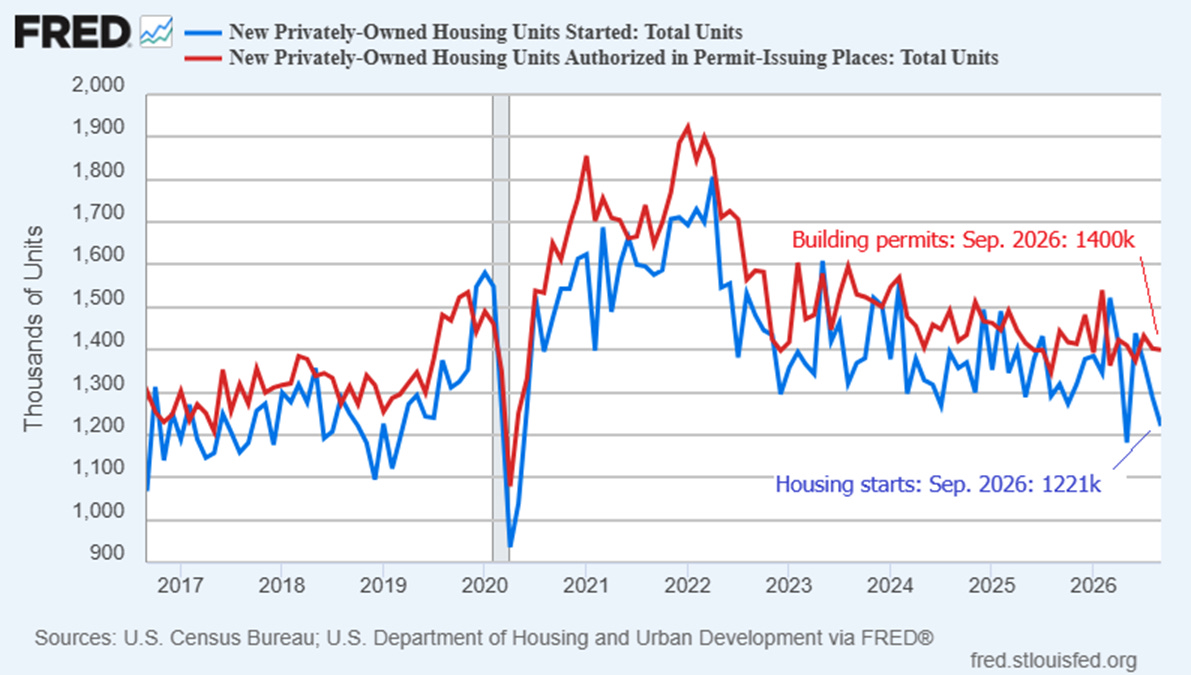
Housing, by contrast, remains on the back foot. New residential construction fell sharply in September, sliding to 1.22 million units, a 7.4% decline from a year earlier and near the lowest level since the pandemic ended. Building permits suggest activity will stabilize in the near term, albeit at a relatively low level compared with recent history. Even so, prospects remain dim for housing to provide meaningful support for economic activity in the months, and perhaps quarters, ahead.
Real estate sales are also soft. Pending home sales tumbled 7.3% last month from August and plunged 11.3% from a year earlier. A key factor is the sharp rise in borrowing costs. The average 30-year mortgage rate held at 7.40% this week, remaining near its highest level in nearly three years after a seven-week climb, according to mortgage buyer Freddie Mac.
Unsurprisingly, sentiment in the homebuilding industry remains gloomy, falling to a 14-year low in October as mortgage rates above 7%, affordability challenges, and weak buyer demand continued to weigh on new-home sales. Pending home sales tumbled 7.3% last month from August and crashed 11.3% year-over-year.
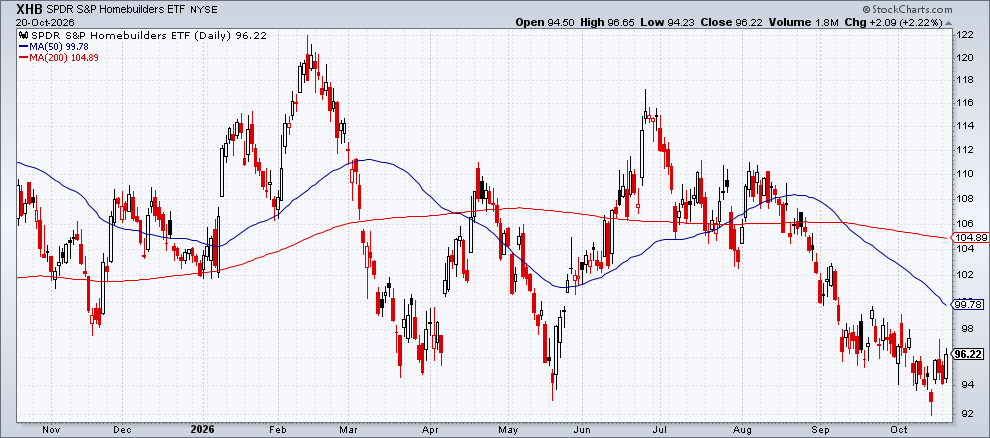
The bearish tide is weighing on homebuilder stocks, but this corner of equities may not yet fully reflect the industry’s troubles. The SPDR S&P Homebuilders ETF (XHB) has been retesting recent lows and appears close to breaking below support, a move that could trigger a new round of selling pressure.
The irony is that the long-term supply-demand fundamentals remain favorable for housing. Years of underbuilding have left many markets short of available homes. But as a recent report from Harvard University’s Joint Center for Housing Studies observes, “Persistent affordability challenges and rising economic uncertainty are squeezing housing conditions, with weakening labor markets and plummeting immigration dampening household growth.”
The bottom line is that housing no longer appears to be the economic kingmaker it once was. A resilient consumer sector, homeowners insulated by fixed-rate mortgages, and a surge in technology investment have allowed the broader economy to absorb a housing slump that might have triggered a recession in earlier decades.
Yet housing’s troubles are far from over, which raises the concern the ongoing pain could start to cast a longer, deeper shadow over the economy. Housing may no longer drive the business cycle the way it once did, but it would be a mistake to dismiss the sector entirely. If interest rates continue rising, further pressure on affordability and homebuilding could magnify housing’s economic footprint, turning today’s modest drag into a more consequential headwind for growth.
