The yield premium on the U.S. 10-year Treasury note continued to rise in September, driven by concerns over inflation and government debt. The benchmark yield climbed sharply last month, pushing the spread between the market rate and The Capital Spectator’s estimate of fair value to its widest level in nearly two years.
The calculation of fair value for the 10-year Treasury yield is based on three models. The average estimate from those models edged up to 4.2% last month. The market yield rose even faster, averaging 4.99% in September. That left the benchmark rate roughly 79 basis points above the average fair-value estimate, the widest gap since November 2024.
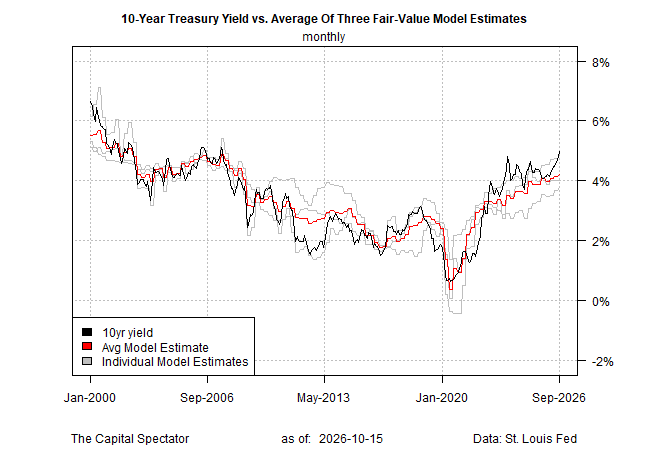
The rising market premium extends a trend that began after the spread bottomed in October 2025, when the market yield and fair-value estimate were roughly in equilibrium. Since then, the premium has steadily widened, reflecting several influences, including the Iran conflict and the war in Ukraine, both of which have contributed to higher headline inflation through rising energy costs.
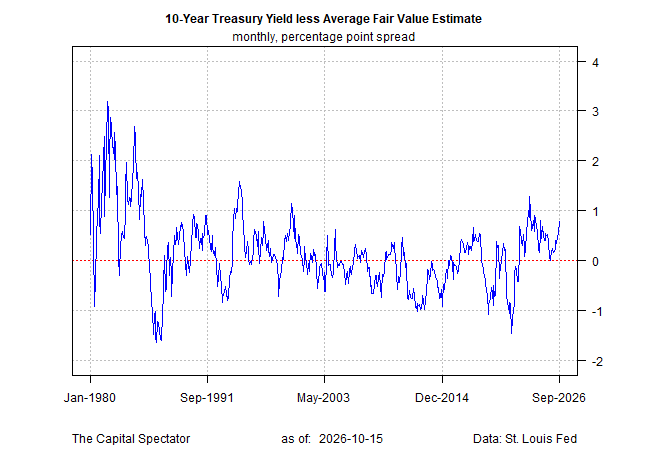
The bond market has pushed the 10-year yield higher at a faster pace than the fair-value estimate, which accounts for the increase spread. Although fair value has also been rising, it has done so more gradually.
While the market premium has increased in most months of 2026, it remains well below its previous high of roughly 1.28 percentage points in October 2023, when pandemic-related inflation pressures were still reverberating through the economy. Today’s premium is about half that level, but the return of inflation concerns could continue to encourage investors to demand higher yields in the months ahead.
A key question is whether the recent rise in headline inflation, driven largely by higher energy prices linked to the Iran conflict, is beginning to spill over into the broader economy. If bond investors conclude that the answer is yes, Treasury yields and the 10-year premium are likely to move higher.
Yesterday’s update of consumer prices for September suggests this risk continues to reasonate, raising fresh concerns that inflation is proving more persistent than many had recently assumed. Headline CPI accelerated to a 3.7% year-over-year rate (seasonally adjusted), marking the fastest pace since May. Core inflation rose to a 2.6% year-over-year rate. Although that remains near the lowest level since the pandemic, September’s increase marked the first acceleration in annual core inflation since May.
A more robust way to gauge the risk of inflation spreading beyond energy and into services, goods, and supply chains is by monitoring multiple measures of core inflation beyond CPI. Several estimates through September were released yesterday. While the median reading among these measures ticked up to a 2.64% year-over-year pace (red line in the chart below), the increase does not yet appear alarming. It is worth noting, however, that the core Personal Consumption Expenditures (PCE) Price Index (blue line) is running substantially higher, at 3.0% through August. (The September PCE report will be released later this month.)
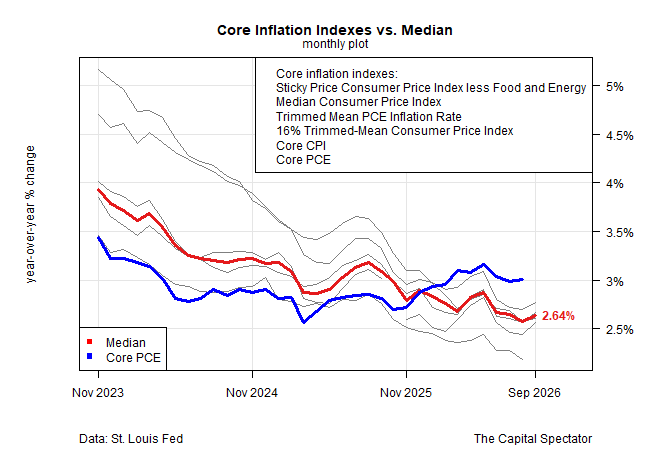
Because PCE is the Federal Reserve’s preferred inflation gauge, the data suggest the central bank is likely to continue raising interest rates in an effort to bring inflation closer to its 2% target. To the extent that bond investors are pricing in that outlook, the 10-year Treasury yield appears poised to rise further, which would in turn widen the market premium on the benchmark rate.
The key to breaking this cycle lies largely with inflation. Although alternative measures of core inflation suggest that price pressures outside the energy sector remain relatively stable and close to the Fed’s target, core PCE tells a different story. Until that measure begins to ease meaningfully, the odds appear tilted toward higher Treasury yields and a wider market premium for the 10-year rate.
Is Recession Risk Rising? Monitor the outlook with a subscription to:
The US Business Cycle Risk Report