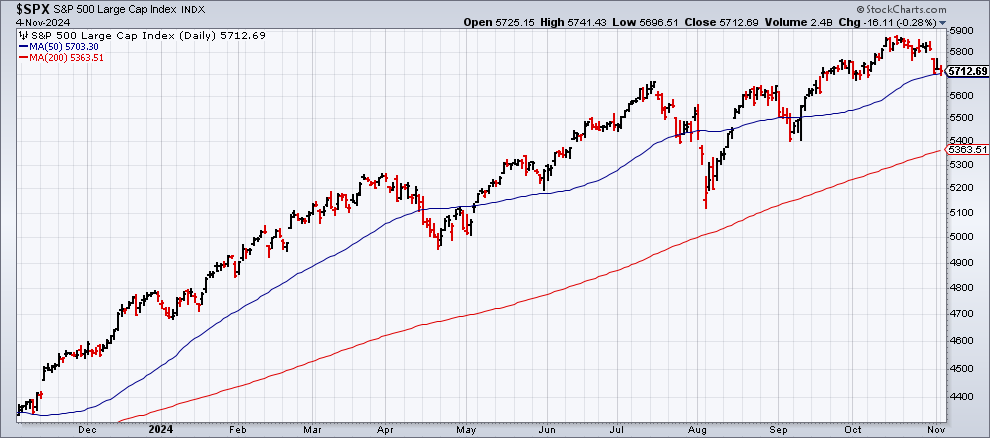
Can the stock market predict the election? For those who like to think so, the “Presidential Predictor” is cited. Advocates say this indicator has correctly forecast 21 of the past 24 elections, including Joe Biden’s win in 2020. The current reading points to a win for the Democratic Party and Kamala Harris. The forecast is based on whether the S&P 500 Index has incresed in the three months before the election, which signals the incumbent party will stay in office. On that basis, the market’s rise over the trailing 3-month window is telling, or so it seems. But since the market tends to rise generally, there’s plenty of room for doubt. “There is no simple, or complicated, economic model that predicts perfectly whether the incumbent’s party will win a presidential election,” says Jay Ritter, professor of finance at University of Florida’s Warrington College of Business. “When it comes to presidential elections, I would say that the stock market has about the same forecasting ability: better than nothing, but not a whole lot better.”
Total Return Forecasts: Major Asset Classes | 04 November 2024
The long-run performance outlook for the Global Market Index (GMI) ticked higher in October. Today’s revised forecast marks the first higher estimate in the past four months for GMI, an unmanaged benchmark that holds all the major asset classes (except cash), based on market weights via a set of ETF proxies.
Macro Briefing: 4 November 2024
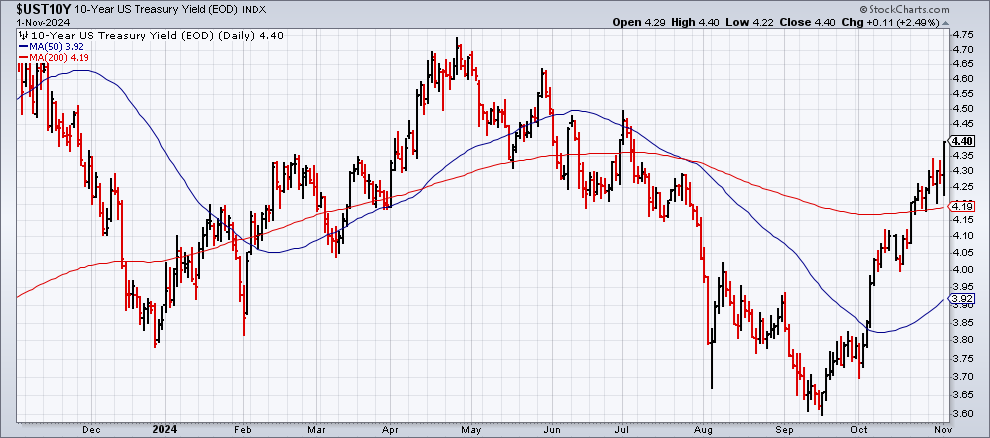
The US 10-year Treasury yield rose to 4.40% on Friday, a four-month high. The head of rates strategy at TD Securities, Gennadiy Goldberg, says the 10-year could approch 5% if Trump wins the election and the Republicans sweep in Congress. Reuters reports: “If Republicans take both houses of Congress and the U.S. presidency, it likely would bring higher tariffs, and consequently higher interest rates, especially at the back end of the yield curve, due to inflation. Increased U.S. Treasury debt supply to finance a huge fiscal deficit also lifts longer-end yields.” If Democrats win: “it could bring higher taxes on corporations and higher-income households that could weigh on economic growth. Disinflation is likely and as such, more aggressive easing by the Federal Reserve would be possible. Interest rates are likely to decline in this environment, led by the front end of the curve.”
Book Bits: 2 November 2024
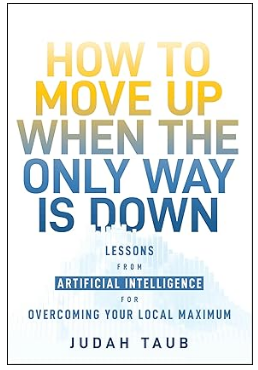
● How to Move Up When the Only Way is Down: Lessons from Artificial Intelligence for Overcoming Your Local Maximum
Judah Taub
Interview with author via CTech
Q: What are some of the ways that humans can learn from AI in these instances where humans might metaphorically ‘climb the wrong mountain’? How can humans adopt some of those AI lessons?
A: The key challenge that I’m discussing is the goal of everybody is to reach a higher point, a higher altitude. The higher out point in a field could represent a higher valuation if you’re a startup, or if you’re an individual making more money. These are the very capitalist ones – other things could be more happiness in your life or doing more good. You can define success however you want. And the point is higher up in the field is better, lower down is not as good.
Major Asset Classes | October 2024 | Performance Review
Global markets suffered a broad-based downturn in October. For the first time since April, a majority of the major asset classes posted monthly losses, based on a set of ETF proxies. The upside outliers: cash and commodities.
Macro Briefing: 1 November 2024
US jobless claims fell to a five-month low last week. The decline marks the third straight week of lower filings for unemployment benefits and appears to be another round of fading distortions from hurricanes that struck the Southeast US in September.
Consumer Spending Drives Solid US Economic Growth In Q3
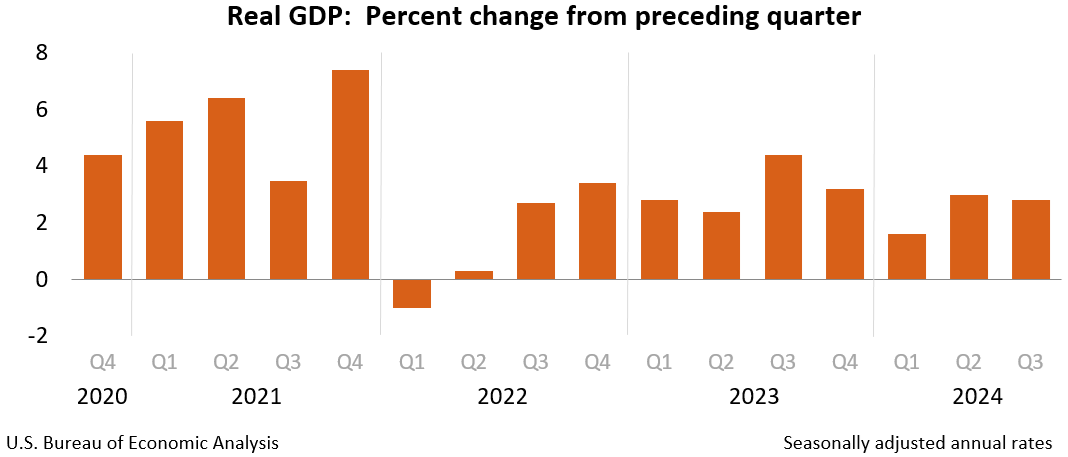
What a long, strange trip it’s been for some analysts since the summer of recession forecasts turned into yesterday’s robust 2.8% rise in third-quarter GDP. A key driver of Q3’s advance: higher consumer spending, which accounts for roughly two-thirds of GDP. Personal consumption expenditures increased 3.7% in Q3, a robust pickup from Q2’s 2.8%.
Macro Briefing: 31 October 2024
US GDP rose 2.8% in the third quarter–a solid increase but slightly below expectations. The gain marks a slowdown from Q2’s strong 3.0% increase. A key driver of Q3’s advance: higher consumer spending, which accounts for roughly two-thirds of GDP. Personal consumption expenditures increased 3.7% in Q3, a robust pickup from Q2’s 2.8%.
Momentum, Large-Cap Growth Factors Still Top US Returns In 2024
In the competition for 2024 calendar performance there’s no competition. Momentum and large-cap growth factors continue to outperform the rest of the field by a wide margin, based on a set of ETFs through Tuesday’s close (Oct. 29).
Macro Briefing: 30 October 2024
US job openings fell in September to the lowest level since January 2021. “The low level of quits is consistent with a decline in the availability of employment opportunities,” writes Oxford Economics lead US economist Nancy Vanden Houten. “The steady decline in the quits rate is consistent with wage growth continuing to slow and easing the inflationary impulse from the labor market.”