The Federal Reserve raised interest rates yesterday, resisting President Trump’s demands for lower borrowing costs. Fed Chairman Warsh outlined his views on inflation, which he said is still too high, suggesting the central bank may be headed for a rocky relationship with Trump in the months ahead. Adding to the uncertainty is the bond market’s mixed reaction to yesterday’s hawkish pivot and new forecasts from policymakers that additional rate hikes are likely.
There’s a lot to unpack here. Let’s start with the Fed’s ¼-point increase in its target-rate range to 3.75%-4.0%, the first increase in three years. In a press conference yesterday, Warsh explained the hike, which was unanimously approved by all 12 members of the Federal Open Market Committee, as a reaction to what he described as: “The plain fact is that inflation is too high and has been for too long. This summer’s inflation readings do not tell me that underlying trends have meaningfully improved.”
Based on the most recent CPI and PPI data, the 12-month change in total PCE prices likely was around 3.6 percent in August. Core PCE and CPI prices are running at about 3.2 percent and 2.4 percent, respectively. Too many categories are still posting increases above 3 percent, on both a 6- and 12-month basis.
Core measures of inflation are generally viewed by the Fed and economists as the more relevant benchmarks of the underlying trend for influencing policy decisions. The reasoning is that by excluding volatile food and energy prices, the central bank can focus on goods and services over which it has more influence, albeit indirectly. But with the Iran conflict dragging on, with no end in sight, the war’s effects on raising energy costs, which the Fed prefers to look through, appear to be factoring into policymakers’ views recently.
Warsh suggested as much, saying: “I noted in Jackson Hole that overall commodity prices also bear watching, and over the inter-meeting period, the prices of many of these key inputs have risen.”
A key risk is that higher energy costs are starting to bleed into the wider economy if the Iran shock persists, which more geopolitical strategists say is likely. One sign that the inflation spillover is happening is the recent rise in core PCE, which, along with headline PCE, is the Fed’s preferred inflation benchmark. Core PCE’s year-over-year rate has picked up recently, running above 3% and sitting more than a full percentage point above the Fed’s 2% target.
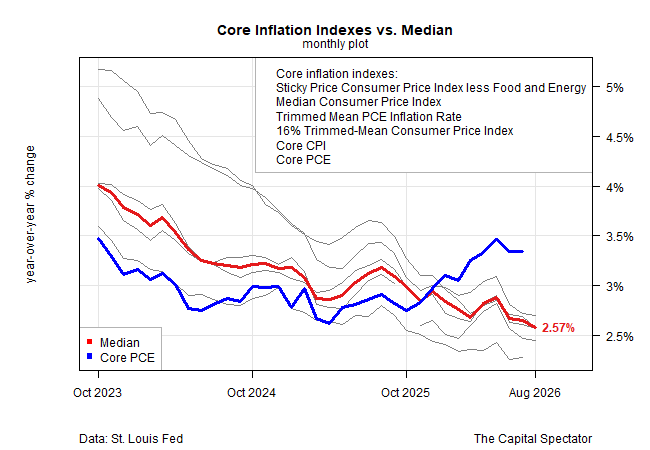
Other measures of core inflation, by contrast, are substantially lower and continue to suggest that a mild degree of disinflation is continuing, as shown in the chart above. Core PCE is the upside outlier, which is likely influencing the Fed’s decision to raise rates.
The bond market’s initial reaction to yesterday’s increase was mixed. The 30-year Treasury yield, the most inflation-sensitive maturity, ticked lower to 5.36%, which is just below the recent peak that marked its highest level in over two decades.
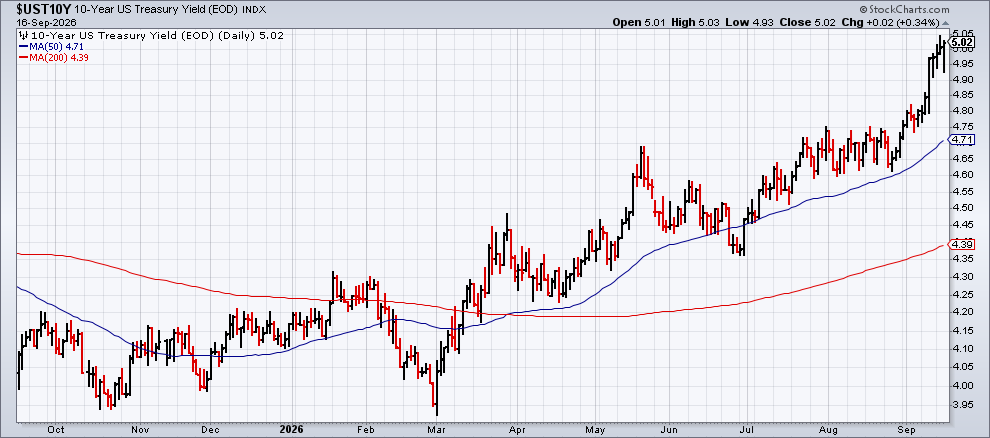
The 10-year yield, by contrast, edged up to a new high on Wednesday, closing at 5.02%, the highest close since 2007.
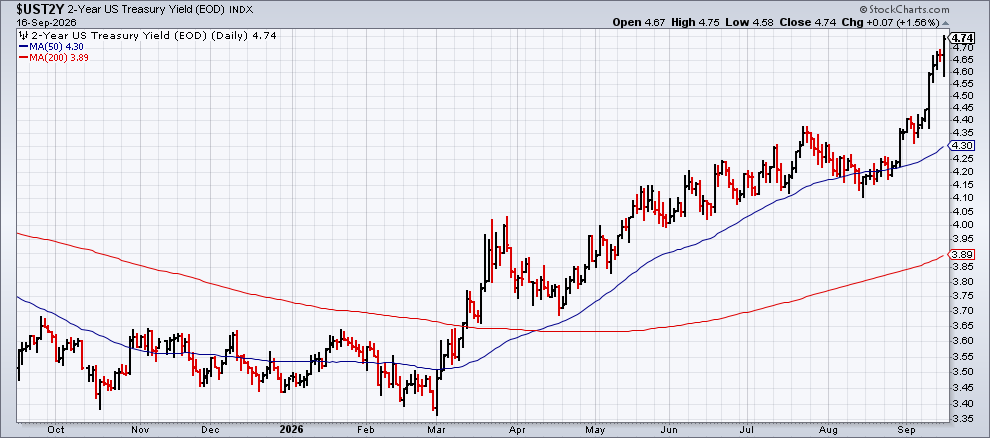
A more significant change in the near-term outlook is the spike in the 2-year yield yesterday, which jumped to 4.74%, signaling higher confidence that one or more rate hikes are forthcoming.
Although Warsh refrained from so-called forward guidance on policy decisions, new Fed forecasts, reflecting policymakers’ expectations, point to at least one additional rate hike in the near term. Fed funds futures are also pricing in at least one increase by the end of the year.
The hawkish policy path ahead looks set to clash with Trump’s ongoing demands for rate cuts. After the Fed’s vote to raise rates yesterday, the President wrote on social media: “Interest Rates in the United States should be 1%, or less, because we are the Best Credit in the World, BY FAR.” Separately, he said, “I talked to Kevin and I said, ‘you might as well vote with the board because it’s not going to matter.'”
Earlier in the month, Trump demanded that the Fed “lower the rate or I’ll stop trading with countries with which we have a deficit.”
How all this plays out is unclear, but the President’s ongoing pressure on the central bank could end up backfiring and becoming a factor in triggering even higher Treasury yields if the market becomes increasingly concerned about the Fed’s independence.
The real constraint on Trump’s campaign for lower rates may not be the Fed. Instead, it’s the bond market. Central bankers can come under political pressure, but investors allocating trillions of dollars tend to focus on inflation, deficits, and economic risk. As long as those concerns persist, markets are unlikely to deliver the lower borrowing costs the President is demanding.
Is Recession Risk Rising? Monitor the outlook with a subscription to:
The US Business Cycle Risk Report