To the extent that globally diversified portfolios are posting strong gains this year, two asset classes account for most of the upside: commodities and stocks.
Commodities are leading by a wide margin, based on a representative set of ETFs tracking the major asset classes. Fueled by the Iran conflict, raw material prices, particularly energy, have surged in 2026. U.S. and foreign stocks are also posting robust gains, but they trail commodities significantly. The WisdomTree Commodity Index ETF (GCC) is up nearly 27% through Tuesday’s close.
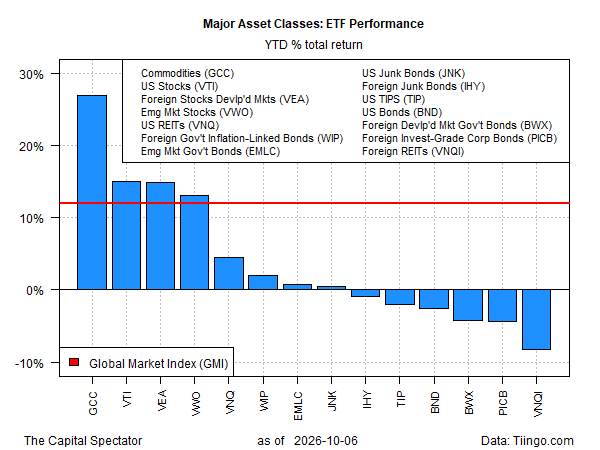
U.S. equities (VTI) and developed-market stocks outside the U.S. (VEA) are effectively tied for second place, each posting gains of roughly 15% this year. If those returns hold through Dec. 31, VTI would deliver a fourth consecutive year of double-digit gains, while VEA would post its third straight.
Emerging-market stocks (VWO) rank next with a 13.1% total return. If maintained, that gain would mark a third consecutive positive year and the strongest annual advance since 2020.
The rest of the field is well behind, reflecting a mix of modest gains and outright losses. The weakest performer is foreign real estate (VNQI), which has fallen more than 8% year to date.
The Global Market Index (GMI) is up 12% so far this year, highlighting a strong run for a forecast-free, passive strategy that targets a global mandate. GMI is an unmanaged benchmark (maintained by The Capital Spectator) that holds all the major asset classes (except cash) in market-value weights via ETFs and serves as a competitive benchmark for globally diversified, multi-asset-class portfolio strategies.
The strong performance of stocks and commodities naturally raises questions about how much upside remains after such sizable gains. Commodity markets, in particular, have been driven by a geopolitical shock tied to the Iran conflict, leaving investors to wonder whether the rally can continue if supply concerns ease. History suggests that commodity bull markets can generate outsized returns, but they are also prone to sharp reversals once the catalyst driving prices higher begins to fade.
Equities face a different set of challenges. Stocks have continued advancing despite rising bond yields, but higher interest rates eventually increase borrowing costs and the effects will likely pinch earnings at some point. If yields continue climbing, investors may be forced to reassess how much they are willing to pay for stocks, especially in sectors where valuations already reflect lofty growth expectations.
More broadly, the sustainability of gains may depend on whether economic momentum remains strong enough to support earnings growth while sustaining demand for raw materials. For now, the backdrop remains supportive. But with commodities posting their strongest gains in years and many equity markets on track for another year of double-digit returns, the margin for disappointment may be narrowing. The key question is whether fundamentals can continue improving fast enough to justify the impressive gains already recorded in 2026.
Investors remain willing to look past many of these risks, largely because of optimism surrounding artificial intelligence. The AI buildout has fueled a surge in spending on data centers, semiconductors, software, and related infrastructure, providing a powerful tailwind for corporate earnings and helping justify elevated valuations, particularly in the U.S. market.
As long as investors believe AI will deliver meaningful productivity gains and sustain profit growth, the bull case for stocks is likely to remain intact. At the same time, the market’s leadership has become increasingly tied to continued progress in the AI theme, raising the stakes if expectations begin to outrun reality.
For now, however, optimism still rules. The S&P 500 Index closed at a new record high, keeping the bears on the defensive and reinforcing the view that investors remain confident that economic growth and technological innovation can overcome the market’s mounting challenges.
Is Recession Risk Rising? Monitor the outlook with a subscription to:
The US Business Cycle Risk Report