Today’s fourth-quarter report on GDP reminds that pessimism is a risky sport when it comes to forecasting America’s economic outlook.
Annualized real GDP grew by 3.5% at an annual rate in the last three months of 2006, the government reported this morning. The pace was surprisingly strong for Mr. Market and the legions of dismal scientists who watch the economy for a living. The consensus prediction called for 3.0% growth, according to TheStreet.com.
Expected or not, 3.5% growth is impressive. That’s the fastest pace since the red-hot rise of 5.6% in 2006’s first quarter. More importantly, the 3.5% pace of 4Q 2006 came in a quarter that was widely said to be marred by the real estate correction. So said Larry Kantor, a managing director and co-head of research at Barclays Capital, in New York this morning. Your editor just happened to be at a press conference at the firm this morning when the GDP news arrived. Reflecting on the update, Kantor said that the drag on the economy in the recent past was hardly devastating.
Monthly Archives: January 2007
TIPPING UP
Earlier this month, we observed that the inflation-indexed Treasury market was priced for the assumption that inflation was a fading threat. But since then, the TIPS market appears to be having second thoughts.
On December 4, a 10-year TIPS yielded a real (inflation-adjusted) yield of 2.11%, according to U.S. Treasury data. As of last night’s close, the 10-year TIPS changed hands at 2.50%–the highest since last October.
As our chart below shows, the 10-year TIPS yield has jumped dramatically in recent weeks. Is this a good time to jump in?

Clearly, the bond market generally has become more anxious about inflation’s threat in recent weeks. The nominal 10-year Treasury now yields nearly 4.90%, the highest since last August.
IT’S ALL ABOUT THE DIVIDENDS
Divining the future by dissecting the past is, like parachuting and wrestling crocodiles, a venture saddled with more than a little risk. Yet each is thrilling in its own way, and at times may even offer perspective–assuming you don’t lose an arm and a leg, figuratively or literally, depending on the sport.
Ours is a quantitative adventure in the land of investing, and among the various statistics we routinely review is the equity risk premium (ERP), and so the risk is limited to those little bits of paper with images of George, Abe, Alex, et. al. There is much debate about the underlying rationale for the ERP, or the excess return thrown off by stocks relative to the risk free rate, which we define here as the 12-month rolling total return on the S&P 500 less the same on 3-month T-bills. Nonetheless, the ERP is quite real, or at least it has been in the past. The question is whether it will continue in the future, and if so, by how much?
As our chart below illustrates, the ERP is hardly a static number. Back in July 1997, the trailing 12-month ERP was an extraordinary 47%; in September 2001, the ERP over the previous year had turned negative to the tune of -31%. The average ERP turns out to be around 7.9% since 1987 through the end of last year.
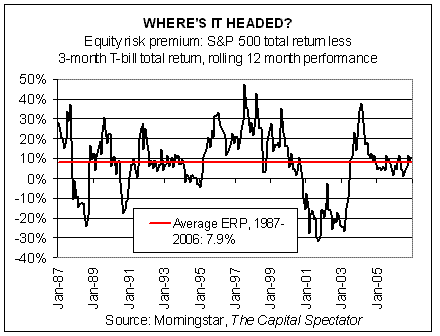
The ERP in recent years has tended to stay with in a range of 4-12%. Over time, that could deliver a tidy gain for the patient, long-term investor. Ah, but deciding if 4-12% will be high, low or middling is the asset allocator’s dilemma. Of course, there is no good answer, given the history of prognosticating investment returns and the myriad of factors that ultimately go in to determining how the future unfolds.
THE BOND MARKET BLINKS
There was enough weakness in yesterday’s report on existing home sales for December to keep pessimism alive about the economic outlook for 2007. But the bond market wasn’t waiting around for definitive signs and instead ran for cover. (Update: Since we posted this morning, new home sales numbers for December were released, reporting a gain of 4.8%. As a result, new home sales rose last month to their highest since April, offering an optimistic offset to yesterday’s less-inspiring news on existing home sales.)
The selling yesterday pushed the yield on the 10-year Treasury up sharply, closing at around 4.87%, the highest since last August. The notion that the economy will stay fairly robust has apparently taken root in the hearts and minds of bond traders and planted the fear that rates may rise before they fall. For the fixed-income set, that’s reason enough to become defensive.
But while the trading floors focused on the 10-year Note seem to have blinked in deference to the growth-will-be-stronger-than-expected crowd, there are no signs of capitulation (yet) over in Fed funds futures pits. Looking at the array of contracts expiring in coming months, one theme is clear: the popular bet at the moment is a Fed that will hold rates steady at 5.25% for the foreseeable future. That’s been the bet for some time now, based on recent history in Fed funds trading, and it appears to be the consensus view for pricing Fed funds through the summer.
THE WORLD ACCORDING TO MILTON
The late, great Milton Friedman reordered thinking on the relationships between monetary policy, inflation and the economy. In essence, Friedman argued, and quite persuasively, that money supply matters. Ignore it or mismanage it and you risk trouble. Such insight had eluded the Federal Reserve early on, most notoriously during the Great Depression, which was exacerbated by the central bank’s monetary blunders.
Alas, Friedman put forth no formal treatise on the matter since he co-authored the monumental A Monetary History of the United States with Anna Schwartz in 1963. Friedman wasn’t exactly quiet in the decades since his 1963 magnum opus hit the streets. In columns, interviews with journalists and a variety of papers, the grand old chief of monetarism opined far and wide. But the paper trail is somewhat messy. In an attempt to bring some order to Friedman’s thinking during the last several decades, Edward Nelson, an economist at the St. Louis Fed, has sifted through the record and distilled what is arguably the essence of Friedman’s views since the early 1960s. Although his comments generally support his earlier findings on monetarism, Friedman wasn’t so intellectually rigid as to remain immovable when empirical evidence suggested otherwise. His thinking, in short, evolved, but mostly on tactics rather than strategy.
IS VOLATILITY SET FOR A COMEBACK?
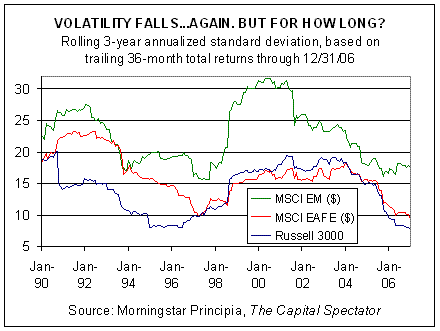
The last several years have been remarkable for the gains across the major asset classes. A commensurate, albeit lesser-known trend is the fall in volatility generally.
Consider our chart below, which graphs rolling 36-month, annualized standard deviation of monthly equity total returns through December 31, 2006. It’s clear that stock markets overall have become calmer, gentler beasts. The trend has been particularly notable in emerging markets, as per the MSCI Emerging Markets Index. At the end of last year, the benchmark’s volatility weighed in at an annualized 17.6 standard deviation for the past three years, down from more than 30 in 2001.
THE GLASS IS STILL HALF FULL
The bond market’s been arguing with the stock market in recent months about where the economy’s headed. On the fixed-income side, the outlook has been one of relative pessimism for 2007. Stocks, by contrast, see a brighter future for this year. By one economist’s reckoning, the stock market has won the debate.
So said Nariman Behravesh, chief economist for Global Insight, at a Dow Jones-sponsored conference in New York this morning. Behravesh opined that U.S. economic growth is stronger than some assumed it would be. Corporate earnings growth in 2007 will be “decent” after all. Slower than in ’06, he acknowledged, but still fairly robust. “There’s a lot of strength in the U.S. economy,” he said.
ARE EMERGING MARKETS STILL WORTHY?
Emerging markets stocks have been hot in recent years, but there are signs that the momentum is slowing . The MSCI Emerging Markets Index, in dollar terms, has slipped 1.7% so far this year. But whether the index turns in another year in the black or slips to red is irrelevant for one wealth manager. Jeffrey Troutner of TAM Asset Management is rethinking the value of emerging markets stocks as a strategic holding. In an interview in the January 2007 issue of Wealth Manager, Troutner told your editor that emerging markets have disappointed over the long haul. That’s quite a statement coming from someone who was one of the early proponents of the asset class back in the mid-1990s. To learn more, we recently had a long chat with Troutner, with excerpts published in the January issue of WM. You can read along here….
THE RETURN OF RED
On more than one occasion your editor has lamented the lack of good buying opportunities on the asset class level in 2006. If January’s experience so far is any indication, 2007 may be kinder for bargain-minded investors with an eye on the long term.
As our table below indicates, the red ink is starting to pile up this month. A few weeks hardly reveals much, if anything, about the strategic future for asset class returns. Nonetheless, we’re hopeful that the prospects for rebalancing are looking brighter relative to the recent past. No, we don’t hope for bear markets, but we’re prepared to take advantage of them when they inevitably return to one or more asset classes. That, as they say, is what makes strategic rebalancing go ’round.

Whatever’s coming, 2007 so far is clearly a change from recent years, when all the major asset classes tended to post gains. Indeed, 2006 wasn’t much different from 2005, 2004 or 2003 on that score. Make no mistake: we’re not complaining. We like bull markets across the asset class spectrum as much as the next fellow. But as a student of market history, we also realize that such parties can’t last forever, even if recent history suggests otherwise, without one of two players stumbling.
STILL WAITING…
The latest inflation numbers are in and, once again, there’s something for everyone in the December report on consumer prices.
As usual, the immediate focus will be the top-line CPI number, which posted a sharp rise last month relative to November. Consumer prices advanced by 0.5% in December after standing pat in November, the Labor Department advised today. The main source for the rebound in prices was energy.
Ah, but energy prices are retreating this month, suggesting that the December CPI is already out of date and that January’s CPI update will provide a more comforting profile in the eternal battle against inflation. Crude oil futures continue to tumble in ’07 and now change hands at the lowest levels since mid-2005.