Pardon the timing, but your editor is about to step out for a few days. Wouldn’t ‘ya know it? Just as we’re heading for Los Angeles, Mr. Market decides to take a dive. So it goes. Maybe the brief interlude from blogging will dispense some additional perspective. Insightful or not, we’ll be returning on Monday, March 5 for another round of fun. Meanwhile, Tuesday’s crumble in stocks reminds once again that there’s a reason to include bonds as part of a comprehensive asset allocation strategy: low correlation with equities. That profile was in all its glory today. The iShares Lehman Aggregate Bond ETF managed to post a modest gain on Tuesday. No big deal, except for the fact that the modest gain came amid a roaring sell off in stocks. Diversification among asset classes has merit after all.
Monthly Archives: February 2007
CANARIES IN THE COAL MINE?
What’s the link between the Chinese stock market and U.S. subprime mortgage market? Nothing, really. Well, almost nothing, except that both had previously been soaring and have recently hit some speed bumps.
That leads us to an astonishing conclusion: markets that have enjoyed long and robust bull markets eventually hit a wall. Bear markets, in short, haven’t been banished, even if it appears otherwise.
Full disclosure: we don’t have a clue about what’s coming. But we do have a firm grasp of history, which is conveniently available for all to see in full clarity.
The fact that China and subprime mortgage markets have slipped may be dismissed as marginal events of no real relevance to the capital markets. But we think such stumbles are early warning signs of things to come. Granted, this is a highly speculative notion and so readers should proceed accordingly. Nonetheless, we think our view has merit if only because bull markets have flourished across the spectrum of asset classes for some time and, well, nothing lasts forever.
ALAN TURNS GLOOMY
The yield curve has been inverted for long enough for investors to get used to its presence without worrying about its historical implications. But just when it seemed that a 10-year Treasury yield trading below Fed funds was irrelevant, along comes former Fed Chairman Alan Greenspan to suggest otherwise.
“When you get this far away from a recession invariably forces build up for the next recession, and indeed we are beginning to see that sign,” Greenspan told a business conference today. “For example in the U.S., profit margins … have begun to stabilize, which is an early sign we are in the later stages of a cycle,” he said via The International Herald Tribune. “While, yes, it is possible we can get a recession in the latter months of 2007, most forecasters are not making that judgment and indeed are projecting forward into 2008 … with some slowdown.”
The maestro’s comments today come in the wake of his observations last fall, when he advised that the worst of the housing correction was behind us. Not long after, various commentators began saying that the economy looked stronger than expected. And in fact, the fourth-quarter GDP report was surprisingly strong, suggesting that growth would continue to dominate.
It’s debatable how much sway Greenspan retains over popular imagination on economic thinking, but perhaps we’ll find out this week. By our reckoning, the stock market’s looking for an excuse for a correction, and Alan’s opining is as good as any.
The S&P 500, to cite the obvious benchmark, has been on a roll for some time and perhaps it’s significant that it’s closing in on its old high set back in March 2000. Mr. Market has a nasty habit of retracing old bull markets only to stumble at the 11th hour. We have no doubt that the S&P will one day ascend to greater levels, but we’re not so sure a new record will come by the seventh anniversary of its old zenith.
PUT (A CELLULOSIC-ETHANOL-BASED) TIGER IN YOUR TANK
In his State of the Union address last month, President Bush announced a grand objective of reducing gasoline use in the U.S. by 20% by 2017. In an effort to keep the spotlight on the issue, the President yesterday visited a plant in North Carolina that’s researching the science of alternative fuels. He’s been making tech/energy media trips lately, playing up the notion that America can R&D its way out of its growing reliance on foreign oil.
The sky’s the limit for alternative fuels, the President advised on Wednesday. “Someday you’re going to be able to get in your car, particularly if you’re a big city person, and drive 40 miles on a battery,” he said via The Guardian. “And by the way, your car doesn’t have to look like a golf cart. It could be a pickup truck.”
The notion of using corn and other domestic supplies of home-grown materials to produce fuel is an optimist’s dream. The stakes are certainly high. If the United States could reduce imports of foreign oil, the savings would be huge, delivering a massive windfall on the economy.
THE HOUSE OF THE RISING CORE
Since Ben Bernanke became chairman of the Federal Reserve a year ago, he’s been talking up the moderating influence that a slowing economy will bestow on general price trends. In that time the economy has in fact slowed, but the jury’s still out on whether the moderating forces will deliver salvation on the inflation front.
Today’s report on January consumer prices offers one more reason to reserve judgment. Yes, top-line inflation appears contained, but core inflation (which excludes energy and food prices) continues to inch higher, as our chart below shows.

Core CPI is now running at a 2.7% annual pace through last month. That’s up from 2.6% for 2006 and close to the peak of recent years (2.9%) set last September. The rising pace of core inflation is a problem because the Fed is widely reported to have a target of 1-2% for core. By that standard, the central bank is behind the monetary eight ball.
THE CASE FOR FUNDAMENTAL ANALYSIS OF ETFs
ETFs trade like stocks, but should they be analyzed as such? Yes, says Michael Krause, who runs AltaVista Independent Research, a boutique firm that specializes in ETF analysis. Your editor interviewed Krause in the February issue of Wealth Manager magazine, where he explains his research methodology and the general case for applying fundamental analysis to ETFs. Here’s a sample of his thinking: “If you were considering buying shares of General Electric or IBM, you’d want to look at more than a price chart; you’d want to know the earnings growth and so on,” he says in the article. “I don’t see any reason why you’d go from fundamentally analyzing one or two stocks to ignoring such questions for a basket of stocks in an ETF.”
For the rest of the story, click here….
MONEY QUESTIONS (AGAIN)
Bull markets can be found everywhere, and the M2 money supply is no exception.
Measured on a rolling 52-week basis, seasonally adjusted M2 rose by 5.6% for the year through February 5, according to Federal Reserve data. That’s the fastest annual pace in two years, as our chart below shows.
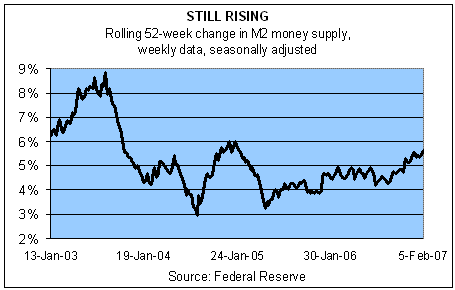
How fast is 5.6%? For perspective, the economy expanded at a 5.0% annual rate during last year’s fourth quarter (measured in seasonally adjusted nominal terms, as per the Bureau of Economic Analysis). The point, dear readers, is that money supply is expanding at a rate faster than the economy’s.
A FRESH CASE OF WINTER BLUES
It’s only been a few weeks since optimism about the economy bloomed anew. But it’s not too early to rethink what was previously rethought. This is the golden age of revise, revisit, rework and rewrite in the realm of economic forecasting.
The latest batch of numbers lends fresh incentive to ask if the on-again-off-again growth story for the economy is off again. Let’s start with this morning’s news that January’s new housing starts fell 14% from December to a nine-year low. Next, the Federal Reserve yesterday announced that industrial production fell 0.5% last month from December. Zeroing in on the weakness, the accompanying press release noted that “output in the manufacturing sector declined 0.7 percent in January; about one-half of the decrease was a result of a drop of 6 percent in motor vehicles and parts.”
Adding to the fresh bout of gloom is yesterday’s update on the latest weekly jobless claims, which jumped to the highest since last November in the week through February 10.
Is it time to, then, for a new flip-flop to embrace the recession theory anew? “There was a general sense that housing had stabilized,” Amitabh Arora, head of U.S. interest-rate strategy at Lehman Brothers Inc., told Bloomberg News today. “This will cause some reassessment of that view.”
IS DIVERSIFICATION DEAD?
In 1997 and 1998, emerging markets and commodities crumbled. But the pain was offset by gains in U.S. and foreign developed markets stocks. Bonds did well in those two years too.
During the great bear market of 2000-2002, stocks in general were bleeding. REITs offered a rare exception, posting tidy gains in those otherwise dark three years for the stock market. Another bright spot in 2000-2002: In two of the three years, commodities posted solid gains and bonds did well too.
Diversification, in short, has proven its worth in the recent past. The question is whether the strategy of owning a broad mix of asset classes will continue to impress? We pose the question because the recent past has witnessed an extraordinary rise in, well, everything. Starting in 2003, most of the broad asset classes have enjoyed gains for each and every calendar year. Yes, there have been some exceptions and a fair amount of variation within the asset classes. There are enough indices out there to prove (or disprove) whatever you want in money management. But by our reckoning, bull markets have more or less prevailed across the board for the past three years.
RETHINKING CONTANGO
Investing (speculating?) in oil has gone mainstream. The recent arrival of several exchange-traded products has opened up the commodity to the masses (iPath Goldman Sachs Crude Oil and U.S. Oil Fund.) There are also a growing number of ETFs and mutual funds that track broad commodity indices, which routinely have a significant portion of assets committed to oil. Beyond that, institutional investors in recent years have made strategic allocations to commodities in general and oil in particular. In sum, there’s a lot of new money pouring into oil.