Asset allocation, we’re told, is the critical variable driving success and failure for diversified portfolios in the long haul. If you get asset allocation wrong, market timing and security selection can’t save you. We’re inclined to agree, although that generally sound counsel suffers from subjectivity once you go into the details of designing actual portfolios. One man’s notion of an asset allocation dream is another’s nightmare. Perhaps that’s inevitable, as every asset allocation should be custom designed for each investor’s goals, risk tolerance, time horizon, and so on.
Standard benchmarks, in short, are hard to come by for asset allocation. But if there’s such a thing as a default, Mr. Market’s take on how to allocate money arguably comes closest to such an ideal. By “Mr. Market” we’re referring to the distribution of market capitalization. To be sure, market cap is under attack these days from new-fangled concepts of benchmark crafting, i.e., fundamental indexing. But say what you might about market cap, it still seems to be the most objective measure of the capital markets. You may or may not want to own equities based on market-cap allocations, but the measure remains a valuable and largely objective standard by which to gauge trends in the financial markets.
With that in mind, we crunched the numbers on the world equity markets, courtesy of data from S&P/Citigroup Global Equity Indices. Although this benchmark series offers dozens of indices, we looked at seven with the idea of forging a big-picture overview of the changing face of market-cap equity allocations on a global scale.
Monthly Archives: January 2007
EXPECTING HIGHER INFLATION IS NOW A CONTRARIAN BET
On Thursday, the government will release its December report for inflation. But it looks like it’ll be a non-event because the crowd believes that consumer prices are no longer a threat.
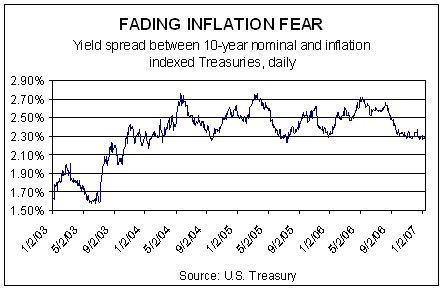
One measure of the market’s comfort that prices are contained can be seen in inflation-indexed Treasuries, otherwise known as TIPS. The spread between the yields on standard 10-year and 10-year TIPS was a mere 2.28%, as of last Friday’s close. That’s near the lowest levels of recent years. The implication: the market’s not worried about future inflation and has become less worried of late.
CASH QUESTIONS
The markets are closed today in the United States, in honor of Dr. Martin Luther King Jr., but the government’s printing presses never take a holiday. In fact, the Federal Reserve has been spitting out dollars at an annual pace not seen since in nearly two years.
M2 money supply advanced by 5.6% for the past 52 weeks through January 1, 2007, according to Fed data. That’s the fastest rate of increase for 52 weeks since February 7, 2005. Calculated on a 10-week basis, M2’s pace isn’t quite a strong relative to recent history, but it’s clearly taken flight and is just a shade under the previous 10-week peak of 2.4% set back in May 2003.

DECEMBER’S RETAIL REBOUND
Another day, another reason to think that the economy’s stronger than previously thought. Or, perhaps it’s more accurate to say that the economy’s not as weak as the consensus expected.
Whatever language you prefer, there’s no getting around the fact that the economic data trickling in continues to offer reasons for rethinking that 2007 will deliver pain and suffering on a macro scale. But lest we get too excited, we don’t expect that GDP will suddenly surge to the sky. A downshift in economic momentum is still underway, but the downshift looks set to be mild, or at least milder than many recently thought.
The latest evidence for a touch more optimism comes by way of this morning’s retail sales report for December. The U.S. Census Bureau reported that retail and food service sales advanced by 0.9% last month over November.

That’s impressive on several fronts. First, 0.9% for December is more than twice as strong as December 2005’s 0.4% gain. Second, a 0.9% rise is the best monthly gain since July’s 1.4% surge. In addition, looking at 12-month changes in retail sales reveals that December’s pace of 5.4% over the previous December suggests a turnaround is in progress.
OUTLOOK ADJUSTMENT
Today’s update on initial jobless claims deals another blow to the notion that the Federal Reserve will lower interest rates any time soon.
The Labor Department reported this morning that workers filing for unemployment benefits for the first time dropped to 299,000 last week. That’s the lowest number of weekly filings since last July 22.

The evidence, in other words, is mounting that the economy isn’t as weak as previously thought. The outlook adjustment promises to weigh heaviest on the bond market, which seems to be rethinking the appropriate level of yield on the benchmark 10-year Treasury. As of yesterday’s close, the 10-year traded at 4.68%, up from 4.43% on December 1.
EASY MONEY
Is there any value left in the world’s equity markets? That depends on your definition of “value.”
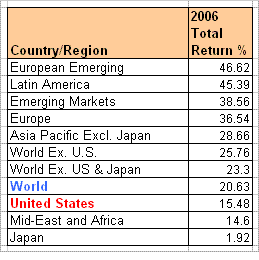
A review of market fundamentals and performance for 2006 certainly paints an encouraging profile (based on data for S&P/Citigroup Global Equity Indices). As our first table below shows, it was hard to lose money last year by owning stocks. European emerging markets were the hottest region, posting a total return of nearly 47%. Worldwide, stocks rose a tidy 21%.
CONSIDERING A YEAR OF SLOWER EARNINGS GROWTH
In case you haven’t noticed, there’s a bull market in stocks. Our particular interest in this essay is U.S. stocks, for which the S&P 500 is the oft-quoted benchmark. By that measure, the recent past has been good if not spectacular.
Through yesterday, the S&P 500’s total return for the past year is a nifty 12%, comfortably above the long-term average of around 10%. For the past three years, the annualized total return isn’t quite as strong, but tidy nonetheless at 9.7% a year, according to Morningtar.com.
The market’s rise has been warranted based on the surge in corporate profitability, which has of course translated into earnings growth. In fact, the earnings growth has been extraordinary. As outlined this morning by Bob Doll, chief investment officer for Blackrock, S&P 500 earnings have advanced at a double-digit pace for each year starting in 2002. Once the final numbers are in for 2006, Doll believes that S&P operating earnings will climb by 18%, he explained today at a press conference in New York, where yours truly was in attendance.
WAGES TAKE WING
There are an infinite number of trends for Mr. Market to consider, and here’s one more: wages are rising at a pace considerably faster than inflation. In fact, the trend has been around for a while. The question: what does it mean?
But first, the numbers. The Labor Department last week reported that average weekly earnings rose 4.5% in December on a seasonally adjusted basis–more than twice the inflation rate of 2.0% over the past year, as reported in November.
The rate of increase in wages is hardly new. Courtesy of number-crunching from NoSpinForecast.com, it’s clear that the 12-month rate of change in earnings has been moving skyward for some time. Indeed, the last time that wages were growing a more than 4% annually was in the late-1990s.
REASONS TO BE CHEERFUL…AGAIN
It’s a new year and apparently it’s time for a new debate. Or at least a rehash of a former debate that’s been routinely embraced, dismissed and then embraced anew.
We find ourselves in the embracing-anew phase in terms of the thankless task of trying to figure out where the economy’s headed. This morning’s latest from the Labor Department on the employment picture is the source of our conundrum today. Unemployment remained steady at a low 4.5% in December as the pace of job growth for nonfarm payrolls picked up slightly to 167,000 last month.
Consider the monthly change in payrolls for the last few years, as per our chart below. Is this the profile of an economy headed for a material slowdown or worse? A casual reading of the trend might pause before giving a definitive answer. And for good reason. Employment trends are no trivial factor in driving the economy.

SECTOR SCORECARD
The broad asset classes maintained a bullish front last year, as we noted on Tuesday, and the trend held true among for equity sectors.
Breaking the S&P 500 into its 10 sectors reveals that 2006 was a winning year across the board for large-cap equities. As our tables below document, gains were easy find last year, no matter the sector.
The bottom performer in 2006 was healthcare, which delivered a relatively mild 5.8% price gain, or less than half of the S&P 500’s price change last year. The top performer was telecom services, which displaced energy, which was the leader for both 2004 and 2005.