Amid yesterday’s selling of equities and fresh worries over subprime mortgages, you might have missed the latest from the International Energy Agency. Stockpiles of crude in developed countries is poised to drop to the lowest levels in 10 years, the group warned. The solution, as if you didn’t already know, is that OPEC will need to come to the rescue by pumping more oil.
“Preliminary data suggest that OECD stocks have fallen by over 1.26 million [barrels per day] over the first two months of the year, and could be heading for the largest first quarter stock draw for over 10 years,” the IEA report advised, via Reuters. “In reality, stock trends and prices are signaling that higher OPEC exports will be needed in the months ahead.”
Monthly Archives: March 2007
ALL THE WORLD’S NON-US EQUITIES IN ONE (OR ANOTHER) ETF
No asset allocation strategy worth the name can ignore foreign equities. More than half of the world’s equity capitalization lies beyond America’s shores. The challenge is figuring out where to begin when moving offshore. There are nearly 900 mutual funds (not counting different share classes) and close to 80 ETFs that fall under the heading of “international” stock portfolios, according to Morningstar. And the list keeps growing.
Two new ETFs (one from State Street, one from Vanguard) help simplify the decision by offering all the world’s non-U.S. equities in one package. The SPDR MSCI ACWI ex-US (CWI) and VANGUARD FTSE ALL-WORLD EX-US (VEU) combine developed markets with emerging markets. (The Vanguard ETF is also available as a mutual fund via the ticker VFWIX). This is old hat in mutual funds, but it’s something new for ETFs.
Conceptually, the idea of buying all non-U.S. equities in one fund as opposed to breaking up the allocation into developed and emerging market portfolios appeals to investors looking for a core product for foreign stocks that’s comparable to the broad-minded Russell 3000 or S&P 1500 for U.S. equity market exposure.
Your editor interviewed spokesmen for State Street and Vanguard on the new international ETFs in the March issue of Wealth Manager. To learn more about these products, read on….
NO APPETITE FOR RISK
Risk may be the new new focus in the capital markets these days after the recent turmoil in equity markets around the globe, but the price of risk isn’t exactly compelling when measured by yields in debt securities.
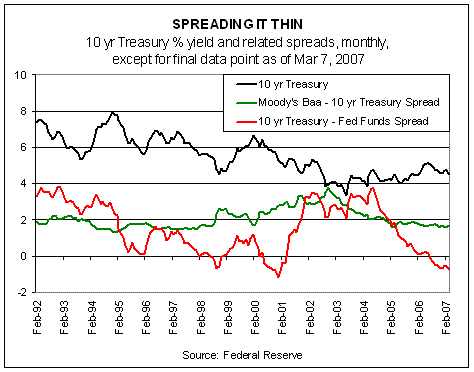
With the 10-year Treasury yield under 4.6% at the moment, there’s little incentive to rush in and buy if the goal is holding until maturity. Nearly half of the current yield is slated to evaporate into the ether of inflation, based on the latest measure of annualized consumer prices.
Meanwhile, we’re in no mood to reach down into lesser-graded debt in search of higher yields. Moody’s Baa-rated corporate bonds (the lowest rung of investment-grade debt) last week were yielding around 6.16%, or about 166 basis points over 10-year Treasuries. As our chart below shows, that’s the slimmest risk premium for Baa over the 10 year since the late-1990s.
GLOBAL EQUITY MARKETS REVIEW
The selling wave that engulfed the world’s equity markets on the last day of February and reverberated for several sessions beyond was traumatic, but not so as to carve deep losses across the board so far this year.
Looking at 2007 returns through March 8 reveals some red, but much of it has been limited to the riskier slices of the globe’s equity markets. Emerging markets in particular are off 2.5% so far this year through yesterday, with European emerging leading the slide with a 7.7% loss as of March 8. By and large, however, the world’s markets so far this year are mostly flat, give or take, according to S&P/Citigroup Global Equity Indices.
How did the markets around the world stack up on a valuation basis at last month’s end? Let’s start with P/E ratios. Emerging markets were the least expensive, on a relative basis, posting a trailing P/E of 13.8 as of February 28. That’s down slightly from 14.5 on December 31, 2006. The most expensive regions are in the 17-plus range. Japan, in fact, was nearing a 22 P/E as last month closed. (P/E and all fundamental data below based on
S&P/Citigroup Global Equity Indices, as of Feb. 28, 2007.)

A SENATOR AND HIS MONEY
The presidential election is still more than a year-and-a-half away, but it’s not too early for a fresh dose of controversy. The latest wrinkle involves money. (Shocking, isn’t it?)
It seems that a certain junior senator from Illinois made some questionable investments of as much as $100,000 in two small companies that just happened to be owned by two of his political contributors. Actually, Senator Barak Obama didn’t personally deploy the money; his advisor did via a so-called blind trust.
The concept of a blind trust is that it’s designed insulates the investor, in this case a United States Senator, from any repercussions, political or otherwise, that might arise from the investment. Oh, well–so long to that myth. Obama is being questioned, ever so subtly, in the press on the age-old issues of, What did he know and When did he know it?
THE FINER POINTS OF MONTE CARLO ANALYSIS
Ideas, theories and strategies are seemingly infinite when it comes to the choices for managing an investment portfolio. But no matter how you manage your nest egg, there’s a growing number of independent financial advisors who counsel that Monte Carlo analysis should be an integral part of the process.
What is Monte Carlo analysis? A statistical tool for measuring the probability of various outcomes. (For a deeper look at MC, peruse the myriad of information on the web by
clicking here.) Thanks to the computer revolution of the past generation, Monte Carlo analysis is now widely available at affordable prices. Sophisticated investment advisors routinely use Monte Carlo analysis for judging the odds that an asset allocation strategy will live up to expectations. One popular application is using MC to adjust a portfolio in order to improve the odds that an investor won’t run out of money.
But while there’s much to embrace when it comes to applying Monte Carlo to finance, there are no free lunches in the land of statistics. In the February issue of Wealth Manager, your editor penned an article–“A Sure Bet?”–on Monte Carlo and its applications among financial advisors. The conclusion: MC is a powerful and potentially enlightening tool for investors intent on managing risk to their advantage. But there are pitfalls as well, starting with the fact that a fair degree of subjectivity inhabits Monte Carlo analysis. For the details, read on….
WATCHING & WAITING
Yesterday’s update on the ISM Non-Manufacturing Index for February reminds that the economy is slowing and perhaps more than expected. The ISM index for the services sector, which represents 80% of the economy, slid to 54.3 from 59. (A reading above 50 indicates expansion). That’s the biggest drop, in percentage terms, since September 2005.
But nothing is simple in the 21st century. Keeping the chattering classes busy, the ISM Manufacturing Index, updated for February last week, posted a rebound last month, rising to 52.3 from 49.3. The jump was significant in that it reversed the below-50 reading set in January. In short, fresh evidence has arrived that manufacturing activity in the U.S. may be poised to tread water if not rise.
The larger point is that coming to hard and fast conclusions remains a risky affair in matters of economic forecasting. That’s always true, of course, and the challenge is elevated at this point in the cycle. Indeed, the ISM Manufacturing Index has twice slipped below 50 in recent months, suggesting that the sector’s outlook is clouded, at best.
Then again, if you’re trading for a living, you must have an opinion now, today, this minute. No wonder then that the rehabilitated doubt about what’s in store for the economy in 2007 has revived hope among fixed-income traders that the Federal Reserve will cut interest rates later this year. The July Fed fund futures contract is now priced in anticipation of a 5% rate, or 25 basis points below the current level.
But lest the fixed-income set become too excited, St. Louis Fed President William Poole on Monday sought to throw cold water on the bond bulls. “To me, and I believe the mainstream forecasters both in government and out — we don’t see a recession on the horizon,” he said via The Herald Tribune/AP.
PROFILES IN RED
By almost any measure, last week was a tough one for the capital markets. As our table below reminds, March arrived like a lion as investors repriced risk with a vengeance. Among the major asset classes, only cash, TIPS and bonds in general were spared the selling.

Year to date, the performance tallies don’t look quite as bad. The question is whether the red ink will spread and deepen, or give way to the bulls once again? Excuses one way or the other will probably be found in this week’s economic reports, including today’s ISM Non-Manufacturing Index. The crowd knows that manufacturing has been weak, if not in a recession. Services, by contrast, have remained robust. And since services constitute a much bigger slice of the economy, this benchmark holds more sway as to what comes next. Adding to the statistical fun will be Friday’s non-farm payrolls report February.
For the moment, volatility is back. Painful as this fact is, it’s not entirely unexpected. As readers of this blog know, your editor has been sitting on overweight cash positions for some time in anticipation of exploiting rebalancing opportunities. We’re not sure if the red ink offers the opportunity of a lifetime, but it’s shaping up to be the best deal so far this year. Then again, the year is still young.