Investing in the real world faces a number of challenges, one of which is the human inclination for juicing returns, beating the crowd and (hopefully) delivering results that make for engaging conversation at cocktail parties. In practice, however, stuff happens that alter the best laid plans of mice, men and, yes, even mutual fund managers.
The latter come to mind after reading a story in today’s Wall Street Journal (subscription required), which reports, “Mutual-fund companies are proposing big investment-policy changes this year, with many asking shareholders for permission to put more of their money into foreign stocks and real estate just as those once-hot investments are slowing down.”
Opportunities often appear brighter elsewhere for active managers, particularly those wedded to the relatively efficient world of domestic stocks. It’s getting harder to look good by swimming in mid- and large-cap American equities. The realities of expenses, trading costs, taxes and unexpected events conspire to turn an otherwise impressive paper strategy into something less by the time the net results filter down to the end user–i.e., you and me. The challenge isn’t limited to U.S. stocks, although arguably it burns brightest there.
Monthly Archives: March 2007
INFLATION, MEDICINE & LIABILITIES
Inflation may appear contained these days, but the future is always unclear.
As we discussed in our previous post, there’s a persuasive new report making the rounds that extends further support for the notion that human beings are in control of their own monetary fate. That, at least, is true in a world where fiat currencies prevail and the gold standard is considered the financial equivalent of the horse and buggy.
If central bankers can excel (as they have in recent years) at their appointed task of controlling inflation through enlightened monetary policy, they can also stumble (as the decade through the early 1980s reminds). Perhaps success will continue into perpetuity for the grand task facing the Fed and its counterparts around the world. Alas, we’re unsure of the outcome one way or the other in the long run. So it goes in matters where human beings are in charge.
OPTIMISM RISK
Of all the days to pick for chatting up optimism on inflation’s outlook, this past Friday wasn’t ideal. Nonetheless, two voices from the Fed were on the rubber chicken circuit on March 23, expounding on the benefits that flow from enlightened monetary policy.
Philadelphia Fed President Charles Plosser told a bankers conference that “I anticipate that the yield curve is likely to be flatter, on average, than at comparable points in past business cycles. This is not to say that the yield curve is going to be inverted all the time, but, on average, I believe the curve will be flatter.”
The reason, he opined, was because inflation expectations had become less volatile. “My case for a flatter yield curve is based on two premises: first, inflation and inflation expectations are likely to be lower and more stable, and hence, the inflation premium will be smaller than in the past; and second, inflation and the real economy are likely to be less volatile, so the risk premium will be smaller.”
Although Plosser didn’t think an inverted yield curve would be a permanent fixture, he said he had “confidence in the fact that inflation in the United States is going to stay low and more stable [and that] means there is less reason for long-term rates to be above short-term rates.”
ASSET CLASS REVIEW
Financial noise can be disorienting. This week was no exception. Between the Fed’s FOMC statement and the various economic reports, there’s been enough play in the numbers to see whatever you want to see.
But while the economy remains a gray area, Mr. Market continues to speak, as he always does, with numerical precision. Economists may hedge their forecasts, but traders must put a definite number on their sentiment, either in the affirmative or negative. Market prices, in short, prevail. They may be wrong, right or something in between, but for those of us without a crystal ball, we can’t afford to dismiss the trend in pricing assets.
With that in mind, here’s a quick look at how the latest market profile stacks up across the broad asset classes. What’s striking these days is the fact that the red ink is starting to pile up when measured by recent history. As our table below shows, the biggest loser over the past month has been REITs, which shed 5%. Even so, REITs are still up by that amount and more for the year. The asset class has been second to none in resiliency in the 21st century. No one knows if REITs can weather the storm one more time, but it’s clear that if economic and real estate risks linger, the group may be vulnerable.
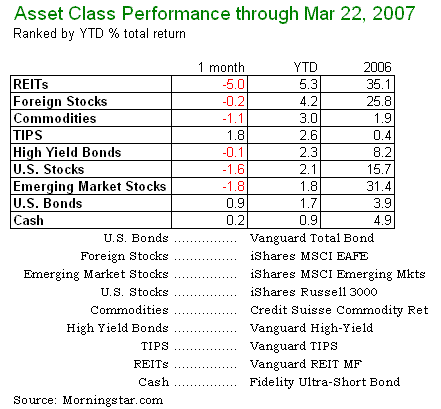
Another group to watch is emerging markets, which have tumbled by nearly 2% in the past month. Like REITs, emerging markets returns are still firmly in the black on a year-to-date basis. But as a high-risk corner of equities, this would not be a great time to go to sleep in monitoring the group.
In fact, everything save U.S. bonds, TIPS and cash has fallen over the past month. The fact that the selling has been across-the-board in recent weeks is a sign, at least to us, that returns won’t come as easily, if at all, going forward. Ours is a new era of rising risks and potentially lower returns for the foreseeable future compared with the last few years. You wouldn’t necessarily know that by looking at last year’s returns, which we list in the above table. But investors should remain vigilant to the fact that recent history can distort perceptions about what’s coming.
Yes, diversification across asset classes is still your only friend in the long run. Then again, it’s no guarantee. The inherent risk, by our reckoning, in choosing the right mix of asset classes is on the rise. But since there’s really no alternative to owning multiple asset classes for the long haul, it’s a risk that strategic investors must face. To paraphrase Churchill, asset allocation is the worst possible strategy except when compared to the alternatives.
EXUBERANCE DU JOUR
As rallies go, yesterday’s pop in equity and bond prices was impressive. Shortly after the Fed’s FOMC announcement hit the street, which confirmed that interest rates would remain unchanged, buyers took control. In the final two hours of yesterday’s trading session, the S&P 500 jumped 1.7% while the bulls pushed the yield on the 10-year Treasury down to 4.52%, the lowest in more than a week.
But rather than seeing yesterday as an end, the session was the start of a new gambit on predicting the next phase of the business cycle, which increasingly looks long in the tooth. Consider yesterday’s comments from Gail Fosler, chief economist of The Conference Board. Although the economy continues growing and still looks healthy, there are warning signs to consider, especially in connection with inflation. “The forces driving corporate profitability will likely become more adverse as we get further into 2007,” Fosler said. “Slowing productivity and rising costs do not bode well for the future.”
Indeed. But investors yesterday had other ideas. For bond traders, the source of buying optimism was the Fed’s formal recognition that the economy is slowing. In the FOMC statement, the central bank announced: “Recent indicators have been mixed and the adjustment in the housing sector is ongoing.” In addition, the bond bulls focused on the absence of the “additional firming” language in yesterday’s press release regarding monetary policy–a phrase that was present in the previous statement.
But did the buyers overlook the rest of the FOMC statement? For instance, this passage doesn’t inspire confidence when it comes to owning bonds: “Recent readings on core inflation have been somewhat elevated. Although inflation pressures seem likely to moderate over time, the high level of resource utilization has the potential to sustain those pressures. In these circumstances, the Committee’s predominant policy concern remains the risk that inflation will fail to moderate as expected.”
Interest rates are unchanged, and the Fed’s worried about rising core inflation. Ok, we can take a hint.
But for now, there’s enough doubt about the future to justify almost any short term move in the markets. As the Fed advised, “incoming information” will determine what comes next. Nonetheless, by our reckoning, the central bank is preparing the market for what may be a new round of tightening if inflationary momentum continues. Mr. Market, however, chose to place his focus elsewhere. So be it. Optimism usually wins out when there’s a choice. Most of the time, the optimism’s well placed. Will it be again? Or was yesterday’s buying another case of irrational exuberance?
THE CALM BEFORE THE YAWN
Almost no one expects the Federal Reserve to announce an interest-rate cut this afternoon, when the FOMC is scheduled to make a public announcement on the price of money and the economy.
The sentiment is quantified in Fed funds futures. As we write this morning, the April contract is priced for the status quo of 5.25%. By the end of the year, however, the market expects that rates will be lower, or so the futures contracts predict. But that doesn’t help in the here and now.
“What is likely is no change at all,” said Jim Russell, director of core equity strategy for Fifth-Third Asset Management in Cincinnati, in the Mercury News Wire. “We might get a little commentary on the housing market nationwide … but we don’t think there’s much action in the cards.”
Nonetheless, some observers are looking for calming words from the Fed in the wake of jitters over the subprime mortgage market. “There’s been uncertainty in the market about where the U.S. economy is heading,” Oscar Gonzalez, economist at John Hancock Financial Services,
told AP via The Baltimore Sun. “I think the Fed’s message will be one of stability.”
The question is: What constitutes enlightened thinking on stability these days when it comes to monetary policy. Martin Crutsinger, economics writer for AP, puts his finger on the quandary facing the Fed in his column today via The Houston Chronicle:
…the economy has turned weaker with business investment, which had been expected to take up the slack from a weakening home market, faltering. And consumer spending is weaker as well.
That is why some economists have been pushing the possibility of a recession higher this year. Greenspan put the odds at one in three.
Normally, the central bank would respond to spreading economic weakness by cutting interest rates. However, two reports on inflation last week showed that price pressures remain a problem with both wholesale and retail prices rising more rapidly in February.
Ed Yardeni, CIO of Yardeni Research, weighs in today on the economic outlook in an email to clients. “Real GDP growth is likely to remain subpar during the first two quarters of 2007,” he wrote. “The culprit is residential investment, which chopped a full percentage point off of real GDP growth during the last two quarters of 2006, and is likely to do the same to Q1 and Q2 of this year.”
If rates are held steady, and the slowdown/inflation threat remains, the task du jour later today will be parsing the FOMC statement for crumbs of insight about what’s coming in monetary policy. Beyond that, tomorrow’s initial jobless claims update promises to attract attention, as will Friday’s report on existing home sales for February.
We’re still data dependent, but for the moment there’s precious little new data to dissect.
A TIMELY BOUNCE
You can almost hear a collective sigh of relief.
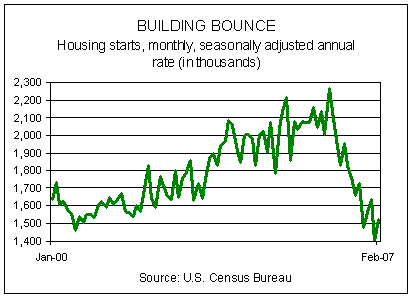
After this morning’s update on housing starts for February, there’s reason to think that a thin ray of optimism is in order when it comes to pondering real estate for 2007. It may be fleeting, but for a few hours, at least, hope has a new lease on life.
The source of the cheer comes by way of the Census Bureau, which reported today that new privately owned housing units rose by 9% last month over January, based on a seasonally adjusted annual rate. In raw numbers, that translates into 1.525 million new starts in February. As the chart below shows, that delivered a much-needed bounce to the battered housing market.
WATCHING, WAITING… TRADING?
The combination of last week’s renewed fears that inflation might not be quite dead after all and this week’s Fed FOMC meeting means that speculation on prices will dominate the talking and trading points this week in the financial markets.
Inspired by the news, the gold market has started inching up again. The dollar, meanwhile, is slipping, as per the U.S. Dollar Index.
The anxiety is spilling over into the equity markets. The S&P 500 last week continued to wander sideways, waiting for a clearer picture of what this week will bring. The market for the benchmark 10-year Treasury Note has also become cautious now that inflation has returned as a topic of discussion.
UPSIDE SURPRISE
Mr. Market won’t be happy with today’s inflation report. Consumer prices rose 0.4% on a seasonally adjusted basis last month, double the pace of January and above the 0.3% that the crowd was expecting.
Using the new numbers, the consumer price index advanced by 2.4% for the past year through February, the Bureau of Labor Statistics reported. A 2.4% annual rise in inflation may not look all that threatening, but when you take a closer look at the numbers, there’s reason to wonder what’s coming.
Consider the core rate of inflation, which strips out energy and inflation. The Fed’s target for core CPI is widely reported as a range of 1% to 2% year. But as today’s update reminds, core CPI is rising by 2.7% a year as of February. That’s nearly as high as it’s been in recent years. In fact, the last time core CPI was within the Fed’s range was August 2004.
More ominously than the level is the direction: core CPI continues to inch higher, a drift that’s been under way more or less for nearly three years. As warning bells go, this one looks pretty convincing. To be sure, in any given month there’s no dramatic story for core CPI. But viewed over time, it’s clear that core inflation aspires to higher elevations, as our chart below shows.

Or does it? Alas, no one really knows. But based on recent history, it’s clear that upside inflation momentum, though slight, appears to have the upper hand.
Nipping that momentum in the bud isn’t a problem. Tightening monetary policy is the accepted prescription. That’s what central banks are supposed to do. The question is whether the Fed’s prepared to unsheathe that monetary weapon again. The economy just happens to be slowing at this point. The prospect of raising interest rates is sure to go over like lead balloon in Washington and throughout the country. Then again, central bankers are hired for results, not popularity.
Bernanke’s Fed last raised Fed funds by 25 basis points last June to 5.25%. We don’t have a clue as to what the central bank’s thinking, other than to read the public tea leaves that are available to everyone else. But this much, at least, seems clear: Bernanke and company will be taking another hard look at monetary policy between now and next week’s FOMC meeting.
A WARNING, OR JUST A BLIP?
This morning’s update on February wholesale prices should give the Federal Reserve something to think about.
At its worst, the continued rise in core producer prices last month is another sign that inflationary momentum is building in the manufacturing pipeline. Perhaps it’s just a temporary blip. But until and if future reports suggest otherwise, prudence dictates that monetary policy should err on the side of caution. Inflation isn’t easily put back in the proverbial bottle. Meanwhile, keeping it from seeping out in the first place is much easier and, in the long run, more productive for the economy.
As for today’s PPI numbers, here’s how it stacks up. Top-line PPI jumped 1.3% in February, the highest last November and near the highest monthly figures posted in recent years. On a 12-month basis, PPI is now rising by 2.6% a year, the highest since last summer. The respite in upward wholesale pricing pressure from last July through October now appears to be fading.
It’s tempting to say that energy is the sole cause for the latest price surge. Indeed, energy prices jumped 3.5% for finished goods last month, nearly reversing the 4.6% decline in January. But if you strip out food and energy from PPI, there’s still something to worry about. Core PPI last month rose by 0.4%, twice as much as January’s increase. On a 12-month basis, core PPI is advancing by 1.8%. That’s not the end of the world, but it’s up sharply from last summer. The question is whether the momentum has legs.
It’s too early to hike rates, although it’s also too soon to start cutting. For the moment, we can only wait for tomorrow’s consumer price report for February for a deeper understanding of price trends. But after looking at the latest PPI numbers, we’ll be that much more skeptical when digesting the CPI update for February.