Change may come slowly, almost imperceptibly to the capital markets. Or it may come as a thunderbolt from the blue. But invariably it comes, raising questions and sidetracking long-running expectations in the process.
What’s unfolding presently in one corner of the marketplace appears to be change in its more subtle hue. That leaves room for debate, although it spurs questions too. Reading the trail left by the major asset classes shows that REITs are at the head of the shifting financial winds. Posting the only loss so far this year among our list of broadly defined markets, real estate securities are testing a concept that has long eluded the sector: loss.
As our table below shows, red ink distinguishes the asset class so far this year:
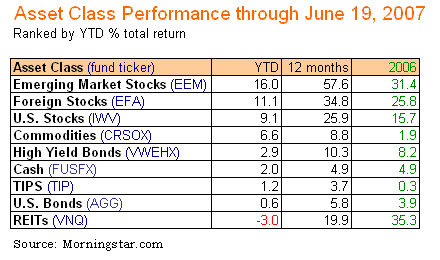
To find a calendar year in which REITs generally suffered a loss one has to return to 1999, when Wilshire REIT’s total return was a negative 2.6%. Since then, REITs have been on a bull market run that’s extraordinary for its duration and magnitude. If you had the prescience to buy the Wilshire REIT at the close of 1999, the resulting annualized total return from that point through this past May was a stellar 22.3% vs. a paltry 2.2% for the S&P 500, according to Morningstar Principia software.
The question is whether the REIT train has finally run its course? No one knows, but there are several reasons to consider the possibility. We can start with the observation that nothing goes up forever. REITs have taken flight now for seven years straight through the end of 2006. We don’t know if fate will make that eight in a row, but after such a long bull run, the odds of extending a rally with ancient origins looks decidedly lower the longer the party goes on.