The market’s down and your editor is out–out of town. As we depart for a bit of R&R, the equity market’s getting roughed up. Although a post or two may pop up on these digital pages, yours truly will be returning to the regular grind on August 7. Meantime, we’ll be watching the usual suspects (and looking out for bears) from an undisclosed location on the California coast.
Monthly Archives: July 2007
OPTIMISM TAKES ANOTHER HIT
Real estate’s still in a slump, as yesterday’s report on June sales of existing homes reminds. The National Association of Realtors reported that sales of single-family homes tumbled 3.8% last month to an annualized rate of 5.75 million units–the lowest in almost five years.
More weakness may be coming, predicted Thomas Higgins, chief economist at money manager Payden & Rygel, in a research note sent to clients yesterday. He reasoned that the recent jump in mortgage rates will keep the pressure on sales in the coming months. He explained that a high correlation (77%) between mortgage rates and a two-month lag on existing home sales suggest as much, as per his chart below.

Source: Payden & Rygel
“Between May 11 and July 13, the rate on a 30-year fixed-rate mortgage surged from 6.15% to 6.75%,” Higgins wrote. “As the chart above shows, a rise in mortgage rates tends to impact existing home sales with a two month lag.” As a result, he warned that existing home sales “could see another down leg in July and August.”
This line of thinking throws a potential wrench into the machine of optimism, which of late has espoused the idea that the worst of real estate’s ills had passed. The sector isn’t necessarily poised for boom or even modest rebound. But if the market would simply stop bleeding, the flat-lining would go a long way toward boosting the economy in the second half of 2007 into 2008.
SOUTHERN FRIED MOMENTUM
Risk continues to pay off handsomely in the world’s equities markets. As our table below shows, reaching for more has delivered more, reinforcing the notion in 2007 that higher risk equates only to higher reward.

The top-performing region through last night’s close was Latin America, which has climbed an astonishing 41% in dollar terms (this and all data are courtesy of S&P/Citigroup Global Equity Indices). In fact, double-digit gains remain the norm for much of the planet’s stock markets, with Japan being the conspicuous exception.
This year’s rally may reflect rational pricing of assets, but the gains in Latin America are inducing some head scratching. Indeed, the region’s relative strength is conspicuous this year, but it’s hardly a new trend. BCA Research last week observed that Latin America has outperformed Asian markets for nearly 20 years. “This is remarkable, given strikingly superior economic performance in Asia relative to Latin America,” the consultancy wrote.
Some of Latin America’s equity leadership can be attributed to the fact that the region is relatively rich in commodities compared to Asia. Among the obvious examples: Chile is a major copper producer and Venezuela is among the world’s biggest exporters of crude oil. The bull market in commodities, then, solves the puzzle for why Latin American stocks are running hot for so long, right? Well, only partly. The commodities rationale isn’t completely persuasive, BCA advised, noting that Latin America also outperformed in the 1990s even though commodities prices were weak in the decade.

THEORY & PRACTICE
The academic literature is long and deep in favoring core inflation as a superior predictor of headline inflation. By that reasoning, the recent dip in core indices gives hope to the prospect that the Federal Reserve has contained the beast. As the chart below shows, the Fed’s preferred measure of inflation (the price index for core rate of change in personal consumption expenditures) is showing signs of behaving lately.

But as we’ve been discussing this week, there’s still plenty of anxiety about inflationary trends, in part driven by the rise in headline gauges. In fact, the anxiety that springs from the conflicting signals of headline vs. core has been front and center in debates within the Fed. Yesterday’s release of the minutes from the FOMC meeting of June 27-28 details the worries in the meeting’s conversations, as the following excerpt reveals:
The incoming data on core consumer prices were viewed as favorable, but were not seen as convincing evidence that the recent moderation of core inflation would be sustained. Participants noted that monthly data on consumer prices are noisy, and recent readings on core inflation seemed to have been depressed by transitory factors. Moreover, a number of forces could sustain inflation pressures, including the generally high level of resource utilization, elevated energy and commodity prices, the decline in the exchange value of the dollar over recent quarters, and slower productivity growth. In addition, while core consumer price inflation had moderated of late, total consumer price inflation had moved substantially higher, boosted by rising energy and food prices. While total inflation was expected to slow toward the pace of core inflation over time, a number of participants noted that recent elevated readings posed some risk of a deterioration in inflation expectations. On this point, several participants cited the uptick in forward measures of inflation compensation over the intermeeting period derived from Treasury inflation-indexed securities. However, a portion of this increase might be attributed to technical factors, and survey measures of long-term inflation expectations had held steady over recent weeks. Nonetheless, several participants emphasized that holding long-run inflation expectations at or below current levels would likely be necessary for core inflation to moderate as expected over coming quarters.
The voices worrying about inflation are all the more timely with oil prices rallying anew, perhaps to a new all-time high in the near future. The question then becomes whether the public thinks inflationary pressures are on the rise. If the answer is “yes,” then the fear may become a self-fulfilling prophecy. After all, there’s a lot of consumers out there paying more for food and energy who are behind the times when it comes to reading the academic literature on core.
HEDGING AND HAWING
Maybe, just maybe, Fed Chairman Bernanke has no better handle on inflation’s future than the rest of us.
Yes, Ben’s a smart guy. To be precise, he’s one of the most respected monetary economists in the country, if not the world. That’s a big part of why he sits atop the world’s most important central bank. But as his testimony yesterday to Congress suggested, even the mighty feel inclined to bow to the vagaries of the future when it comes to setting monetary policy for the morrow by making decisions today.
We refer readers to yesterday’s news that core inflation continued to fall in June. By any reasonable standard, the trend should encourage the Fed, having professed for some time now that core measures of inflation are superior to headline measures for influencing monetary policy. But listening to Bernanke’s testimony, we were struck by his tendency for hedging his comments about the prospects for keeping inflation contained.
At the heart of this hedging was the Fed chief’s reference to rising headline inflation (which includes food and energy) at a time when core (which excludes those two items) is slipping. “Sizable increases in food and energy prices have boosted overall inflation and eroded real incomes in recent months–both unwelcome developments,” he admitted in his prepared remarks. “As measured by changes in the price index for personal consumption expenditures (PCE inflation), inflation ran at an annual rate of 4.4 percent over the first five months of this year, a rate that, if maintained, would clearly be inconsistent with the objective of price stability.”
BETTING ON CORE
Inflation, the government reported this morning, was running at an annual pace of 2.7% through the end of June. That’s near the fastest rate posted so far this year, falling just short of the 2.8% increase in March.
Granted, 2.7% by itself is nothing to lose sleep over, as headline rates of inflation go. But it’s the upward bias that concerns us. After dropping precipitously in the second half of 2006, inflation has proven itself resilient in bouncing off the low-1% range that briefly triumphed last October, as our chart below shows.

Of course, the Fed looks to core inflation as the superior measure of inflationary trends. The reasoning is that by stripping out the statistically noisy elements of headline inflation (i.e., food and energy), a core reading of pricing trends offers a superior tool for predicting where headline inflation is headed. A number of studies conclude no less. As Alan Blinder, a former Fed vice chairman and currently a Princeton economics professor, told the Wall Street Journal last week: “The Fed is pretty powerless to do something about the price of energy or the price of food. I don’t want to charge the Fed with responsibility for something it can’t do.”
ANOTHER DESPERATE SEARCH FOR CONTEXT
Analyzing the past may give us a leg up on handicapping the future. Then again, it may not. The financial gods are funny that way: they keep us guessing and make no apologies. Nonetheless, we’re sufficiently naive and properly motivated to look at the historical record anyway–and take our lumps when and if they come (which invariably they always do).
With that caveat out of the way, today’s effort focuses on the 10 major sectors that comprise the S&P 500. To the extent that one can assess major trends in the recnet trading of domestic equities, clues may be ripe for the picking. We can begin by observing that energy is this year’s big winner…again. Through Friday’s close, the energy sector’s up by a cool 24.8%, as the chart below shows. That’s more two-a-half-times higher than the S&P 500’s 9.5% year-to-date gain, which itself is impressive as broad-market averages go over such short periods.

THE SLUMP DU JOUR
No matter how hard you crunch yesterday’s data, the number du jour reserves the right to surprise.
The latest example comes in today’s retail sales report for June, which the government unveiled this morning. The crowd was looking for a flat June; instead, the report showed that sales slumped by 0.9% last month–the largest drop since August 2005, as our chart below shows.

Lower sales at auto dealerships were the primary cause for the decline, accounting for roughly two-thirds of the overall slump in retail sales. But as one economist remarked, there’s reason to stay cautious. “These big declines [in auto-related sales] followed unexpectedly large gains in May and do not necessarily imply a marked erosion of retail activity,” wrote David Resler, chief economist at Nomura Securities in New York, in a note to clients today. But then he qualified the statement by noting: “Nonetheless, the data do translate into a sharp slowdown in consumer spending — to 1.5% to 2% — in the second quarter that could be the start of a much slower trend in consumer spending for the rest of this year.”
TAXES & ASSET ALLOCATION
Asset allocation is arguably the most-important decision facing strategic-minded investors. Meanwhile, taxes are inevitable, which implies that factoring in the government’s skimming when designing portfolios is both practical and essential. Traditionally, however, the twain never meet. Research on asset allocation is usually conducted as if taxes didn’t exist. The idea, then, of incorporating taxes into asset allocation analysis is eminently reasonable. In fact, there’s a small but growing school of researchers who advocate no less. But the devil’s in the details. Inserting tax strategy into portfolio design adds more complication. Does it also yield superior results? In search of an answer, your editor interviewed an authority on this budding area of study: Stephen Horan, head of private wealth at the CFA Institute. Our conversation appears in the current issue of Wealth Manager. You can also read the article here.
ANOTHER CRACK IN THE WALL OF BULL MARKETS?
Today’s Wall Street Journal has a story suggesting that high yield bonds’ days of flying high may be numbered. Perhaps, although in the year-to-date rankings for the major asset classes, junk bonds aren’t yet waving the flag of capitulation.
Surrender thus far in 2007 remains contained to REITs, which are in the red through yesterday to the tune of -3.1%, as our table below shows. High yield bonds, by contrast, are still up by 1.6% through July 9.
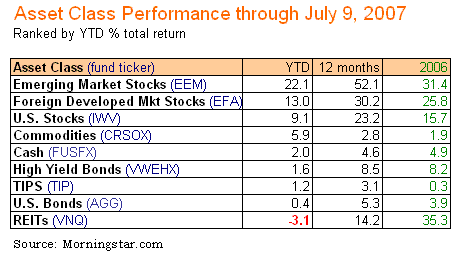
Then again, don’t let YTD numbers fool you. As the Journal article reminded, there’s a number of reasons to wonder how long the junk rally can last. Indeed, the asset class of junk bonds has posted a gain in each and every calendar year starting in 2001. But signs of pressure are building, starting with the fact that the average high yield bond trades at yield premium of around 300 basis points over comparable Treasuries–down from 1000 basis points in 2002, the paper reported.
Of course, the compression of risk premiums is nothing new. Your editor has mentioned the trend more than a few times over the past year or so, only to watch Mr. Market ignore the advice.