The rise in the 10-year Treasury yield to its highest level since 2002 may or may not signal a secular change in the future supply of liquidity. But when it comes to interpreting the signal, strategic-minded investors should think strongly about erring on the side of caution. The advice is all the more relevant for those who’ve profited from the liquidity driven bull market of the past five years that’s dispensed gains in all the major asset classes.
For all we know, the current spike in interest rates may end tomorrow–or not. But when the bond market sends a message this crisp, we’re reluctant to dismiss it out of hand.
Then again, the rise in the 10-year yield isn’t all that astonishing, given the recent evidence that the economy’s still bubbling. For those who assume the economy’s not headed for recession any time soon, the case for an inverted yield curve (long rates below short rates) has been on shaky ground.
“We’ve been through a three- or four-year period where yield curves have been a weird shape,” said Tim Bond, head of asset allocation at Barclays Capital, told Reuters. “I think you’ve got further to go [with rising interest rates]; yield curves are just normalizing.”
No matter your view on where the economy’s going, the bond market has some very definite ideas. To be sure, the ideas of the moment stand in sharp contrast to the ideas of the recent past, as our chart below reminds. In fact, those ideas may change again.

The future, of course, is debatable; the past is set in stone. Looking at the carvings left by fixed-income trading reveals that something approaching a normal state may be coming in the relationship between yields and maturities. Using last night’s close as a guide, there now exists a 60-basis point spread in favor of the 10-year over the 1-month T-bill. At the close of last year, the 10-year’s yield was 10 basis points under the 1-month T-bill. On its face, the change implies that the economy will stay stronger than previously assumed. Now all we need is fresh data to support the bond market’s forecast.
Monthly Archives: June 2007
A TIMELY REVIEW OF REBALANCING
Fear got the upper hand on greed last week, offering a rare change of pace in the five-year-old running of the bulls. Deciding if the turnaround in sentiment foreshadows more of the same, or was just a temporary detour in an otherwise intact bull market, remains to be seen.
Without the benefit of the answer, now seems like a good time for a refresher course on the all-weather strategy that’s fitting for market trends driven by bulls and bears alike. Rebalancing is no get-rich-quick scheme, nor can it guarantee triumph in one’s voyage through the capital markets. What it does offer is a prudent approach to managing a multi-asset class portfolio with an eye on balancing reward with risk over time.
Finding the right balance between gain and loss in portfolio management is an evolving and always challenging pursuit. But if there’s a promised land, the path to that nirvana arguably rolls through the province known as rebalancing. But even assuming as much offers no shortcuts.
There are as many ways to rebalance as there are brokers on Wall Street. In an effort to bring order to what is in theory a black hole of potential is one Gobind Daryanani, a CFP who’s researched the subject of rebalancing in search of strategic enlightenment. Your editor interviewed Daryanani in the June issue of Wealth Manager. If you’re inclined to share in the finer points of his analysis, read on….
LIQUIDITY’S INDICTMENT?
As signals in the bond market go, yesterday’s was fairly lucid. Translating bondspeak to street language, the trading in the 10-year Treasury on Thursday might be interpreted thus: Ahhhhhhhhhhh!
As the chart below shows, the 10-year yield jumped more than a little, closing at roughly 5.1%. That’s the first time the benchmark Treasury has been swimming in those statistical waters since last July.

Source: BarChart.com
What caused the revaluation in the price of money? In broad terms, it’s clear that risk is being repriced. What’s triggered this repricing? Liquidity invariably turns up as a suspect. Mr. Liquidity is innocent till proven guilty, of course. But for the moment, he’s been arrested and awaits arraignment.
Meantime, the court of public opinion will survey the evidence until a formal decision arrives. Exhibit A is the supply of liquidity in the global economy. But most standards, it’s in amply supply, and then some. But for every action there’s a reaction, which may or may not arrive in a timely fashion. Eventually, however, liquidity will have an impact and the debate about what comes next will be done.
IT’S ALL ABOUT INTEREST RATES–AGAIN
The yield on the benchmark Treasury is climbing–again.
Yesterday, the 10 year closed at just under 4.98%, the highest since last August. The immediate cause of the renaissance in the price of money is the growing suspicion that the recession has been postponed–again.
Almost no one’s arguing that economic growth’s about to explode on the upside, but the latest batch of data suggests that a contraction in GDP isn’t imminent either. The most persuasive evidence came in yesterday’s update on the ISM index of non-manufacturing activity, otherwise known as the service sector. The gauge rose last month to its highest since April 2006, reversing March’s tumble and suggesting that growth still has some momentum.
But along with the upward momentum in business activity comes news that prices are following suit. As David Resler, chief economist with Nomura Securities in New York, wrote in a note to clients yesterday, “Non-manufacturing businesses continue to face rising prices as the prices paid index rose to 66.4 in May, the highest since last August (71.9).”
The bubbling of pricing pressure hasn’t been lost on the bond market, which now sees fit to err on the side of caution as to what comes next. Adding to the anxiety in pricing money is yesterday’s counsel from Fed Chairman Ben Bernanke on the always delicate matter of inflation. “Although core inflation seems likely to moderate gradually over time,” the chairman said in prepared remarks for the International Monetary conference in South Africa, “the risks to this forecast remain to the upside.”
The potential for future inflation trouble, in short, isn’t quite dead, he warned–again.
RISK IS STILL A FOUR-LETTER WORD
Rarely have so many earned so much for so long.
That sums up the performance record for the broad asset classes. By almost any measure, the past five years have been extraordinary. Rarely has everything run higher, year after year, and posted robust gains in the process.
One might think that the party would be showing signs of age after such an astonishing track record. But as our table below suggests, momentum in its upward form remains the dominant force in the markets this year–again. Indeed, red ink has been banished from the list.
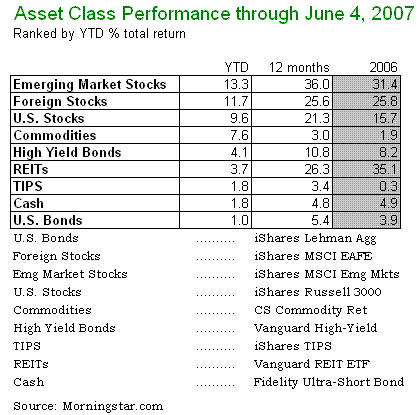
Debating how long red will continue to be conspicuous in its absence from the performance tally should be topic number one for strategic-minded investors. By extension, one can reasonably question how long the mother’s milk of this bull era will last, namely, liquidity, which has been exploding globally for some time now.
IRRATIONAL PESSIMISM?
Inflation, we’re told, isn’t a problem, and won’t be any time soon. But we worry about the threat just the same. Maybe we’re a victim of irrational pessimism.
Whatever afflicts our powers of analysis, there’s no question that inflation’s had a pretty good run since the Federal Reserve’s founding in 1913. Yes, recent history offers reason to argue that the central bank has finally figured out how to tame the beast. Maybe, although we’ll continue to reserve judgment, thank you very much. It’s our money, after all, and we’re reluctant to watch it slip away, in either relative-purchasing-power terms or through outright capital losses.
That said, we’re not obsessed with inflation, or so we believe. Our allocation to gold, TIPS and other hedges against upward pricing pressures is still modest, bordering on insignificant if inflation were to come roaring back tomorrow. And by rank-and-file goldbug standards, our investment strategy could be confused with thinking that inflation has forever been banished.
Still, your editor recognizes that, in the long run, the political and economic pressures to inflate are potent, as a careful study of the past reminds.
Even at today’s reportedly modest rate of inflation, the damage adds up as the years pass. Consider that what cost $100 in 2000 now, on average, sets one back to the tune of $120, according to the inflation calculator on the Bureau of Labor Statistic’s website. In other words, a dollar’s worth 20% less today than it was just seven years previous. That disturbing state of affairs has unfolded during what officially hailed as a triumphant suppression of inflationary forces!
The above calculations come by way of the government’s definition of inflation, as per the consumer price index (CPI). By some accounts, the definition underestimates the true extent of pricing pressures. But for most investors, the opportunities are limited for hedging away inflation’s corrosive effects. Gold, of course, is a traditional strategy, although few are willing to will hold more than a token amount of the metal. There’s also the vast world of collectibles and commodities, but any number of issues plague this realm as practical tools for inflation-fighting inflation, ranging from illiquidity to volatility to lack of pricing transparency.
For most investors, that leaves inflation-protected Treasuries, or TIPS, as the more practical choice. But since the bonds are tied to CPI, buying them requires a certain amount of faith in the underlying benchmark. For some, that’s asking too much, as we reported in the June issue of Wealth Manager magazine. Nonetheless, as the article reminds, most investors are stuck with CPI. For an exploration of the implications, read on….
WHAT HAVE WE LEARNED FROM THE MAY JOBS REPORT?
This morning’s update on job growth for May offered a dose of encouragement for the stock market bulls.
The consensus forecast called for a net gain of 135,000 nonfarm jobs last month, according to TheStreet.com. The actual number exceeded the collective guess by a comfortable margin: a rise of 157,000 new jobs in the nation in May, the Bureau of Labor Statistics advised. Adding to the tally’s shine is the fact that last month’s gain nearly doubled April’s lethargic advance of 80,000–the lowest in more than two years.
By recent standards, then, all looks well. The economy’s ability to mint 157,000 jobs will be hailed as evidence that the gods of growth continue to hold the upper hand. Perhaps, although without knowing what the future will bring we can only look to the past for definitive clarity. On that score, there’s reason to stay modestly cautious on the always precarious business of forecasting.
For those who’re interested in a broader historical context, last month’s 157,000 rise in nonfarm payrolls is hardly stellar, welcome though it is after April’s stumble. Crunching the monthly percentage change in nonfarm payrolls for the past four years reminds that last month’s rise is no more than middling, and that’s by a standard that’s been steadily slipping for more than a year.
Indeed, the trailing 12-month average percentage change in monthly nonfarm payrolls has been declining virtually nonstop since early 2006, as our chart below shows. Last month’s 0.11% rise in new jobs exactly matches the average change for the past 12 monthly reports. Each and every investor must decide if such facts inspire confidence, despair or something in between.
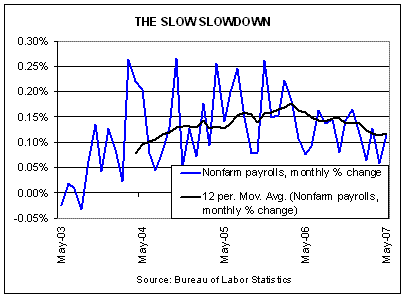
That said, there’s a case to be made for embracing the in-between theory, which runs like this: if the economy can maintain 150,000 new jobs a month, something approaching a sweet spot in balancing growth and inflation containment may be at hand for the foreseeable future. The jury’s wide open on which outlook will prevail, but at least we can agree about the road that’s brought us this far.