The photo op didn’t help.
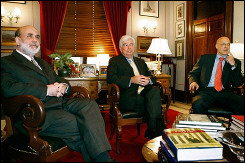
Bernanke meeting yesterday with Sen. Dodd and Treasury Secretary Paulson
There’s much debate about how to proceed on monetary policy, but on at least one basic point there can be no argument: history clearly shows that central banks must be independent if they’re to be effective stewards of a nation’s currency. Simply put, the political factor has no place in central banking. Yes, it leaks in from time to time, but every effort should be made to keep it at arm’s length. The issue is more than window dressing. A large body of evidence shows that central banking works better when the political influence is reduced, ideally to zero.
With that in mind, a central bank’s independence flows from two fonts of power and influence. Ultimately, one is at risk when the other’s threatened, or is perceived to be threatened. The first is the fundamental autonomy that’s driven by the opportunity to weigh decisions based solely on the economics, i.e., monetary decisions that are unbound from the political aura that otherwise informs government action. The second source of a central bank’s authority and efficacy is what one might call soft power: the ability to shape perceptions in the market by tools other than the hard power of changing interest rates, adjusting money supply, etc. Giving speeches, for instance. Soft power draws heavily on the prevailing pool of respect for the central bank and a belief in its integrity for effecting change based on the economic merits. And the market’s belief in that integrity relies in no small part on the assumption that the Fed’s impervious to the political winds du jour.