
Sad memory wakes anew at morning’s touch
And, as some muscles move without our will,
She seizes, with involuntary clutch,
The sorrow that we hate, our bosom ill;
But we are formed with such fine wisdom, such
A Providence our moral need supplies,
That we can seldom overrate our sighs
Nor prize our organs of regret too much;
Then welcome still these ever-new returns
Of anguish! Who escapes or can escape
The burthen, while the great world sins and mourns?
Grief comes to all, whatever be her shape
To each, but we are framed with pain to cope;
And, when we bow, we help our climbing hope.
Charles Turner, Morning Sorrows
Monthly Archives: September 2007
BERNANKE’S BIG TEST IS ABOUT TO BEGIN
The Federal Reserve is virtually certain to cut Fed funds rate in the wake of Friday’s news that the economy is shedding jobs for the first time in four years. But the anticipated easing still comes with risks.
It’s not obvious that more liquidity is the solution for what ails the economy. The return of job losses after four years of gains may simply be the natural ebb and flow of the business cycle. There’s a general sense that such cycles have been banished to the dustbin of economic history, but that’s a premature conclusion. Yes, the Fed has learned how to smooth the business cycle with tactical injections of liquidity. But there’s no free lunch and it’s possible that keeping deep recessions at bay all these years has been a temporary triumph that’s had the unintended effect of letting excesses build up to the point that they’re now set to burst forth.
If the cycle is poised to reassert itself on the downside, the Fed will no doubt intervene in an effort to keep the economy bubbling. The past 20 years have shown that the central bank is inclined to do just that. But at what cost? Has the smoothing of the business cycle in past years dispatched the fallout or simply rolled it into the future?
The economy may be weakening but the cause doesn’t fit neatly into the classic boom-bust story. In the old days, the Fed would choke off rising economic growth by raising interest rates, sometimes by too much. The tightening brought recession, which in turn spurred the Fed to ease to induce growth once more.
This time, however, it’s debatable if the economic slowdown that appears to be in progress is directly caused by excessive monetary tightening in the traditional sense. The Fed funds rate has been at 5.25% since June 2006, but the charge that the price of money’s been too high is exaggerated. Only in recent weeks has the cry for lower rates gained critical mass.
A DARK CLUE?
Is the bond market finally right? It’s starting to look that way.
Yesterday we discussed the latest slide in the 10-year yield and presumed that it reflects rising pessimism in the fixed-income set that future economic growth will disappoint if not evaporate completely. This morning, the argument for that pessimism received another piece of supporting evidence in the August jobs report.
Nonfarm payroll employment slipped by 4,000 in August from July, the Labor Department reported. Statistically, that works out to a wash in a labor force numbering upwards of 138 million. Nonetheless, there are still several reasons to embrace the warning signal embedded in the report.
First, consider the chart below, which graphs the monthly percentage change in nonfarm payrolls. It’s clear that the trend has changed this year and for the worse. Only the financial gods know for sure what comes next, but mortal observers will have no trouble drawing rather dark conclusions from the trend. An economy that had been creating jobs fairly steadily is now an economy that’s treading water in minting employment opportunities. Is the next phase an economy that destroys jobs?

The trend looks better if you look at the pace of job growth on a year-over-year basis, as per our second chart below. By that definition, nonfarm employment rose 1.2% in August compared to a year ago. But the trend still doesn’t inspire. An annual rise in jobs of 1.2% is the slowest in over three years and the downward momentum looks like it has a head of steam.

Then again, it’s worth noting that last month’s slippage in private-sector employment generally was exclusively due to job losses in construction and manufacturing/goods producing. By contrast, the other major areas of private employment posted gains, including the single biggest source of private jobs: services employment, which rose by 0.5% in August.
The great debate now is whether the pain in the goods-producing area spills over into the broader employment picture. Optimists think the answer is no, an outlook that jibes with the forecast that the real estate correction will remain an isolated problem without triggering a recession.
Hope isn’t dead, although it took another blow this morning. Meanwhile, the case for dropping interest rates just got another bit of statistical support. This much, at least, is clear: each and every economic number dispatched will take on more import than the one that preceded it for swaying Mr. Market’s sentiment.
BACK TO THE (GHOULISH) FUTURE
When the 10-year Treasury yield briefly dipped under 3.10% on an intraday basis one day in June 2003, some thought a milestone had been set that would last for years, even decades. But suddenly there’s reason to wonder if the era of low rates is poised for renaissance.
The immediate cause for such thinking comes from looking at yesterday’s action in the bond market. The 10-year yield closed at 4.47%. That’s the lowest close this year, as our chart below shows.
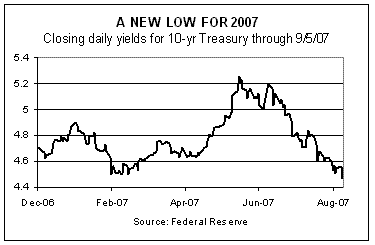
That may come as a surprise for some, although in the broader context of history it doesn’t look out of place. As our second chart below illustrates, the longer history has been one of falling interest rates, interrupted only by temporary jumps higher. The latest jump upward has been unusually long. But is it temporary? Or is the longer trend of falling rates reasserting itself once more?
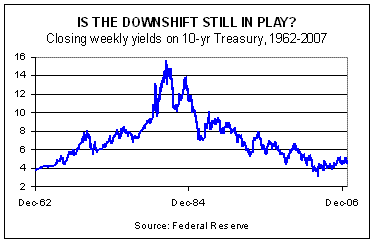
It’s been popular to look at the trend since the low of June 2003 and conclude that the era of cheap money has ended and that rates will slowly but inexorably rise from here on out. The prediction has more or less held true in the last four years or so. But after yesterday’s dip, one might take a minute to reassess the implications for portfolio strategy if rates take a turn south in a big way.
PONDERING MULTI-ASSET CLASS PORTFOLIOS
Asset allocation is built on the premise that some asset classes zig when others zag. Recent history has put this notion to the test as virtually everything has run up in price. Yes, there’s been a correction of sorts in July and August, but red ink still remains scarce so far in 2007 among the major asset classes. The notable exception is REITs, although considering that the asset class soared 35% last year leaves more than a little room for correction in 2007 without materially impacting the general uptrend. The question of what the flowering of bull markets across the board implies for asset allocation strategies was a topic for this reporter in the current issue of Wealth Manager. Easy and obvious conclusions are elusive, but pondering what it all means nonetheless offers some healthy food for thought for strategic-minded investors. If you’re inclined to take a bite, here’s today’s blue plate special.
IT’S STILL A GOOD YEAR…SO FAR
The capital markets greet September with many questions. But whatever perils or opportunities await, the year-to-date tally doesn’t look all that bad.
August was a rocky month, but the bulls remain the dominant species on Wall Street. That may change, of course, but for the moment the numbers speak for themselves. Everyone’s favorite benchmark–the S&P 500–is up 5.2% on a total return basis in 2007 through August 31. Not bad, if you consider that on an annual basis that represents above-average performance.
In fact, the major asset classes are still bubbling in 2007. Some may be battered a bit after August’s slings and arrows. But the upward bias appears intact on a collective basis. That’s not to say that smooth sailing’s assured for the remainder of the year. But one can at least look at the trailing numbers and dream.