The pace of growth in money supply is a number that’s meaningless in a vacuum. To quote a rate of expansion offers no more insight than looking a stock or bond and having no knowledge of valuations beyond. With that in mind, what can we say of the 6.6% advance (in nominal terms) over the past year in M2 money supply, based on the latest data for the week through October 29?
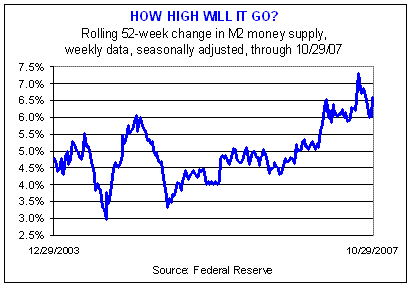
We can begin to search for an answer by considering the speed of the economy. For the third quarter, the government’s current estimate tells us that nominal GDP grew by an annualized 4.7%. Using those figures in combination, it’s clear that the Fed’s printing money at a significantly higher rate than economic growth.
So, what have we learned? On its face, the data suggest that money supply is rising faster than prudence suggests. But again, additional context is necessary lest we make a hasty judgment.
Let’s also add to the record that the 4.7% nominal GDP pace fell from 6.6% in Q2. For additional perspective, take note that the benchmark 10-year Treasury yield now stands at 4.23% and the Fed funds rate is 4.50%. In sum, interest rates are generally lower than the economy’s rate of growth while money supply is rising at a pace that’s substantially higher than GDP’s growth.
All of which might be considered perfectly reasonably if the goal is to juice the economy and head off a slowdown. To be fair, a slowdown for Q4 and beyond is now on everyone’s lips; only the degree seems to be in question. But once again, additional context casts a cloud of uncertainty over an otherwise obvious decision to err on the side of monetary stimulus.