The repricing of risk in the capital and commodity markets may be intimidating, but it’s a natural, recurring process, and one that often brings fresh opportunity (along with new and so perhaps unexpected risks) for strategic-minded investors.
Periodic rebalancing as a general rule is a good idea, perhaps more so than usual these days given the rise in volatility in some asset classes and the growing sense that more than the usual demons haunting the markets and the economy may be lurking in the shadows. All of which provides a timely excuse to update the correlation trends between stocks, bonds, REITs and commodities if only to see how the recent turmoil in markets has reshuffled the relationships between the asset classes.
To keep things manageable, we’ve crunched the correlations from a U.S. stock market perspective (see chart below by clicking for larger image). The decision doesn’t mean that looking at correlations from the vantage of bonds or REITs or commodities is unproductive. Indeed, a full and prudent study of correlations demands considering all the angles. But in the interest of brevity, today we look exclusively at how correlations have evolved vis a vis U.S. equities, as represented by the Russell 3000, which is a broad measure of the market.
click for larger image
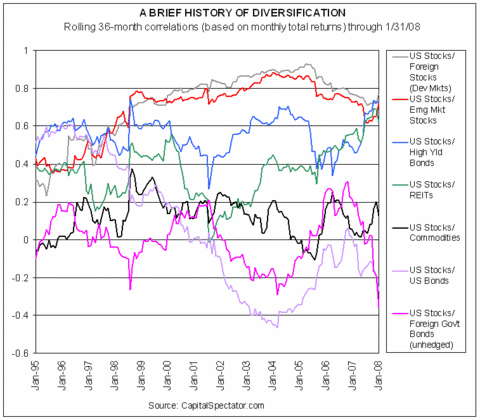
Indices used in calculation: Russell 3000, Lehman Bros. Aggregate Bond, DJ Wilshire REIT, DJ-AIG Commodity, iBoxx High Yield, Citigroup
Non-$ World Govt (un Hdg, $), MSCI EAFE, MSCI EM
Before we start analyzing the trends, let’s first define some terms. The chart above profiles 36-month rolling correlations based on monthly total returns for the respective markets. For example, the correlation between U.S. stocks and commodities for January 2008 comes from a correlation derived on the previous 36-month total returns for each asset class. Correlation measures the relationship between two data series, in this case monthly total returns. A correlation of 1.0 equates with perfect positive correlation, meaning that the two markets are effectively one and the same, or at least highly similar. A correlation reading of 0.0 is no correlation, and a correlation of -1.0 is perfect negative correlation. And, of course, there’s a strong case for building portfolios by mixing asset classes with low and negative correlation. The devil’s in the details, but as a general rule this one carries a lot of weight in our book.