Several astute observers of the financial scene have noticed recently that the yield on the 10-year inflation-indexed Treasury bond (a.k.a. the 10-year TIPS) has fallen to levels that look distinctly unattractive. Of course, one might ask: Unattractive compared to what?
There’s no doubt that the 10-year TIPS yield has fallen sharply in recent months. As of last night’s close, buying a 10-year TIPS equated with locking in a real (inflation-adjusted) yield of 1.43% for the next 10 years. Meanwhile, the always-perfect clarity of the rear-view mirror tells us that a better time to buy was last June, when the 10-year TIPS yield briefly rose to 2.83% at one point that month.
Since then, the TIPS yield has been falling virtually nonstop. Of course, the same is true for the nominal 10-year Treasury yield. Last June, the nominal 10-year was temporarily available at 5.23%, a relatively alluring yield that’s since fallen to 3.77% as of yesterday.
Suffice to say, yields generally are now lower–a lot lower, in fact, compared with the prevailing rates of last June. But the decline has not been distributed evenly in the land of Treasuries. On that note, consider the chart below, which compares the yields of the 10-year TIPS with the nominal 10-year Treasury, the latter adjusted by the 12-month rolling CPI rate. (Both series are based on constant 10-year maturities using monthly data, as per the St. Louis Fed.) The result is a back-of-the-envelope attempt at putting the two Treasuries on roughly equal footing in terms of comparing real yields.
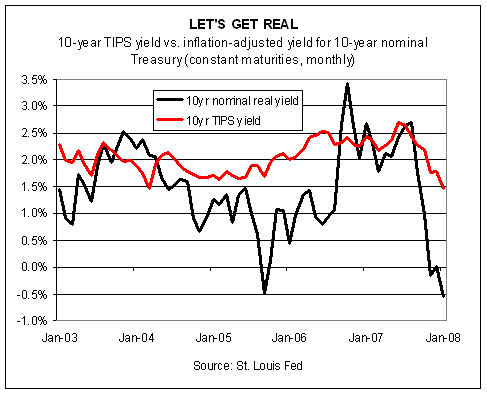
The striking feature of the chart is that inflation-adjusted yield in the nominal 10-year Treasury has sunk to an unappealing depth of roughly negative 50 basis points. In other words, adjusting the nominal 10-year yield by the latest CPI number (which reports annual inflation running at 4.3%) means that a buyer today would suffer a loss after subtracting inflation’s bite.