Monthly Archives: December 2008

WELCOME TO OUR NEW PODCASTING SERIES

These are glorious days for value investing. Sale prices abound and sellers are eager to make a deal.
The challenge for buyers is separating the wheat from the chaff. Same as it always was, although given the economic backdrop there’s a lot more chaff than wheat these days and so caveat emptor has rarely been more germane to the money game, regardless of strategic focus. That’s the price of opportunity, one might say. Nonetheless, there are a lot of bargains out there if you know where to look–and how to look.
For starters, value-minded investors need to distinguish among assets with encouraging prospects that happen to be trading at discounts to fundamental value from those that deserve to be priced on the cheap. Figuring out which is which with an eye on profiting from the knowledge was Ben Graham’s forte, of course. Among the celebrated value investor’s countless disciples is one Jon Heller, CFA and president of KEJ Financial Advisors in Newtown, Pa.
Value investing is a redundant phrase for Heller, who headed up the equity analytics department for many years at Bloomberg L.P. before opening his financial planning practice. The premise of looking for dollars trading for pennies is synonymous with the basic concept of “investing,” he believes. Until recently, that was a rather tedious affair, although it’s recently become a lot more interesting and potentially a lot more productive.
We last talked with Heller in June, when he discussed his Cheap Stocks 21 Net/Net Index, which he writes about along with other value-oriented subjects on his Cheap Stocks blog. With the end of the year approaching (mercifully), and the opportunities for value investing seemingly in surplus, the timing is right to chat with this aficionado of “deep value” investing.
Heller also happens to be our debut guest on our newly launched Inside View podcasting series for The Capital Spectator. Going forward, your editor will routinely be interviewing a variety of investment strategists, economists and other guests of note in finance and economics. But first, let’s start the show…

Please visit CapitalSpectator.podbean.com for more options with this and other Inside View podcasts.
STIMULUS TODAY, HANGOVER TOMORROW?

Governments are now working overtime in dispensing monetary and fiscal medicines intended to renew, restore and revive battered economies. In time the aid will quicken the economic heartbeat, although exactly when and to what degree is unknown. The patient has for years gorged on any number of goodies, ranging from the sweet treats of leverage and the candied delights of easy money to roller-coaster thrills of irrational investing.
The party, of course, is over, and the cleanup may go on for some time—probably longer than we expect. In a somewhat haphazard and increasingly desperate effort to ease the current and future pain, governments are dishing out unprecedented rounds of stimulus pills. For obvious reasons, everyone’s watching each new step in what promises to be a long run of conventional and unconventional programs intent on propping up economies from east to west, north and south and everywhere in between.

Continue reading

RESEARCH BRIEF: LOOKING FOR CLUES IN ECONOMIC VOLATILITY

Volatility isn’t the only measure of risk, but it’s a critical one in strategic investing. One need only look at recent history for real-world confirmation. Indeed, volatility has rarely been so extraordinarily high as it has been in 2008. No wonder, then, that real and perceived levels of risk have taken wing.
Volatility analysis has long been popular in the money game and it’s also been a fertile area of study at the macroeconomic level. And yet there’s been little research into how economic and market volatility interact. Helping fill some of the gap is a new academic paper: “Macroeconomic Volatility and Stock Market Volatility, World-Wide,” by professors Francis X. Diebold (University of Pennsylvania and NBER) and Kamil Yilmaz (Koç University, Istanbul).

Continue reading

STARING AT THE FLOOR

This is what the end of the line looks like.
The Federal Reserve announced this afternoon that it was “establishing a target range for the federal funds rate of 0 to 1/4 percent.” This is a bit like a fish issuing a press release that it will hereafter be swimming in water.
The target rate for Fed funds is lowered anew to just above zero, but the effective Fed funds (which is based on actual banking transactions) is already there, and has been for some time. Nonetheless, Bernanke and the boys are right to announce the new lower range for the target Fed funds, which works out to as much as a 75-basis-point cut from yesterday’s target rate. Just don’t hold your breath for an encore performance when the next FOMC meeting commences on January 28-29.

Continue reading

MORE TROUBLE WITH PRICES

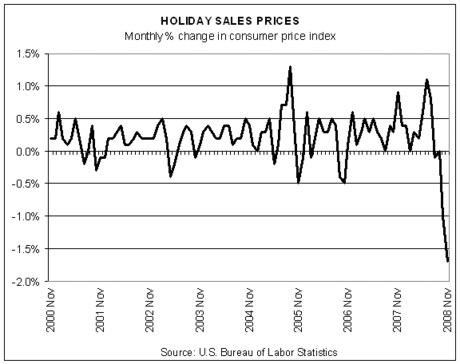
For the second month running, consumer prices fell. And by more than a little, invoking the specter of deflation once again.
CPI slumped by a hefty 1.7% in November on a seasonally adjusted basis, the government reports today. That follows October’s 1.0% fall. More dramatically, last month’s tumble is the deepest monthly decline in CPI since the Labor Department began keeping records on this series in 1947. Meanwhile, MarketWatch.com reports that the 1.9% non-seasonally adjusted fall in CPI is the steepest monthly rate since January 1932—the height of the Great Depression.

Meanwhile, core CPI (which strips out food and energy) is unchanged, following a slight decline in October. As this is the Fed’s preferred measure of inflation, even a central banker can’t deny that inflationary pressures have evaporated, at least for the time being.

Continue reading

PAINFUL RECKONINGS

It’s no secret that risk premia have taken wing in recent months, as our chart below illustrates. Nor is it any mystery as to the cause. Prices have slumped like a rock in a lake, and that’s boosted trailing yields and interest rates to the sky. What’s less obvious is if it’s time to avail oneself of the relatively rich offerings.

Alas, the answer to this perennial question is always debatable. Even in the best of times, the wisdom of investment decisions is always in doubt, albeit in varying degrees depending on the context du jour. But this is a major hazard only if you’re betting the farm on a given day or limiting your investment world to a narrowly defined subset of assets. Avoiding those dangers are essential for sound investing and sound sleeping, although it doesn’t allow us to completely sidestep uncomfortable choices or mistakes. Nonetheless, it’s a solid basis for putting our investing strategies on a firm foundation for improving the odds of long-term success.

Continue reading

THE “D” RISK KEEPS RISING

Deflation with a capital “D” may still be a remote possibility, but it’s getting tougher to dismiss the idea that deflation light is here.
Exhibit A is this morning’s update on producer prices, which fell 2.2% last month. That’s the fourth month running that wholesale prices turned south. We can debate exactly when, or if a deflationary climate has begun, but once it’s clear to everyone that the big “D” has arrived it’s probably too late to do much about it. Simply put, if there’s any hope of slaying the deflation dragon, the opportunity is a pre-emptive one. But that leads us back to the question: Is deflation really here? Or is the ongoing price retreat only temporary?

One can argue that collapsing energy prices are the primary cause of the downdraft in wholesale prices. True enough. But energy prices won’t keep falling forever. Indeed, crude oil has fallen sharply since the summer, when it set an all-time record of $147 a barrel in New York. In December, crude’s been trading under $50. Yes, crude and other energy prices may go even lower, and that would keep downward pressure on general price indices. But aren’t we close to the bottom of this downward spiral?

Continue reading

DEMAND FOR JOBLESS BENEFITS KEEPS RISING

Another update on the labor market and another reason to worry.
The offending statistics today come in this morning’s news on initial jobless claims, which rose sharply last week to 573,000. At this point, no should be shocked to learn that the lines at the unemployment offices around the country are growing longer by the week. Nonetheless, the rapid increase in striking, as our chart below shows.

Even by the negatively skewed standards of late, last week’s 58,000 rise in new filings for unemployment was unusually large —the highest weekly advance, in fact, in more than three years.

Continue reading

IS AVERAGE PERFORMANCE FATE?

The Wall Street Journal today reports that Bill Miller has “destroyed” his former reputation “as the era’s greatest mutual-fund manager.” Miller’s downfall is hardly surprising, given the severe bear market this year. Indeed, Miller (who runs Legg Mason Value Trust) has lots of company. Humbled active managers are everywhere these days.
Miller was long thought to belong to a different breed—a super investor, if you will. This, after all, was the man who beat the S&P 500 every calendar year from 1991 to 2005. As the Journal noted, that’s “a streak no other fund manager has come close to matching.”
But now the streak is over and Miller has rejoined the overcrowded ranks of mediocrity. Again citing the Journal story: Miller’s Value Trust has crumbled by 58% over the past year—20 percentage points deeper than the S&P 500’s loss.

Continue reading

PICTURES FROM THE IMPLOSION

We all know the story, but if you’re inclined to review the gory details and, perhaps, enhance your historical perspective along the way, the Bank for International Settlements has just the report you’re looking for.
Yesterday’s release of the December 2008 installment of the BIS Quarterly Review is a sobering publication, to be sure, given the events of late. Indeed, children and squeamish individuals may want to avert their eyes.
Having pored over a number of similarly recondite treatises in recent months, your editor is up to his eyeballs in official reviews and reflections. Newspapers are great for immediacy, but a broader, deeper perspective is essential. If you only read (or selectively scan) one of these documents, and you have a preference for academic accounts of financial chaos, put this one on your short list.

Continue reading