The pummeling that has infected every corner of the global equity market this year may or may not be near its end, but thoughts of brighter days are inspiring pundits and traders alike. It may be fleeting, of course, like so many rallies before it this year that soon faded. But for the moment, hope springs anew.
The reported stimulus behind the pop in foreign markets today is, well, the prospect of more stimulus. President-elect Obama worked the talk shows over the weekend, promising to spare no effort in propping up, bailing out and rebuilding once he takes up residence in the White House. Like-minded statements from governments around the world recently are helping nurture the idea that more stimulus efforts are coming.
It’s anyone’s guess if this is the catalyst to unleash a sustained rally. Certainly the global combination of enticing equity valuations, battered prices, cheap money and pledges of state spending are turning heads. Timing is always in doubt, but with so much red ink in stock markets everywhere, Mr. Market is now discounting a fair amount of pain, as our table below suggests.
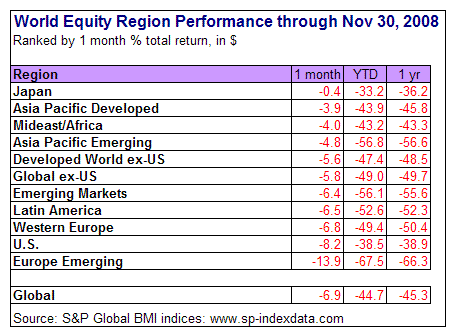
The great unknown is the global economy in 2009. More to the point, are equities now sufficiently discounted for what awaits next year? Perhaps, although the answer will only arrive in daily doses. The future, in short, is still as unclear as ever, and perhaps a bit more than usual. Indeed, the recession in the U.S. is still in its early stages.
Monthly Archives: December 2008
MORE JOB DESTRUCTION
Our long-running worry that the economy’s suffering would get worse before it gets better finds ample support in this morning’s employment report for November. Nonfarm payrolls plunged by 533,000 last month, the U.S. Labor Department reports. That’s the steepest monthly decline since 1974 and the sixth-worse number on record going back to 1939.

The labor market, to be frank, is bleeding, and it’s not obvious that blood will stop flowing soon. The negative momentum has a head of steam—no question about it. Whatever monetary quivers the Federal Reserve has left to play should be deployed post haste. That includes dropping the Target Fed Funds Rate to 50 basis points, perhaps even to 25 basis points while ratcheting up efforts on so-called quantitative easing, which is to say the full array of unconventional monetary policies. With interest rates so close to zero, all that’s left with monetary policy are the irregular methods of injecting money into the economy. It’s not clear that such efforts will provide much additional stimulus, but at this point there’s little reason not to try.
The main front in the war to battle deflation and recession now shifts in earnest to Congress and fiscal stimulus. Alas, there’s a bit of a political issue tied to this idea at the moment. The economy can’t wait for President-elect Obama to assume the presidency late next month. Allowing the economy to fend for itself over the next 7 weeks risks letting an already troubling situation fester into an even deeper problem. The Bush administration needs to reach out to the Obama camp and the two sides need to work as one with the lame-duck Congress.
HISTORY ISN’T BUNK, BUT IT CAN BE TRICKY
It may be premature to start planning for a sustained stock market rally, but it’s never too early to look for perspective on what’s in store for the future.
We’ve been collecting odds and ends that lend a bit of insight into matters cyclical, including the burning question: When will the bear market end? In terms of declines, the current tumble (as of Nov. 20) is the deepest in the post-World War II era, based on the S&P 500,
Before the latest rally, in late November, the year-to-date loss in 2008 for the S&P at one point exceeded even the 43.3% total return selloff of 1931, according to Morningstar’s Ibbotson division. It’s anyone’s guess if we’ll ultimately end up in record negative territory once this year’s final trade prints. Yes, there are only 14 trading sessions left to 2008 after today, and as of last night the S&P 500 was off by less than 40% on a total return basis. Painful, to be sure, but a bit better than the year-to-date loss of 47.7% as of November 20’s close.
SOMETIMES A BLIP IS JUST A BLIP
One blip a trend does not make.
Yes, we’re all eager for any sign of hope on the economic front, and so the slight upturn in our broad measure of the October data looks encouraging. But it’s probably just noise—a refreshing bit of noise from the larger bearish trend, but noise just the same.
We’re talking here of our propriety CS Economic Index, which is an equal-weighted measure of 17 leading, coincident and lagging indicators that track the broad trend in the U.S. economy. Leading indicators make up nearly half of this benchmark’s weight. As our chart below shows, October posted a small rise in the index—the first after four straight monthly declines. (The complete range of monthly economic data for any given month arrives at a lag, and so October’s numbers were only recently complete as of last Friday.)

Alas, it’s not the start of a rebound. A big part of the blip in October can be traced to lower interest rates, which register positively in our index. Normally, lower interest rates dispense a bullish tonic for economic activity now and in the future. Unfortunately, the times are anything but normal. Lower interest rates, although they look encouraging on paper, have lost a fair degree of their stimulative power in the real world at present.
DEBATING THE VALUE OF ZERO
Just a few short months ago, it was unthinkable. A year ago, it was beyond the pale. But the extraordinary arrived yesterday when the 10-year Treasury yield fell to lows previously unseen.
The 10-year closed on Tuesday at 2.69%, a record low. The embedded message is clear: the market expects deflation, or something close to it. In the rush to find a safe haven, investors are bidding up the prices of government bonds to extreme levels. In turn, yields are falling to depths few thought possible.

The primary source of this outlook is, of course, the weak economy. “The big picture background for these very, very low Treasury rates is the weakest economy we’ve seen in at least a generation,” Jay Mueller, senior portfolio manager at Wells Capital Management, tells BusinessWeek. “We’re looking at a severe recession and the Treasury markets are reflecting that kind of an outlook.”
The favored policy response for deflation is cheap money, and the Federal Reserve is moving heaven and earth to engineer just that. Indeed, the effective Fed fund rate is roughly 0.5%. But that invites the challenges that come with the so-called zero bound.
MIXED MESSAGES
The recession officially began this past January, NBER tells us. With that out of the way, we can now focus on the burning question: When will it end?
There are many clues for pondering the timing of the business cycle. Calling the turning point in advance is never easy, and in fact it’s quite a bit harder these days. The magnitude of the economic and financial ills is to blame. In a perfect storm, when nothing seems to work and the crowd is ever more skeptical, simply locating your hand in front of your face is tough. An additional complication is the Fed’s pre-emptive monetary policy of late. Traditionally, the Fed hikes rates to slow the economy. This time the central bank was cutting rates in anticipation of a recession. For good or ill, Bernanke and the boys are nearly out of rates cuts. That’s a problem if the recession turns out to be longer than usual.
Meanwhile, the usual data suspects for profiling the business cycle are throwing out more than their fair share of confusing signals these days. As Bob Diele of NoSpinForecast.com recently advised clients, different economic and financial measures are making different forecasts about timing of the economic contraction. Has it only just begun? Or is it near its end? Or somewhere in between. Depending on the data points one chooses to highlight, all three scenarios look plausible.
Consider the chart below, courtesy of NoSpinForecast.com, which was published a few weeks back. If we ignore the NBER’s announcement, a simple review of GDP numbers suggests economic activity peaked earlier this year, perhaps after 2008’s Q2, which posted a 2.8% annualized real rise in GDP. The casual observer might think that Q3’s -0.5% fall in GDP is a good candidate for dating the start of the recession, all the more so since most economists think Q4 will suffer an even bigger decline and 2009’s looking quite weak as well.

Source: NoSpinForecast.com
Nonfarm payrolls are making a similar forecast. Year-over-year comparisons of this series have a habit of diving sharply ahead of the trough. The labor market has certainly been weak this year, suggesting that the peak may have just passed. Diele notes that year-over-year comparisons of nonfarm payrolls tend to coincide with periods when the economy’s at its worst.
The stock market is sending signals that we’re even deeper into the cycle and therefore closer to the cyclical trough than GDP or payrolls suggest. As Diele explains, the stock market has a history of tumbling in advance of the trough. Given the huge losses in equities this year, including recent hefty negative signs for rolling 12-month changes, one could reason that Wall Street is telling us that it smells a bottoming out in economic activity.
Then there’s the spread between long and short rates, which is advising that the economic trough is well behind us and that the recovery phase has begun. Again quoting Diele, the yield curve tends to invert ahead of the trough. With that in mind, what are we to make of the fact that the curve has inverted on and off for several years? The naïve explanation suggests the economy is set to rebound soon. (Don’t hold your breath.)
The above metrics are usually in sync when it comes to identifying where we are in the business cycle, Dieli says. This time, however, there’s quite a bit more variety in the messages. Perhaps that’s par for the course in a year when any number of rules of thumb and otherwise prudent guides have fallen off the wagon. The challenge is figuring out which metrics harbor the faulty signals. For our money, we’re particularly suspicious of the financial spread, which is another way of predicting that the contraction still has a ways to go.
A BIT LESS RED INK FOR NOVEMBER
The all-out bleeding ceased in November. Yes, it was still a painful month for some asset clases, but November offered a break from the across-the-board losses that humbled September and October. Bonds made all the difference.
With the exception of high yield debt, bonds generally staged a comeback in November, providing some respite from dramatic declines otherwise still in force. U.S. bonds led the bounce, with the Lehman US Aggregate Bond Index rising a robust 3.3% last month, as our table below shows. Foreign government bonds in developed markets were a close second, advancing 3.2%. Even the battered world of emerging market debt rallied, tacking on 1.7% in November. TIPS and of course cash were in the black as well.

Everything else, however, continued to suffer. REITs were especially hard hit–again–in November, crumbling by nearly 25%. That follows the even bigger loss in October, when REITs dropped more than 32%. Since the summer, REITs have been nearly cut in half.
Striking as the REIT losses are, they’re hardly out of character. As the chart above reminds, double digit losses have been the norm in the recent past. Nor is it obvious that the correction is over. The market will continue discounting the possibility of future economic and financial problems until investors are convinced they have a veneer of visibility about what’s coming. For the moment, confidence about anything is in short supply, and so sellers still have the upper hand.
But let’s be grateful for small miracles. The fact that November provided some relief, temporary thought it may be, from the onslaught of complete loss suggests that maybe, perhaps, the all-out carnage may be past. Valuations generally are somewhat attractive and so long-term investors are starting to consider the opportunity for the future rather than obsessing over the losses from the past.
Nonetheless, there’s still likely to be plenty of volatility in the future, along with some knuckle-gripping declines in asset classes. Confidence is shattered and the crowd is still sizing up the depth of the recession that’s only just begun. But for the moment, a small milestone arrived last month when some of the red ink was banished from the scorecard. Some might call that progress.