It’s been a long, strange trip in the nearly two years since October 2007, when the U.S. stock market peaked. The details of the journey have been dissected ad infinitum, on a tick-by-tick basis. But what of the big picture? How does a broad review of performance among the major asset classes stack up since October 2007?
We can start by considering total return indices for the usual suspects by setting benchmarks to 100 for everything as of the close of October 2007. The chart below shows how the major asset classes have performed since then through the end of August 2009. (For the underlying indices that represent the asset classes see our post here.)

Another view on the same history is presented in our second chart below, which ranks the total returns for October 2007 through August 2009.

We spend a lot of time analyzing the major asset classes on the pages of The Beta Investment Report. The primary goal is searching for some perspective in managing multi-asset class portfolios and squeezing out a bit more return without taking on more risk. That begins by considering the rebalancing opportunities related to comparing performance. That’s the easy part. By that standard, foreign government bonds appear to need some trimming while buying REITs looks productive, for instance, relative to results from October 2007 through last month.
Monthly Archives: September 2009
MORE GOOD NEWS IN THE LABOR MARKET…MAYBE
This morning’s update on initial jobless claims offers more encouragement for thinking that the economic contraction has bottomed out. That’s still distinct from proclaiming the arrival of a recovery worthy of the name, as we’ve been discussing for months, including here and here. Nonetheless, the downward trend in initial jobless claims—a valuable leading indicator of the business cycle, as we explained back in March—continues to signal that the recession on a broad macro scale is over or nearly over.
RETHINKING THE CONSUMER ECONOMY: CLUE #23
It’s not quite the proverbial canary in the coal mine, but it looks like one. Heck, when even Joe Sixpack’s formerly obsessive spending habits are on the defensive you know something’s changed. Such is the message that even gambling revenues from casinos and lotteries are facing a downfall for the first time, according to The New York Times.
“The decline [in gambling] comes as states are rapidly expanding gambling in hopes of stemming severe budget shortfalls, and it indicates that gambling is not insulated from broader economic forces like recessions, as has been argued in the past,” the paper reports today.
Among the reported losers: Illinois’ gambling revenue is off $166 million in fiscal year 2009 vs. the year earlier; Nevada suffered a $122 million retreat; and New Jersey claimed its slide was $62 million.
Is nothing’s sacred in the Great Recession’s reordering of spending priorities? Apparently not, with the possible exceptions of Washington’s immutable habits with money and certain personal services performed in red light districts. Otherwise, Joe Sixpack’s playing a new game these days and it isn’t roulette. If you can’t count on the crowd’s arrival in Vegas and its lookalikes around the country, good luck with trying to sell an extra truckload of wide-screen TVs next week.
MARKETS, MACROECONOMICS & THE FED
The market’s taking a beating lately, and we’re not talking here about investment returns. Rather, the theory that market prices offer valuable information is on the defensive…again.
The latest assault came over the weekend in Paul Krugman’s New York Times Magazine article “How Did Economists Get It So Wrong?” Among the various indictments in the story is the charge that the efficient market hypothesis (EMH) is a principal cause of the economic ills that afflict the U.S.
Attacking EMH has become a popular sport recently, which is to say more popular than usual. Some of these attacks are exaggerated, others are misleading and some are just plain wrong, especially when it comes to interpreting (and often dismissing) EMH as it relates to investing. We’ve written about such issues regularly over the years and tackle the subject in more detail in our upcoming Dynamic Asset Allocation: Modern Portfolio Theory Updated For The Smart Investor, which will be published in February by Bloomberg Press. Meantime, let’s focus on one point in Krugman’s story regarding the management of the economy.
BETTER BUT STILL FAR FROM HEALTHY
It’s getting better, or at least the pain is lessening. But no one will mistake the labor market as healthy at the moment. Nor is it obvious that salvation’s coming any time soon.
Nonfarm payrolls dropped again last month. The good news is that the loss of 216,000 jobs in August was the smallest decline this year and noticeably under July’s revised 276,000 retreat, the government advises today. On that basis, August represents a step in the right direction. Certainly the trend has improved considerably since the average 648,000 monthly drop that prevailed in this year’s first four months.

Nonetheless, our economic outlook that we’ve been discussing for months remains intact. On the one hand, the technical end of the recession is imminent if it isn’t already here. By that we mean several things, starting with the growing probability that third-quarter GDP will show a small gain when the government issues its first estimate on October 29. But the return of broad economic growth—meager or otherwise—will be accompanied this time by a weak labor market.
THE RETURNS OF AUGUST
August was another hot month for REITs. It wasn’t even a contest relative to the other major asset classes.
The Wilshire REIT index soared in August with a 14.6% total return, building on a 10%-plus gain in July. For the year through the end of last month, REIT performance isn’t quite so spectacular, advancing a handsome but far-from-first-place 10%.
Of course, it wasn’t that long ago that some were saying that REITs were headed for the trash bin of asset class returns. So it goes in predicting: in the grand scheme of the universe, it’s right just as often as it’s wrong. No wonder, then, that in the long run it’s difficult to beat something approximating a true market portfolio, such as our Global Market Portfolio Index. Yes, some manage to win, but many fall behind relative to what finance theory tells is the optimal portfolio for the average investor with an infinite time horizon.
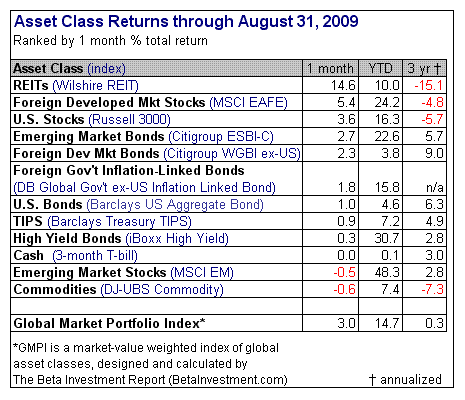
Meanwhile, back to the horse race. At the bottom of last month’s tally of the major asset classes are emerging market stocks and commodities, both of which posted fractional losses in August. For the year so far, however, no one will confuse the returns of emerging market stocks with commodities. Developing market equities surged more than 48% so far in 2009 vs. a far more modest gain of 7.4% for commodities this year through the end of last month.
In fact, a relatively wide range of returns among the major asset classes looks set to be a trend with legs. That will represent a step closer to the historical norm, as we discuss in some detail in the soon-to-be-published September issue of The Beta Investment Report. In other words, the high correlations of the recent past among the world’s capital and commodity markets are giving way once more to a broader range of return independence.
That’s good news, since it suggests that there’s more opportunity in holding and managing a multi-asset class portfolio. It also means more risk, including the risk that portfolio returns will vary by quite a bit more, for good or ill, in the months and years to come.
The money game is changing, as it always does. A different set of opportunity and risk awaits. The days of everything running higher are probably history. Whether the crowd’s ready or not is debatable.
In any case, Vive la différence!