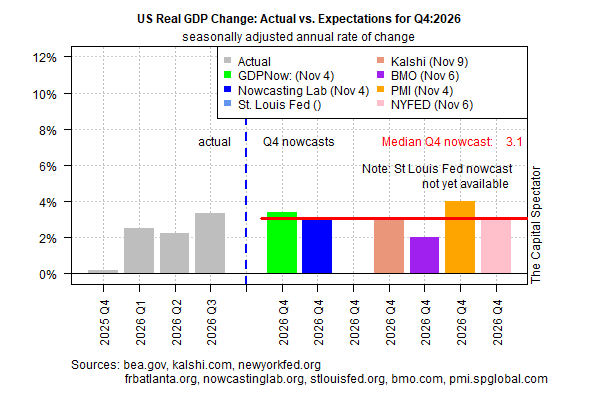
The acceleration in U.S. economic growth in the third quarter appears set to continue into Q4, according to the latest GDP nowcasts. The Democratic midterm election sweep has rattled Wall Street amid concerns that economic policy could shift in the new year. For now, however, growth remains on track to run at a substantially faster pace than it did during the first half of the year.
U.S. growth is projected to increase at an annualized 3.1% rate in Q4, based on the median estimate of a set of nowcasts compiled by The Capital Spectator. That would mark a modest slowdown from the 3.4% gain reported for Q3. Even so, if the current estimate holds, the economy will post back-to-back quarters of robust growth, a sharp improvement from the relatively softer pace recorded in the previous three quarters.
Some analysts caution that Democrats’ election victory could reshape Washington’s policy priorities, creating uncertainty for businesses, particularly in areas such as artificial intelligence regulation. At the same time, many of the Trump administration’s most consequential economic policies have been implemented through executive action, making it unclear how much the broader policy landscape will ultimately change.
Meanwhile, the economy continues to face several significant challenges, including persistent affordability pressures, elevated government spending, labor market uncertainty, and questions about the sustainability of AI-driven growth. As a result, while political developments may alter the economic outlook at the margins, the expansion remains vulnerable if existing risks intensify.
For now, however, the economy retains a growth bias. Recent labor market data support that view. Friday’s October jobs report surprised to the upside, with payrolls increasing by 165,000, the unemployment rate edging down to 4.1%, and prior months revised higher. Collectively, the data suggest that the labor market remains on solid footing, easing concerns that the economy is headed for a sharp slowdown.
The payrolls report is also consistent with other signs of labor market resilience. Initial jobless claims fell to 189,000 in the latest week, remaining below the 200,000 threshold and near multi-decade lows. The persistently low level of new unemployment filings suggests layoffs remain scarce and employers continue to retain workers, providing further evidence that the labor market remains a key source of support for economic growth.
The year ahead could bring its share of economic turbulence, driven by geopolitical risks, inflation uncertainty, and a shifting political landscape in Washington. But the current GDP nowcasts suggest the economy is carrying considerable momentum into year-end, providing a supportive backdrop as 2026 draws to a close.
Is Recession Risk Rising? Monitor the outlook with a subscription to:
The US Business Cycle Risk Report