Federal Reserve Governor Chris Waller didn’t mince words.
“I’m very, very concerned about inflation,” he told CNBC on Wednesday. “It’s kind of headed in the wrong direction, and it’s spreading out. If you really want to get it down, you’ve got to start taking more aggressive actions. You might need to, like, shock people.”
As a first installment on shocking sentiment he said a half-point rate hike at next month’s FOMC meeting is warranted.
Other Fed officials have made similarly hawkish comments this week. St. Louis Fed president Alberto Musalem said that inflation is too high, is becoming broad based and so more policy tightening is needed, advising that “the economy will likely require several interest rate increases before the spring of 2027 to achieve price stability in a timely manner.”
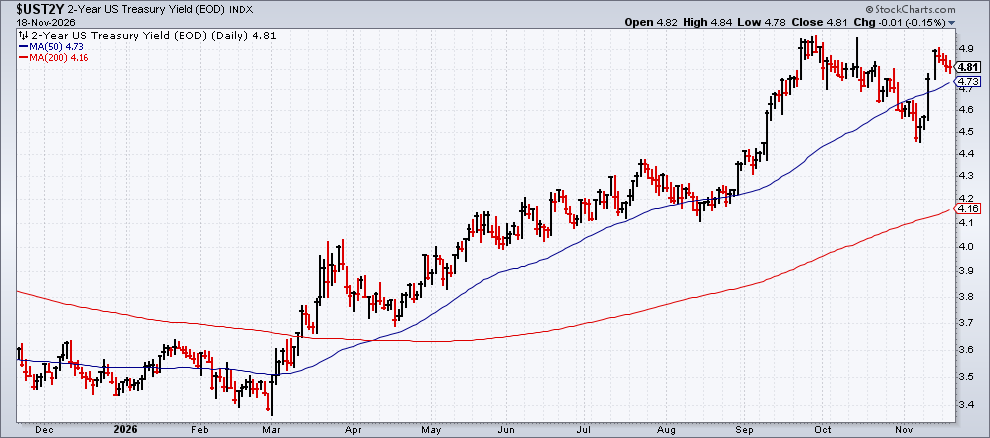
The Treasury market has been pricing in higher odds for a series of rate hikes for months. The policy-sensitive 2-year yield (widely viewed as a proxy for near-term Fed rate expectations) has eased in recent days, but the upward trend is still strong, closing at 4.81% on Wednesday. That’s well above the Fed’s current 3.75%-4.0% target rate, a spread that indicates strong market confidence that hikes are likely.
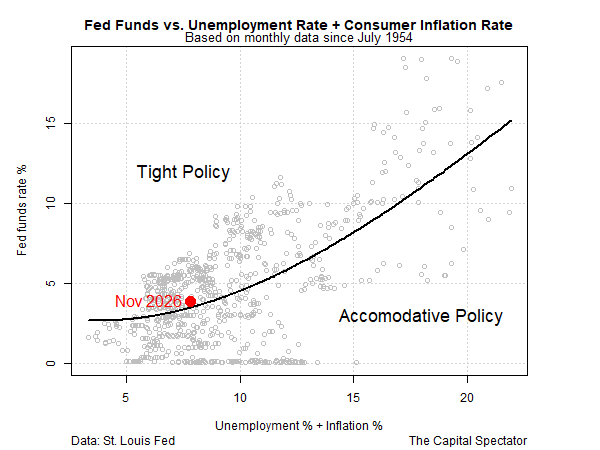
A simple model using unemployment and the one-year change for consumer prices suggests that current Fed policy is roughly neutral. But with inflation continuing to run above the 2% target, and recent updates suggesting pricing pressure is spreading, the central bank is under growing pressure to continue tightening. Neutral, in other words, is no longer sufficient and the ¼-point hike in September – the first in three years — is increasingly viewed as the start of an extended round of tightening.
Fed funds futures are pricing in a 90% probability of a ¼-point hike at the upcoming Dec. 9 FOMC meeting. A 70% probability is the current estimate for a follow-up hike in January.
Robust economic data is a factor that’s also tilting expectations toward additional rate hikes. One input is the low unemployment rate, which slipped to 4.1% in October, which is historically low and down from 4.5% a year ago. The four-week average of jobless claims held at 195,250 through Nov. 7, the lowest in decades. Meanwhile, the monthly change in nonfarm payrolls rebounded in October, rising 165,000, close to the strongest gain this year. Notably, the one-year change is payrolls has been strengthening for months, rising 0.6% from the year-ago level, marking the fastest increase since April 2025.
Headline economic activity is also reflecting an ongoing pickup lately. The Atlanta Fed’s Q4 GDP nowcast is 3.2%, close to the 3.4% advance reported for Q3. The acceleration in growth from the first half’s slower pace, in other words, is expected to continue.
Additional rate hikes won’t be cost-free. The housing market, in particular, remains under pressure from elevated mortgage rates and weak sales activity. The National Association of Realtors (NAR) reports that existing-home sales in October fell 5.5% to an annualized pace of 3.75 million, the slowest since August 2010. NAR’s chief economist attributed the weakness largely to high mortgage rates. Pending home sales, a leading indicator of future transactions, fell to a record low in October, with NAR citing elevated mortgage rates and affordability constraints. Pushing rates higher, which will lift financing costs, will put more pressure on an already struggling housing sector.
Yet the inflation calculus is likely to dominate Fed decision-making in the near term. Unless price pressures show more convincing signs of easing, policymakers may conclude that the risk of doing too little still outweighs the risk of doing too much. With overall economic growth remaining resilient and the labor market holding up, the economy appears capable of absorbing additional tightening, increasing the odds that interest rates move higher and remain elevated for longer than investors currently expect.
Is Recession Risk Rising? Monitor the outlook with a subscription to:
The US Business Cycle Risk Report