The Iran conflict has triggered “the biggest energy security threat in history,” according to Fatih Birol, head of the International Energy Agency (IEA), speaking on CNBC yesterday. Yet the impact will not be felt uniformly, a disparity that likely plays a role in the varied responses in global stock markets to date.
Using a set of ETFs (and one closed-end fund for Central and Eastern Europe) to track investor sentiment on a regional basis highlights a wide mix of performances since the war started on Feb. 28 through yesterday’s close (Apr. 22). Initially, stocks fell just about everywhere, but in late-March a rebound kicked in, although the recovery has been conspicuously uneven, driven in part by differences in energy vulnerability related to the sharp drop in oil exports from the Gulf region.
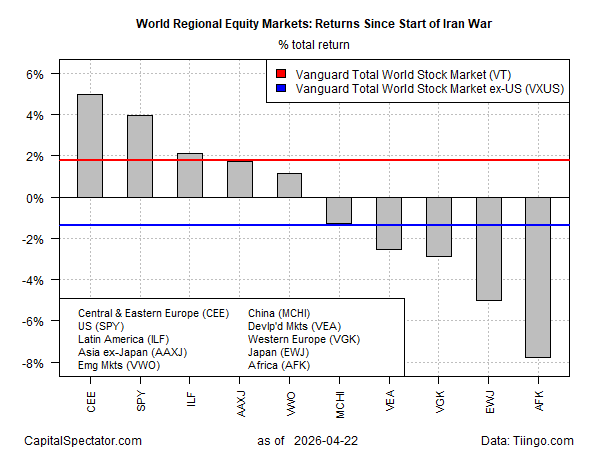
Leading the winners: stocks in Central and Eastern Europe (CEE) are up 5%. That contrasts with a 7.8% loss for equities in Africa (AFK).
US shares (SPY) are in the winner’s circle via a 4% gain since hostilities started.
Notably, a globally diversified portfolio of stocks (VT) has recovered, and is currently up 1.8%. A key driver of that gain comes from US shares: a global equities fund ex-US (VXUS) is still down 1.4% since Feb. 28.
The question is how markets will price in the energy risk that Fatih Birol outlined. The pain will vary dramatically, depending on the level of reliance on energy imports. Asia is especially vulnerable.
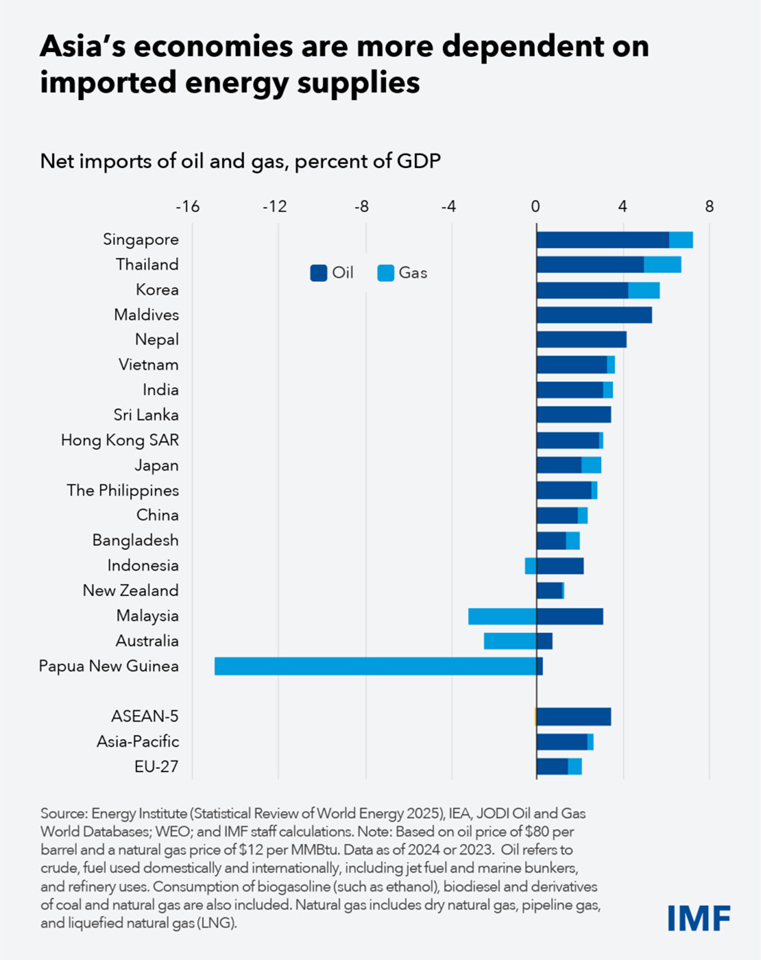
“The war in the Middle East and the ensuing energy supply shock are raising inflation, weakening external balances, and narrowing policy options, underscoring the region’s dependence on imported oil and gas,” the IMF advised. “Even so, we project Asia to remain the main driver of global growth. The 5 percent expansion last year will moderate to 4.4% and 4.2% this year and next, according to the reference forecast in the latest World Economic Outlook that assumes the energy shock proves transient. We expect China and India to contribute 70% of the region’s growth.
Nonetheless, “The headwinds will test Asia’s resilience,” the IMF continued.
The same will be true for the rest of the world, although as varying results in stock markets suggest, the effects will be distributed asymmetrically.
Learn To Use R For Portfolio Analysis
Quantitative Investment Portfolio Analytics In R:
An Introduction To R For Modeling Portfolio Risk and Return
By James Picerno
