“We think that the U.S. economic slowdown underway will put downward pressure on inflation for the next four to six quarters. Inflation is a lagging indicator of economic growth, and it will likely reach the point this year where it ceases to be a major concern for Federal Reserve policy makers, who will then shift their focus to easing monetary policy to address a soft economy.”
So wrote John Brynjolfsson, managing director and portfolio manager at the giant bond shop PIMCO in his February commentary. The bond market this month seems to agree with Brynjolfsson’s bullish scenario for fixed income. The return of buying the 10-year Treasury Note pushed the yield to under 4.80% by last week’s close, down from around 4.90% in late January. The buying may or may not have legs, but for the moment, a cautious optimism has the floor.
Nonetheless, this is no time to take a nap or mindlessly commit gads of long-term money to bonds. Consider that while Brynjolfsson sees 2007 as a generally positive year for bonds, the longer-term outlook isn’t quite so rosy. “Beyond the five-year horizon,” he wrote, “we are very concerned about inflation, largely based on the growing mountain of obligations, liabilities and unfunded promises being heaped upon the government and corporations by demographic shifts.”
Monthly Archives: February 2007
WHAT’S THE DEAL WITH EXCHANGE TRADED NOTES?
Last year, Barclays launched its iPath brand of exchange traded notes. On the surface, they resemble exchange-traded funds. But ETNs and ETFs are in fact quite different, even though the both look like exchange-listed index funds, as your editor observed in the February issue of Wealth Manager. At the moment, there are four ETNs:
iPath GSCI Total Return Index (GSP)
iPath Dow Jones-AIG Commodity Index Total Return (DJP)
iPath Goldman Sachs Crude Oil Total Return Index (OIL)
iPath MSCI India Index (INP)
More are coming. In fact, there’s talk that ETNs may eventually track indices and asset classes that aren’t viable for the ETF structure. Maybe. Meanwhile, the burning questions include: Are ETNs superior to ETFs? Are they riskier? Are they a worthwhile alternative to ETFs? In short, What’s the deal with ETNs? In search of some answers, here’s my report from the latest issue of WM….
MAYBE I’M AMAZED
Never underestimate the power of momentum.
That’s a timely observation as we gaze at the year-to-date returns for the major asset classes through last night’s close. Save for commodities, which have been struggling for months, red ink remains in exile on the performance ledger for the broad asset classes.
As our table below reveals, it’s been hard to lose money so far this year. In some corners, it’s been really, really hard.

Perhaps the most extraordinary number on the board above is the 10.9% return, which is claimed by REITs. Yes, dear readers, that’s 10.9% for year so far–and we’re only halfway through February!
As impressive as REITs are so far in 2007, it’s even more so when you consider that 1999 was the calendar year last when the asset class suffered a bout of red ink. Suffice to say, after rallying for so long and so hard, the year-to-date gain for REITs looks excessive at the moment. No, we’re not predicting a bear market in REITs (that may not happen until every last man, woman and child on the planet has committed money to the asset class). That will come…one day. Meanwhile, perhaps a bit of water-treading in store for REITs. But, hey, what do we know?
Returns so far this year are otherwise relatively modest, but again, it’s only February. That said, what’s striking is the fact that everything beyond commodities is running higher–again. Starting in 2003, the asset classes listed above have posted gains for each and every calendar year. (Commodities arguably lost money last year, although that depends on the index. The oil-heavy Goldman Sachs Commodity Index slipped in 2006, but the Dow Jones-AIG Commodity Index posted a small rise).
The generally ongoing bull-markets-as-far-as-the-eye-can-see trend compels one investment strategist to gaze in wonder when it comes to equities. “The global stock market meltup up is turning into a global stock market blastoff,” wrote Ed Yardeni, chief investment strategist at Yardeni Research, in an email to clients this morning. “It shows perhaps one of the Great Wonders of the modern world,” he continued. “I don’t ever recall seeing so many stock markets going straight up. I take that back: The same thing happened at the beginning of last year.”
A BIAS FOR GROWTH…SORT OF
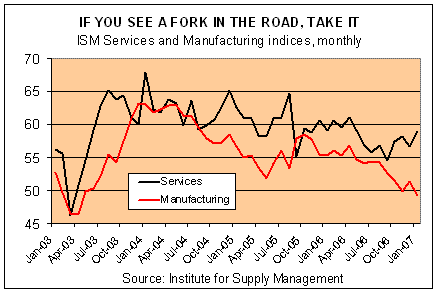
The Institute for Supply Management publishes indices that are widely followed on Wall Street. Two in particular receive quite a bit of attention. Both were updated in recent days, and both offer conflicting signs for the economy.
The ISM Manufacturing Index for January was released last week and its message is anything but upbeat. As our chart below illustrates, this measure of manufacturing has fallen to its lowest in nearly four years. What’s more, the downward bias has been intact for a year or so, suggesting that the weakness is more than a temporary blip. Readings below 50 indicate that manufacturing activity generally is contracting, and so January’s reading of 49.3 is nothing if not clear.
IS MEDIAN CORE CPI A BETTER MEASURE OF INFLATION? (Corrected version)
Note: An earlier version of this story incorrectly identified the median CPI as a top-line index when in fact it’s an alternative measure of core inflation. Below, we offer a corrected version of the story and data.
The report on consumer prices for January isn’t due for release until February 21, but it’s never too early to start thinking about inflation.
Judging by the last update on inflation through December, there’s still reason to wonder what’s coming. Core consumer prices (which exclude the volatile food and energy prices) advanced by 2.6% last year. That’s up from 2.2% in 2005. Will the upside momentum persist?
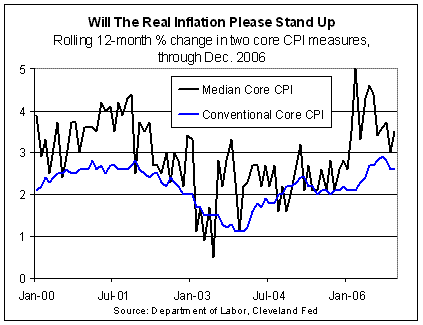
No one knows, but if you’re looking for one more reason to be wary, consider an alternative (and arguably superior) measure of core inflation. The Federal Reserve Bank of Cleveland calculates the median core consumer price index, which is said to minimize temporary “distortions” in measuring price trends that bedevil the conventional core CPI index. The median approach, as an alternative to the core CPI measure, provides a “better” forecast of inflation, the Cleveland Fed opines. “The weighted median CPI is easy to calculate and has a higher correlation with past money growth than other inflation measures, resulting in improved forecasts of future inflation,” the bank explains on its web site.
With that in mind, we took the current numbers on the median core CPI and compared them to the conventional CPI. The result: inflation is significantly higher by way of the median benchmark compared to the standard measure issued by the Department of Labor. To be precise, the Cleveland Fed’s median core CPI advanced 3.5% last year, vs. 2.6% for the conventional core CPI. (There’s a discrepency in some of the Cleveland Fed’s median data, but we’re using the historical series that shows the latest 12-month change in median CPI at 3.5%, although other portions of the web site quote 3.7%.)
In fact, as our chart below illustrates, the median core inflation rate has been relatively higher in recent history compared to the usual measure. In sum, here’s one more reason to delay judgment on whether inflation will be an issue or not in 2007.
WILL THE LABOR MARKET KEEP BUBBLING?
A funny thing happened on the way to the mid-cycle slowdown. The slowdown wasn’t quite as slow as some in the Federal Reserve expected. That at least has been the new new thinking this week, courtesy of the surprisingly strong rise in GDP for the fourth quarter, as we discussed in our previous post.
Into the mix comes this morning’s employment report for December. Nonfarm payroll rose by 111,000 last month, the smallest rise since last May’s 103,000 increase. Is it time to rethink the economic growth story that seemed to bloom anew? No, at least not yet.
January’s rise in nonfarm jobs works out to a 0.08% rise over the previous month. That’s on the low end in recent history, but still within the band of growth posted in 2006. Last May and October witnessed identical rates of nonfarm job increases. Previously, such relative dips in growth inspired warning that job growth was about to stall in absolute terms, to be followed by recession. It didn’t happen then, and it may not happen now.
Indeed, as our chart below reminds, the labor market doesn’t move from growth to contraction overnight. The warning signals will build over months and quarters. Consider that the deterioration in the labor market in 2000-01 was fairly rapid, unfolding over about a year or so. But the type of blatant catalyst at the time–the bursting of the tech bubble–doesn’t offend in the here and now. Corporate profits are high, consumers are spending, the labor market’s growing, and investors are far more cautious. A recession may be coming, but now’s not the time to hold one’s proverbial breath.
