Rebalancing can’t save the world, but perhaps it can bring salvation to portfolios in the long run. History certainly suggests as much.
By opportunistically selling asset classes that have rallied and buying those that have lagged, a disciplined approach to rebalancing a broadly diversified portfolio of beta may best deal in money management. The reason, as Charlie Ellis famously counseled, is that the best way to win over time is by not losing.
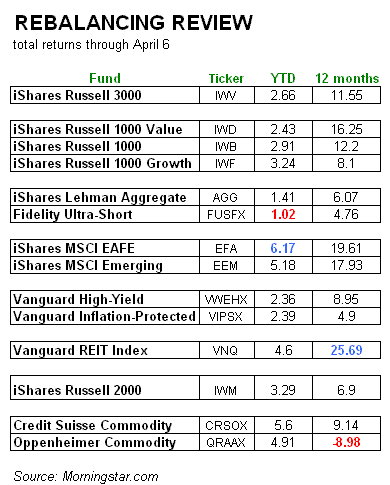
With that in mind, what opportunities currently avail themselves for those inclined toward rebalancing? As our table below suggests, the pickings remain slim based on recent history. Investors looking for obvious candidates to sell based on year-to-date returns through April 6 will note the leader as MSCI EAFE, represented here by the iShares ETF tracking the index. Year to date, the ETF has climbed 6.2%. It’s debatable whether that’s enough of a run to warrant the associated trading costs and taxes that would come from paring the position and reallocating elsewhere.
Monthly Archives: April 2007
GOOD FRIDAY AND OPEN QUESTIONS
If an employment report is released in the forest, does it make an impact?
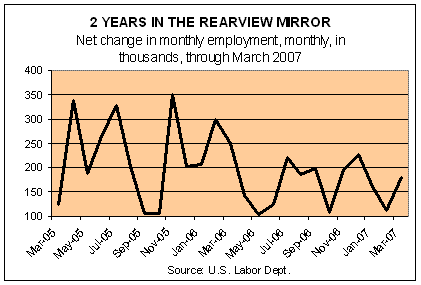
Today’s update on job creation for March arrived when much of Wall Street is on holiday, courtesy of Good Friday. The stock market is closed in the U.S., although government bond trading is open for an abbreviated session. Whether or not anyone’s paying attention, the Labor Department advised that nonfarm payrolls jumped by 180,000. Meanwhile, unemployment dropped to 4.4%, the lowest since last October.
Does the number of new jobs created inspire confidence on the economy? Fear of inflation? Both? Neither? Whatever the answer, it’s certainly an improvement over February’s tally, which rolled in at a gain of only 113,000 new jobs. In fact, March’s rise in payrolls by 180,000 is the highest since December’s 226,000. But even a determined optimist has to admit that last month’s pace of job creation is no better than middling relative to recent history, as our chart below shows.
GRAB A SEAT IN THE WAITING ROOM AND SETTLE IN
If you asked institutional investors what they feared most as a possible threat to the U.S. equity market, how do you think they’d reply? Terrorism? Real estate fallout? Consumer debt? In fact, the leading source of worry among pension funds and other institutional overseers of money is inflation.
That, at least, is the result of Frank Russell Co.’s March survey of 209 institutional investors. Twenty-two percent of the managers ranked inflation as the greatest threat to the equity market, followed by 20% citing geopolitical instability as the primary risk and 15% pointing to a softening real estate market. Meanwhile, nearly two-thirds (64%) of the managers said that domestic stocks generally were fairly valued and 13% thought it’s overvalued.
ANOTHER WARNING FROM MONEY SUPPLY DATA?
Money supply gets no respect, but that doesn’t stop it from setting new, albeit minor milestones in the 21st century.
The latest comes by way of weekly M2 money-supply numbers through March 19, the most recent posted by the Federal Reserve. Based on those stats, M2 grew by 6.1% over the year-earlier amount. As our chart below shows, that beats the previous 52-week rolling peak of 6.0% set back in January 2005.
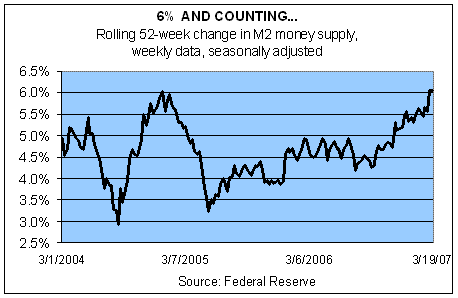
More importantly, M2’s expansion rate continues to climb. The rise this year has been steady, jumping from under 4% at last year’s close to the recent 6%-plus level. The trend may or may not be temporary, but it’s increasingly clear that the Fed has been deliberately elevating M2 in a meaningful way.
Context, of course, counts for something. With that in mind one might ask, How fast is the current 6.1%? For perspective, consider that the economy’s growing at a nominal rate (i.e., at the current dollar rate) of 4.1%, based on the annualized change in current-dollar GDP in last year’s fourth quarter, according to the Bureau of Labor Statistics.
There are any number of explanations (some encouraging, some less so) for why money supply’s rate of increase continues to move higher. Anxious types, such as your editor, worry that the reason is related to the central bank’s inclination to provide aid and comfort to a slowing economy. But the aid and comfort appears to be coming in the form of increasing M2 at rate above and beyond the pace of economic expansion. You can only indulge in that strategy for so long before you run the risk of stoking inflation’s fires.
Perhaps the M2 pace of change will turn down. Perhaps the economy’s expansion will pick up a head of steam. Perhaps Bernanke and company will dispense monetary medicine in exactly the right dosage that satisfies growth while keeping inflation at bay. But for now, we reserve the right to stay mildly skeptical.
THE NUMBERS SPEAK, BUT WHAT ARE THEY SAYING?
Attempts at summarizing an $11 trillion economy are almost certainly doomed to disappoint, but the prospect of failure never stopped your editor from reviewing the numbers to see what’s cookin’.
With that qualification out of the way, we turn to the economic numbers in the hope (however remote) of finding some crumbs of insight into where we’re headed. A smattering of quantitative morsels can be found in the table below. Drawing on numbers posted as of February 2007, there’s reason to think that the economy may have some growth left in it after all. In particular, note the robust gain in personal consumption expenditures for both February and for the past year. The death of Joe Sixpack’s inclination and ability to keep spending more has been predicted in some quarters, but to date there’s no sign of it.

There is, however, reason to worry that the housing correction will take a toll on the wider economy, as the red ink for new home sales and housing starts suggests. But all’s not lost yet in this corner. The rebound in starts in February (up by 9%) extends some hope that upside surprises are still possible.
In fact, as our thoroughly unscientific analysis implies, the recent past carries reason for optimism on the economic trend overall. Based on our limited sampling of numbers, February’s change in the economic reports was modestly higher by an average of 0.2%, as our table above shows. Of course, that compares to an average 12-month dip in the same numbers by 0.5%.
The question then is a familiar one: Are we in the midst of a dead-cat bounce or the start of a second economic wind? Alas, the answer is also one that you’ve heard before, although that won’t make it any more satisfying: It all depends on future economic reports.
TIPS & TAXES
Among the various financial worries that afflict yours truly these days are the double-edged threat of inflation and taxes. One attacks from the left, the other from the right. Ideally, there are some crumbs left over after these two demons have had their way with an otherwise profitable investment. But there are no guarantees, especially for taxable accounts holding asset classes that aren’t likely to deliver stellar gains in any given year, even under the best of circumstances.