Last week’s economic news gave a fresh boost to the notion that long-term interest rates should be higher.
The 10-year Treasury yield surged upward on Thursday and Friday to close at just under 5.2%–the highest closed since June 14. The immediate catalyst was a week that, on balance, suggested a moderate bias for economic growth. A brief recap of the data that re-inspired the view that the economy’s still humming runs as follows:
* ISM Manufacturing and Non-Manufacturing indices each climbed in June to their highest levels since April 2006 (see chart below).
* Non-farm payrolls rose by 132,000 in June. That’s below the trailing 12-month average rise of 167,000 but it was high enough to convince the bond market that economic expansion remains intact.
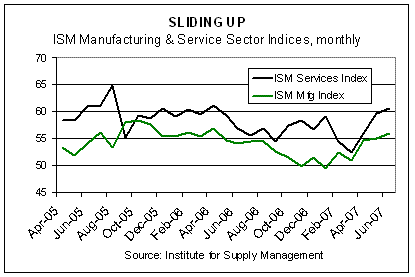
Pessimists can counter that last week’s numbers also gave us weakness in factory orders, which posted a 0.5% contraction for May. Meanwhile, initial jobless claims for the week through June 30 edged up to 318,000 from 316,000 previously. But tempering the negative aura in those gauges is the reasoning that factory orders reflect May activity vs. the more-recent measures portrayed in the ISM indices and non-farm payrolls. In addition, the downturn in factory orders was smaller than the consensus predicted. As for jobless claims, the 318,000 number was within the range of recent activity, making it easy to dismiss as a non-event for the moment, particularly in light of the payrolls and ISM data.
The bond market’s initial reaction to the news was to give the growth outlook the benefit of the doubt and elevate interest rates. But like so much of economic analysis of late, seeds of doubt can be found with a little digging. “The [June payroll] survey suggests that the job market is holding up well despite the housing downturn and the slowing” in the broad economy, Moody’s Economy.com chief economist Mark Zandi told USA Today via DelawareOnline. “Hiring remains sturdy and compensation growth firm.”
Monthly Archives: July 2007
THE FIRST JUNK BOND INDEX FUND
High yield bonds are now well established as a strategic component for multi-asset class portfolios, but it wasn’t until earlier this year that junk was packaged in an index fund. The Barclays iBoxx $ High Yield Corporate Bond ETF (Amex: HYG) is the first attempt to offer beta in something close to its pure form from the lesser-rated realm of fixed-income in publicly traded fund. But indexing is tricky when it comes to high yield bonds, as your editor detailed in the July/August issue of Wealth Manager. For a closer look at the fund, what makes it tick and the complications that accompany the task of passively investing in junk via an ETF, read on….
A 5-YEAR LOOKBACK
Looking in the rearview mirror won’t tell you where we’re going, but it will provide absolute clarity on what’s come and gone. The conceit in giving historical analysis more than passing reference is that maybe, perhaps we can glean clues about the future despite all the compelling evidence to the contrary.
Yes, the jury’s forever out on the value of looking back, but it lends a veneer of credibility to an art form that’s always in need of a plausibility boost. With that caveat, we’re about to engage in activity that, by our own definition, is questionable.
If anyone’s still reading, we refer you to the chart below, which shows that oil and gold have been in the lead over U.S. equities and the dollar, as defined by the U.S. Dollar Index. What lessons can we draw from said chart? One is that investors (or at least gold traders) are increasingly concerned with inflation.

Inflation, as officially calculated by the Department of Labor, has risen by around 3% in the past five years. By that measure, one could be forgiven for yawning at the idea that inflation’s a growing threat. On the other hand, gold has paid no mind to official government numbers and instead has climbed by nearly 16% a year since 2002. The greenback, in its usual role as moving inversely to gold, has lost roughly 5% a year over the same stretch.
231 YEARS AND COUNTING…
We hold these truths to be self-evident, that all men are created equal, that they are endowed by their Creator with certain unalienable Rights, that among these are Life, Liberty and the pursuit of Happiness.

ANOTHER SUMMER FOR THE BULLS?
Yesterday’s upbeat news on the manufacturing sector enthused the stock market. The ISM Manufacturing Index climbed to 56%, its highest reading since April 2006. Equity investors took the obvious clue and reasoned that the economy is still bubbling, which of course it is. The trend encourages growth in corporate profits. Investors were in a mood to agree and the S&P 500 gained more than 1% yesterday.
The notion that corporate profits still have more room to run on the upside is no minority vision. The bulls are still in control of the psychological tone that permeates Wall Street and investment predictions generally. Yesterday’s equity rally is one source of the tone, but there are plenty of other wells of optimism to draw on.
One example: a proprietary equal-weighted index of economic and financial variables calculated by yours truly suggests that the broad trend was distinctively bullish in May. And after reading the ISM report, there’s reason to think that a rebound from this year’s first-quarter GDP slump is under way.
Optimism about optimism, in fact, is evident far and wide. For instance, reports that hedge fund firm Och-Ziff Capital Management Group LLC is planning an IPO remind that these are golden times for raising capital, reporting profits and otherwise basking in the financial glory.