Today’s report on July consumer prices gives the Federal Reserve a bit more elbow room for lowering rates. This alone doesn’t insure a rate cut’s imminent, but at least one can reason that the CPI news alone doesn’t preclude the central bank from unleashing a fresh round of monetary easing.
The Labor Department reported that seasonally adjusted headline CPI rose by a mere 0.1% last month. For the year to July, CPI climbed by just 2.4%, the slowest annual pace since February.
Core CPI also looks contained. On an annual basis, CPI ex-food and energy advanced 2.2% for the year through July, unchanged from the annual rate posted in June.
On its face, the CPI news comes just in time to counter yesterday’s whiff of trouble embedded in the report on producer prices. As we wrote yesterday, there was reason to worry that core PPI was starting to look robust once more. But with no corroborating evidence in today’s CPI, one can breathe a sigh of relief. Taken together, PPI and CPI offer a mostly encouraging review about general price trends.
But for those who look beyond inflation measures proper, there are still gads of liquidity in the global economy. This despite the recent liquidity crunch roiling the mortgage market at the moment. The question for strategic-minded investors is whether to take the CPI report as gospel and dismiss the still-robust growth in liquidity in countries near and far. Alternatively, is there reason to fear that global liquidity presents a threat for the Fed and its mandate to keep inflation contained? If so, does that mean that Bernanke and company have less room to ease rates than the CPI report alone suggests?
Monthly Archives: August 2007
THE NEW PROBLEM WITH CORE PPI
This morning’s update on wholesale prices brings news that inflation may not be going quietly into the sunset just yet.
Producer prices rose 0.6% last month, up sharply from the 0.2% decline in June, the Bureau of Labor Statistics reported today. But that’s a straw man. Energy was the culprit, courtesy of July’s sharp rise in crude oil–a rise that’s since pulled back.
It’ll be tougher explaining away the rising trend in core PPI, however. As our chart below illustrates, PPI excluding food and energy continues bubbling higher on a rolling 12-month basis. For the year through July, core PPI jumped 2.4%, the highest pace in nearly two years.
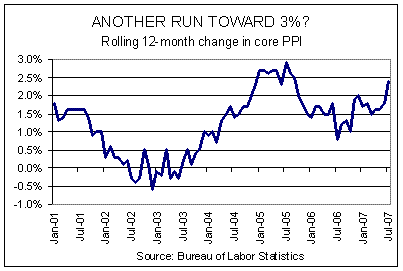
The optimistic view is that the surge in 12-month core CPI is due to “technical reasons”–the falling off of a negative number in the rolling calculation. In other words, the -0.5% for July 2005 drops out of the latest update for the last 12 months, replaced by 0.4% for August 2005. Meanwhile, last month’s core PPI was just 0.1%, down from 0.3% in June. Of course, it’s the longer-term trend that ultimately matters rather than the number from a given month. As such, the above chart is what it is. Perhaps next month will provide evidence that the current 12-month surge was a one-time event; perhaps not.
Meanwhile, the trend as it currently stands seemed to have caught the attention of traders in Fed funds futures. A number of contracts dropped sharply in price in early trading this morning after the PPI news, suggesting that the prospects for a rate cut may have dimmed, at least for the moment.
ANXIOUS & CLUELESS
The only thing worse than a financial crisis is a financial crisis that hits when the economy’s in or near recession. Fortunately, the economy’s still growing, and for the moment there’s no reason to think the expansion is in imminent danger of evaporating.
The latest evidence comes in this morning’s July report of retail sales, which rose 0.3% last month, reversing June’s nasty 0.7% tumble, the U.S. Census Bureau reported today. For the year through July, retail sales climbed 3.2%.
On its face, the numbers suggest, albeit modestly, that the growth machine remains intact. But the worries start to set in when you consider the historical context, which we’ve laid out for retail sales in the following chart.
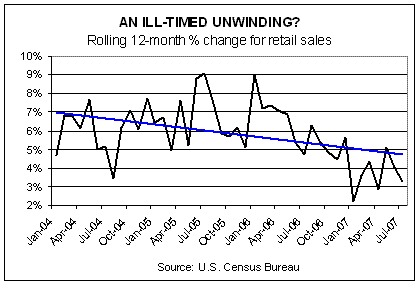
It’s clear that when retail sales are viewed through the prism of recent history, there’s reason to wonder if Joe Sixpack can continue to spend at yesterday’s levels tomorrow. Graphically, the rate of retail sales growth is slowing–on that there’s no debate, as the linear progression trend (the blue line) indicates. Adding to the potency of the trend is the fact that the latest reading is well the trend line, not to mention near the absolute low of late set back in January and about half as much as the latest reading for the nominal rate of annualized GDP growth. All of which raises a few questions: Are retail sales unusually low for the current economic climate? Or is the pace of economic expansion too high given the trend in retail sales?
GREED TAKES A HOLIDAY
Liquidity crunch. The mere mention of the phrase raises fear among the highly leveraged, the overextended and anyone else who’s betting heavily on the notion that the bullish momentum of recent history will last one more day.
With textbook-like regularity, yesterday’s worries over the fading of liquidity in some corners of finance replaced greed with fear, inducing a dramatic bout of selling around the world. Ground zero for the liquidity squeeze was Europe, where the ECB yesterday loaned a record $131 billion to 49 banks in an effort to minimize the fallout arising from subprime-mortgage ills in the United States, MarketWatch.com reported. The Federal Reserve was compelled to engineer a similar injection of liquidity, albeit at a much lower dosage of $12 billion. Other central banks are said to have advanced loans as well yesterday.
It’s hard to judge what the larger trend will be based on just one day. But the idea that the sea of liquidity that’s been bubbling in the 21st century might reverse, and with negative consequences, is hardly a hair-brained nightmare imagined by outcasts to mainstream economics. Much to the chagrin of some, perhaps most investors, cycles are still alive and well. Central banks, in short, haven’t dispatched cycles to oblivion, even if it’s looked otherwise in recent years.
In fact, the latest bout of credit crunching has been years in the making. The law of financial gravity predicted that the Fed’s decisions to favor easy money in the extreme earlier in this decade would come back to haunt the capital markets. In fact, the cornucopia of liquidity has been the elephant in the room for several years, setting the stage for bull markets (inflation?) across the asset spectrum. True, the elephant has been ignored, but a pachyderm won’t suffer obscurity indefinitely, as yesterday’s actions suggest.
Meanwhile, let’s be clear: the Fed and its counterparts around the world have been major players in fueling the bull markets by supplying the necessary credit. Arguably, that credit has been supplied to excess. Few have complained, at least those who’ve been long. Bull markets, after all, have a habit of quieting complaints, easing fear and elevating the demand for martinis and Ferraris. No one wants to spoil a good party, but at some point it’s time to call a cab and head home.
If the corrective power of the bears has returned for an extended stay, a new era of criticism about what central banking has wrought may be in the offing. While we wait for the debate, let’s step back and consider the broader perspective: It’s more than a little ironic that the central banking establishment’s solution for what ails markets is, so far, another dose of the same medicine that brought us to this point. Namely, yesterday’s liquidity injections follow years of the same, albeit in varying forms. Tactically, yesterday’s efforts to ease anxieties by effectively printing more money are really just more of the same policy biases that have been in effect for years. Arguably, the Fed and ECB don’t have much choice at the moment. But that raises questions anew: How did we get pushed into a corner where printing money is at once the problem and the solution? More importantly, what does the constraint imply for the future?
The answer, as always, will arrive one day at a time.
BETTING ON THE STATUS QUO (AGAIN)
No one will be inspired by this morning’s update on initial jobless claims. Then again, the numbers won’t frighten investors either. And that, perhaps, is the point. New applications for jobless benefits aren’t necessarily encouraging, but they don’t they look especially portentous.
That, at least, is our take. But judge for yourself. For the week through August 4, initial claims rose slightly to 316,000 from 309,000 in the previous week, the Labor Department reported. In the context of recent history, 316,000 looks middling, as our chart below shows. True, the bias leans to the upside of late, if only slightly. The four-week moving average of jobless claims is 307,500, modestly below last week’s number.
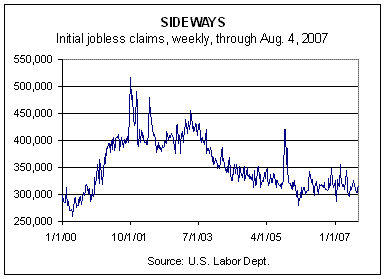
Judging by the broader trend, the news for jobless claims is that there’s no news. And that, arguably, is good news.
Betting on the status quo is a popular choice these days among movers and shakers, including the mover-and-shaker-in-chief: Fed Chairman Ben Bernanke. The central bank on Tuesday continued to hold steady on interest rates, keeping Fed funds at 5.25%, the prevailing number since June 2006. What’s striking about the ongoing preference for doing nothing with the price of money is the fact that in recent weeks the calls for a rate cut have grown louder. Subprime mortgage anxiety has been the immediate catalyst for the thinking that the economy needs a fresh injection of liquidity to keep growth bubbling. But the Fed has resisted, a decision that’s gaining support among pundits, including today’s lead editorial in The Wall Street Journal:
“…Mr. Bernanke did the right thing on Tuesday and refused to pander to the many pleas to rescue credit markets by printing more money.”
The economy, in short, continues to bubble, despite the recent fears driven by the real estate sector. A recession will eventually arrive. The central bank, for all its powers, is run by mortals, not gods. For the immediate future, however, it’s folly to think the economy will contract. There’s ample support for the idea that GDP growth for all of 2007, once the final number is published, will look decent by recent standards.
The “catch” is that time will inexorably take a toll on growth. That’s the nature of business cycles: eventually, they plant the seeds of their own destruction. True, the Fed has learned how to minimize the cyclical risk. Volatility in GDP is a shadow of its former variance. Some ambitious types have even advanced the idea that central banks have assumed the talents to dispatch business cycles to the dustbin of history. We’re highly skeptical of the belief, although for the foreseeable future the inherent allure of that notion will continue to resonate with the bulls.
But financial sobriety is quickly restored if one remembers that ours is a world where the overwhelming majority of forecasts are dependent on the past, and that the past informs the future until it suddenly doesn’t. At some point tomorrow will offer a sharp break with yesterday. The reversal will, of course, look obvious in hindsight while remaining virtually invisible in the here and now. Only by overlooking that monster of a caveat can we say with confidence that the status quo looks likely to prevail. That and $2, as they say, gets you a cup of coffee. And that, dear readers, is why diversification is still your only friend today, tomorrow and forever and regardless of what tomorrow’s headlines proclaim.
IS THERE A CUT IN YOUR FUTURE?
The stock market was surprised and shocked yesterday to learn that the Fed wasn’t cutting interest rates. The initial reaction to the news of standing pat with Fed funds: sell first and ask questions later. But the surprise and shock was fleeting, and investors did a volte face and decided that holding rates steady was the best course after all. Buyers proceeded to bid prices up.
The net effect was that the stock market was on a roller coaster yesterday even though the central bank continued its long-standing policy of sitting on its hands, as defined by Fed funds, which still stands at 5.25%. For those who watch Fed funds futures for clues, yesterday’s news of letting it ride was a yawn. The futures market has long anticipated that 5.25% would remain the standard.
But if futures prices can be trusted, a cut of 25 basis points to 5.0% is coming by late this year or early in ’08. One school of thought thinks a cut makes sense in part because of the current credit crunch that’s thrown the capital markets into a tizzy. But while the Fed has a history of coming to the rescue in times of liquidity squeezes, there’s reason to wonder if erring on the side of monetary caution remains the better choice at this juncture. The credit crunch for the time being isn’t all that crunchy. Liquidity has dried up some, but that’s only relative to the recent levels of excess. In any case, so far there’s still lots of cash looking for a home in the global markets.
LOOKING FOR BARGAINS
Your editor has been absent from these digital pages for just 11 days, but a lot can happen in 11 days.
Consider the table below, which summarizes the performance of the major asset classes of late. In particular, note the prevalence of red under the 4-weeks column. Risk has been showing its other face to investors, many of whom formerly thought that there was but one outcome to embracing the four-letter word.
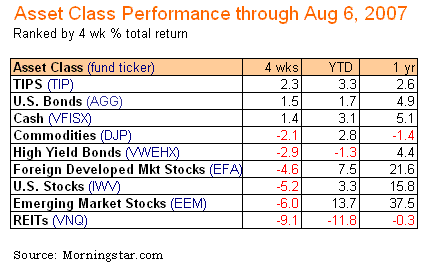
The fact that markets have retreated in earnest should come as no surprise. After a multi-year run of dispensing mostly gains, the major asset classes have reintroduced the notion of humility to the masses. As readers of this site will recall, we’ve been expecting no less for some time. Granted, even a broken clock is right twice a day, and so we’re vulnerable to criticism that our warnings were early. True, although we’ve advised all along that our preferred strategy has been one of raising cash methodically as markets continued moving higher.
As a result, our own personal allocation to cash is well above levels we’re comfortable with as a long-term proposition. The idea of continuing to elevate the cash weighting was always with an eye toward redeploying it when prospects looked more attractive elsewhere. Now that red ink has arrived, is it time to redeploy? Yes, sort of. But in addition to diversifying across asset classes, we’re of a mind to diversify across time as well, for both buying and selling. The reason: we can’t see the future. Yes, we can make some educated guesses, in part driven by quantitative clues handed down by the markets. Those clues, however, aren’t foolproof.
Meantime, let’s be clear: the correction so far, painful as it seems, hardly amounts to an earth-shattering buy signal across the board. Blood is starting to trickle, but it’s still not running in the streets.