Daily Archives: December 26, 2013

A Timely Decline In New Jobless Claims

The encouraging economic numbers for the US in recent weeks have been marred by two sore spots: a sharp rise in new jobless claims and a worrisome deceleration in the growth rate for disposable personal income (DPI). But today’s release on new filings for unemployment benefits suggests that we have one less threat to worry about.

Jobless claims dropped by a hefty 42,000 last week to a seasonally adjusted 338,000. And not a moment too soon. Claims have surged recently, reaching the highest level since March for the week through December 14. But quite a lot of the increase was reduced in today’s report. As a result, claims have slipped to the lowest level since late-September. It’s still unclear if this leading indicator will resume the downward trajectory that was in force until a few months ago. But for today at least we have a new reason to think that the economy’s capacity for creating jobs at a modest pace is intact.
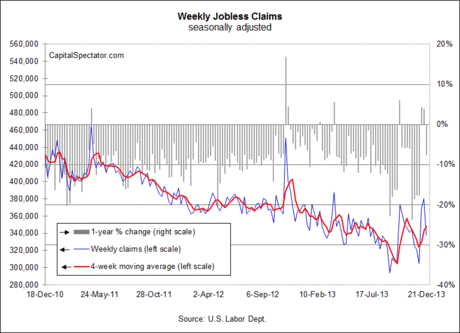
It’s especially reassuring to see the year-over-year trend in claims again reflect a decline after two straight weeks of increases. The change suggests that the jump in claims numbers of late have been tortured by short-term volatility of minimal relevance for reading the business cycle’s tea leaves.

But that leaves us to ponder the troubling weakness in the rate of growth for DPI. As I noted on Monday with regards to the November income report: “DPI’s annual change continues to slump, rising only 1.5% last month vs. a year ago. That’s a sharp deceleration from October’s 2.6% year-over-year rate. It’s also the second-slowest pace of growth this year.”

It’s unclear if this too is noise, or the start of something darker. Exhibit A for leaning toward the former assumption is the wide array of robust numbers across the macro spectrum. Indeed, the economic trend continues to reflect a low level of business cycle risk through November. The generally bubbly overview implies that DPI will again join the party. But that’s a purely speculative projection at this stage, and will remain so until we see more data on income, starting with the next update: the December report, scheduled for release on January 31.

Britain’s Ascendancy & Europe’s Decline

‘Tis the season for predictions and all the usual caveats apply. But amid the din of forecasts as the year winds down is one outlook that’s worth a closer a look for what it says about the UK, the Eurozone, and the price tag for embracing a deeply flawed monetary policy inside a misguided currency union.

“The UK is forecast to be the second most successful of the Western economies after the US,” advises the Centre for Economics and Business Research (CEBR) in a new report published today. “Positive demographics with continuing immigration, rather less exposure to the problems of the Eurozone than other European economies combine with relatively low taxes by European standards to encourage faster growth than in most Western economies.” As it travels along the road to recovery, Britain will edge out France to become the fifth-largest economy on the planet in five years, pushing aside Germany to become Europe’s leading economy by 2030, CEBR projects. It seems that the sun is no longer setting on the British Empire in macro terms.

A lot can change between now and five years, to say nothing of what will unfold over the next three decades. But CEBR’s forecast certainly sounds plausible based on what we know about Britain’s economy this year. If you’ve been following the macro news for the UK, you know that it’s been posting encouraging numbers for months. There’s a fierce debate about why Britain’s economy is recovering. There’s also plenty of skepticism about whether the rebound is sustainable or even healthy—some analysts say that it’s overly reliant on a housing boom, for instance.

But there’s no denying that the UK’s generating numbers that stand in sharp relief with the Eurozone—particularly for the Eurozone ex-Germany. If you consider the upbeat economic numbers of late for the US and Japan, Europe’s troubles stand out even more. What explains the difference? Surely monetary policy is a big part of the answer, as Ambrose Evans-Pritchard of The Telegraph explains:

The crippled eurozone alone has chosen to stagger on defiantly without monetary crutches. The result has been a double-dip recession of nine quarters, the longest since the Second World War. The austerity regime has been self-defeating even on its own crude terms. Debt ratios have ratcheted up even faster.

It doesn’t help that the euro has been imposed in a region that falls short of Robert Mundell’s standards for defining an optimal currency area. But the euro isn’t going away, at least not for the immediate future. So, what could change? Perhaps the European Central Bank will embrace monetary stimulus in a more aggressive form in 2014, although it’s clear that policy choices to date have been far too modest to make a dent in the lingering troubles that continue to afflict France, Italy and Spain.

In absolute terms, Britain’s ascendancy of late can be attributed to internal economic momentum, supported by the simple fact that the UK still has its own currency and therefore has dodged the macro headwinds that weigh on countries tethered to the euro. In relative terms vis-à-vis the Eurozone, however, Britain’s strength speaks volumes about the self-inflicted problems on the Continent.

“The UK’s rebound is not because fiscal cuts have been milder than in Europe,” observes Evans-Pritchard. “The squeeze has been roughly comparable over the past three years. The difference is monetary policy. Kudos to the Bank of England, rising to a historic challenge once again.”