Author Archives: James Picerno

Macro Briefing: 9 December 2020

* White House proposes $916 billion Covid-19 relief bill to Democrats
* US Covid-19 deaths rise to record
* Supreme Court denies Republican challenge to block vote for Biden in PA
* House passes veto-proof defense bill
* Deflation returns to China’s consumer prices for first time in 11 years
* JP Morgan expects rising demand and falling supply for equities in 2021
* US small business optimism slipped to 3-month low in November

Macro Briefing: 8 December 2020

* Stimulus bill at risk as McConnell focuses on alternative plan
* Most of California goes into lockdown to combat Covid-19’s spread
* 90-year-old woman in UK is first to receive Pfizer vaccine outside trial
* Retired Army Gen. Lloyd Austin reportedly chosen as next Sec. of Defense
* Florida police raid home of former state Covid-19 data scientist
* UK Prime Minister Johnson aims for last-ditch effort to salvage Brexit deal
* Goldman Sachs will acquire 100% of securities joint venture in China
* German investor sentiment rises sharply in December on vaccine outlook
* Eurozone GDP for Q3 revised slightly lower
* US consumer-credit growth slowed in Oct
* US 10yr-3mo Treasury yield curve holds near highest level since March:

Macro Briefing: 7 December 2020

* Details on pandemic relief package expected from negotiators today
* Biden picks California Attorney General Xavier Becerra for top US health post
* China’s trade surplus widened to a record in November
* Sterling’s losses against US dollar continue as Brexit talks founder
* Car sales drive German industrial output sharply higher in October
* Slowdown in US payrolls threatens economic recovery
* US Treasury market’s implied inflation forecast rises to highest since May 2019:

Book Bits: 5 December 2020

Less is More: How Degrowth Will Save the World
Jason Hickel
Review via Commonweal Magazine
In his recent book, Less is More: How Degrowth Will Save the World, the anthropologist Jason Hickel attempts to translate the main arguments of degrowthers into an accessible manifesto. He insists both that continued global expansion is incompatible with human and ecological flourishing, and that a future beyond growth need not be an austere one. Abundance can persist long after growth ends.

Continue reading

Fat Tails Everywhere? Profiling Extreme Returns: Part V

Everyone talks about fat tails in markets, but how do you model it in an effort to estimate what may be lurking in the future? There are many possibilities, along with lots of statistical baggage. The main challenge is that trying to squeeze reality into one distribution to capture how markets actually work is challenging, to say the least. But the head of global multi-asset strategies at T. Rowe Price outlines a simple and arguably better approach in a new book on asset allocation.

Continue reading

Macro Briefing: 4 December 2020

House speaker and Senate majority leader resume talks on stimulus deal: CNBC
Moderna: vaccine has ‘potential’ to offer longer-term immunity: MW
Biden and three former presidents pledge to publicly take a vaccine: USAT
Should US policymakers stop worrying and learn to love debt? NYT
Softest gain in 6 months expected for today’s November payrolls report: RTRS
Demand for inflation-protected securities surges: FT
German factory orders rose in Oct, level above pre-crisis level: BBG
Global growth ticked lower in November but remained “solid”: IHSM
US jobless claims fell last week, perhaps due to Thanksgiving holiday: WSJ
US Services PMI: sector growth accelerated to five-year high in November: IHSM
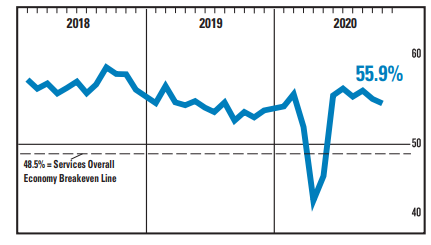
Conflicting with PMI, ISM Non-Mfg Index reflects softer growth in November: ISM

Does The Return Of The Reflation Trade Have Legs?

The Treasury market’s inflation forecast broke above its pre-pandemic high this week, fueling speculation that a new era of firmer pricing pressure is dawning. Maybe, but there are still good reasons to remain cautious before declaring that inflation is at a critical turning point. There’s a case for reviving the pre-pandemic outlook for roughly 2% inflation, but expecting a substantially hotter run still relies heavily on guesswork and dismissing the secular trends — an aging demographic, disinflationary pressure via technology, and other factors — that have prevailed over the past 20 years.
Continue reading