Artificial intelligence has become an increasingly important engine of U.S. economic growth, helping to fuel a surge in spending on data centers, semiconductors, networking equipment, and the energy infrastructure needed to power them. At a time when other sectors have shown signs of slowing, the race to build AI capacity has supported business investment and provided a meaningful lift to economic activity.
That strength, however, may also represent a potential vulnerability. If AI-related investment begins to cool, whether due to overcapacity concerns, weaker returns, financing constraints, or a shift in corporate priorities, one of the economy’s most dynamic sources of growth could fade, exposing a greater dependence on a relatively narrow segment of business spending.
To date, the AI buildout has been a strong net plus. Apollo chief economist Torsten Slok estimates that “AI investment added roughly 1.3 percentage points to real GDP growth over the last three quarters, or about 65% of the roughly 2% cumulative growth, led by software and computers.” That makes AI “the number one source of growth for the US economy, and anyone making statements about the 2027 outlook for equity and credit markets is implicitly making assumptions about the pace and magnitude of the AI data center buildout.”
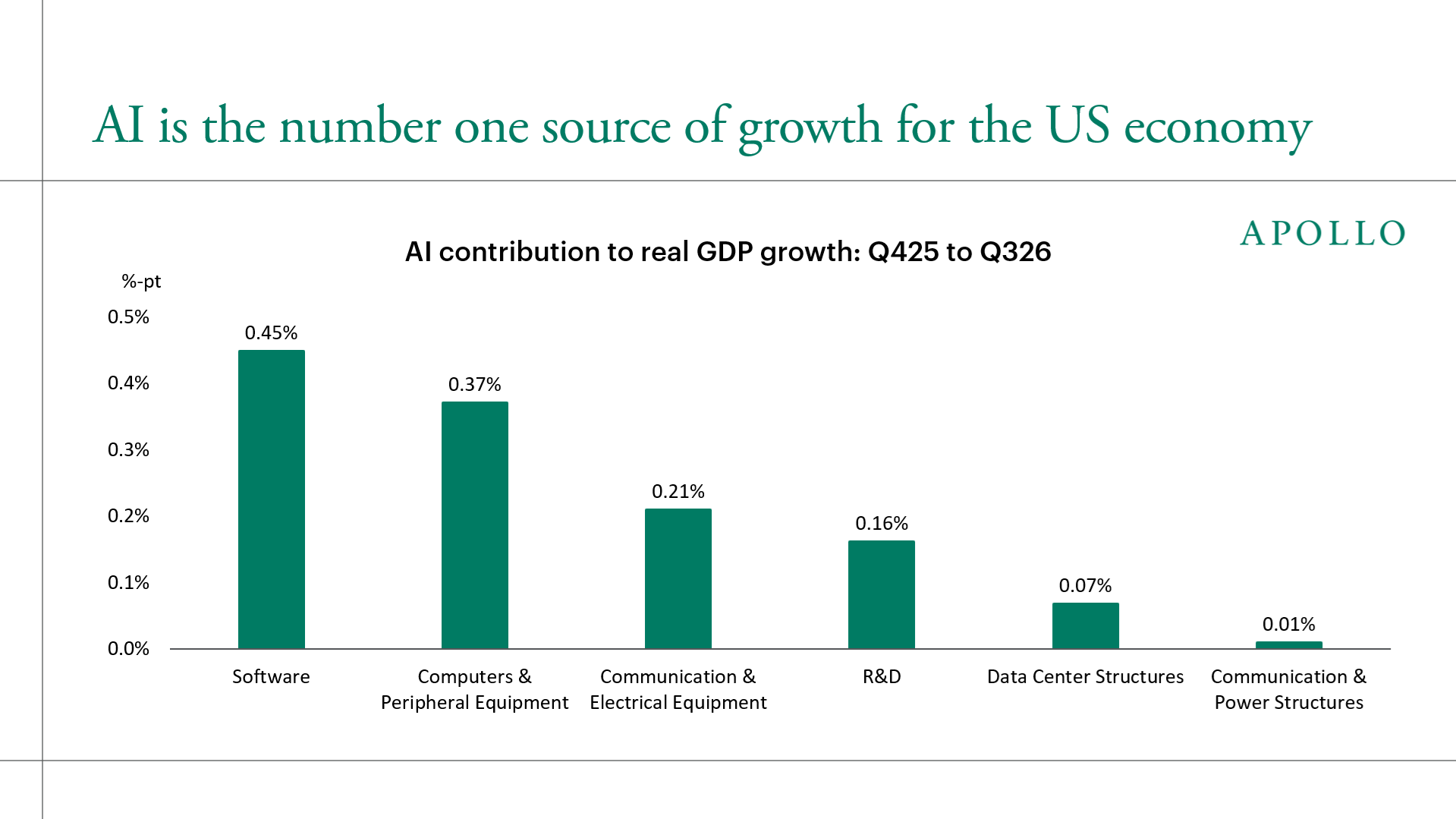
For the upcoming fourth-quarter GDP report, the AI buildout is still expected to be a positive force for economic growth. How long this tailwind lasts, and to what degree, is quickly becoming a focus of debate as tech stocks and the broad equity market continue to slide. The S&P 500 Index tumbled 2% on Thursday and is now down more than 8% since Oct. 6, when the benchmark closed at a record high.
For now, at least, the outlook for economic activity in the October-through-December period remains relatively upbeat. U.S. growth is projected to rise at an annualized 2.9% rate in Q4, based on the median estimate of a set of nowcasts compiled by The Capital Spectator. That’s a moderately softer pace than the 3.4% increase reported for Q3, but the nowcast for the current quarter still points to a faster pace than the mid-2% trend in the first half of the year.
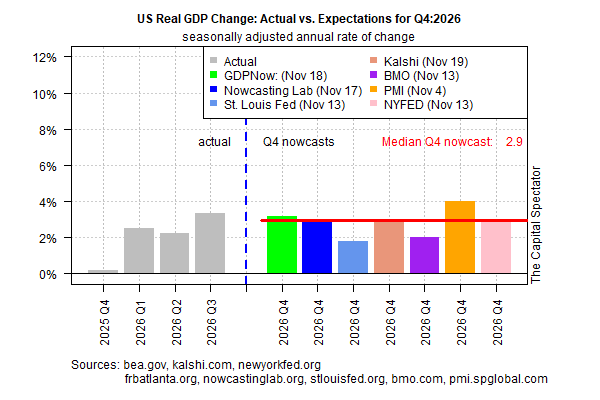
Today’s median Q4 estimate reflects a slight downshift from our previous 3.1% nowcast on Nov. 9. Momentum in the economy is still strong enough to tilt the odds in favor of a solid gain for the current quarter, but questions about what’s in store for 2027 are increasingly coming into focus.
That uncertainty is becoming more visible in asset prices. Equities have retreated this month, leaving the S&P 500 Index at its lowest level since April. Meanwhile, the bond market is benefiting from renewed demand for safe-haven assets, lifting government bond prices and pushing yields lower. The rebound in fixed-income buying reflects a growing debate over whether economic growth will cool in 2027, a development that could also help ease inflation pressures.
Artificial intelligence has been a powerful tailwind for both the economy and the stock market, driving investment, boosting productivity expectations, and fueling a rally in technology shares. More recently, however, investors have begun questioning whether the enormous sums being spent on AI infrastructure and data centers will generate returns sufficient to justify the costs. The resulting shift in sentiment has triggered a broad selloff in tech stocks and raised concerns that one of the economy’s strongest growth drivers may be losing momentum.
The stock market is not the economy, but markets are forward-looking and tend to price in expectations for future growth. The recent decline in stocks, particularly AI-related shares, alongside falling Treasury yields, suggests investors are becoming less confident that the forces underpinning today’s economic resilience will be as powerful in 2027. Whether that concern is justified remains unclear, but it helps explain why investors are taking a more cautious view of the year ahead.
Is Recession Risk Rising? Monitor the outlook with a subscription to:
The US Business Cycle Risk Report