The scent of recession may be in the air, but it’s not yet creating a stink in jobless claims.
New filings for jobless benefits fell last week to 317,000, the lowest in a month, the Labor Department reported. As you can see from the chart below, the trend doesn’t look particularly ominous. In fact, it looks quite middling by the standard of recent history.
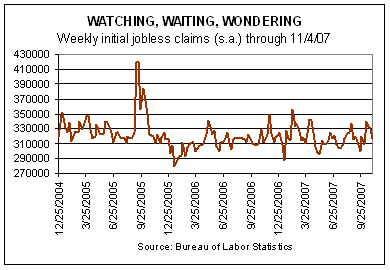
The future may bring darker trends, but for the moment the status quo prevails. In fact, it’s not too hard to find an economist who’ll tell you that initial jobless claims running consistently below ~330,000 a week suggests a bubbling U.S. economy. And while we’re looking at trends, let’s not forget that initial claims have now fallen for three weeks running.
“It’s still consistent with a moderate expansion of the labor base.” Richard DeKaser, chief economist for National City Corp. in Cleveland, told Reuters today.
But let’s not get too excited. Jobless claims numbers not necessarily dispense timely warnings far in advance. Going back to the last time Wall Street and the economy ran into trouble, it’s worth remembering that initial jobless claims stayed calm long after the stock market bubble burst in March 2000. It wasn’t until December of that year and into the first quarter of 2001 that jobless claims reflected the dangers that had been brewing for some time.
Monthly Archives: November 2007
ARGUING WITH THE CROWD
On September 17, the benchmark 10-year Treasury yield ended the trading session at 4.47%, or nearly 80 basis points below the target Fed funds rate, which was 5.25% at the time. The yield curve, in short, was inverted and by more than a little. The next day, the Fed cut rates by 50 basis points, which was followed by another 25 basis point cut at the end of October.
Today, the Fed funds rate is 4.50% and the yield on the 10-year Treasury yield is 4.36%, as per last night’s close. The yield curve is still inverted, albeit by a smaller margin compared with September 17.
Meanwhile, the market for Fed funds futures seems to be inclined to think that another rate cut is coming. Perhaps, although the easy cutting is now behind us.
Lower interest rates invariably come as a package deal, with positive and negative effects. Enhanced liquidity has the power to boost spending, at least in the short term. But lower rates come at a cost elsewhere. Those costs have been minimized and largely overlooked in past years. But that was a function of the moment.
RANTING ABOUT RISK (AGAIN)
The strategies that increase the odds of achieving investment success too often get a bum rap. Drowned out by the advice du jour, financial prudence is forever getting trampled in the latest news cycle as more enticing notions grab the crowd’s attention. Buy this, sell that. Oh, look, XYZ Corp. posted an unexpected rise in earnings last quarter. But, wait, look over there: same store sales are down and Uncle Billy’s Medical Supply Inc.
So it goes in the 21st century, which is awash in investment advice, analysis and outright guessing. Some of its ok, most of it isn’t, and only a small minority of it’s worthy of being enshrined as enduring principles. Only today your editor stumbled across a column of questionable value published by one of the major outlets in the so-called new media. The basic message: mutual funds are for those who don’t know any better. Far better, the column recommended, that investors pick a handful of stocks and forget about it. Not just any stocks, of course, but those that have durable brands and businesses that will stand the test of time and that are selling on the cheap. In short, you don’t need a mutual fund.
The rationale given is that Warren Buffett doesn’t use mutual funds and so neither should you. In fact, the author quoted Buffett directly, lest there be any doubt of the true road to investment success: “Diversification is a protection against ignorance.”
Of course, investing isn’t quite so simple. For starters, Buffett has also gone on the record as saying that index funds are a pretty good investment after all. As the Oracle of Omaha advised earlier this year, “A very low-cost index is going to beat a majority of the amateur-managed money or professionally-managed money.”
The strategies that increase the odds of achieving investment success too often get a bum rap. Drowned out by the advice du jour, financial prudence is forever getting trampled in the latest news cycle as more enticing notions grab the crowd’s attention. Buy this, sell that. Oh, look, ABC Corp. posted an unexpected rise in earnings last quarter. But, wait, look over there: same store sales are down.
So it goes in the 21st century, which is awash in investment advice, analysis and outright guessing. Some of its ok, most of it isn’t, and only a small minority of it’s worthy of being enshrined as enduring principles. Only today your editor stumbled across a column of questionable value published by one of the major outlets in the so-called new media. The basic message: mutual funds are for those who don’t know any better. Far better, the column recommended, that investors pick a handful of stocks and forget about it. Not just any stocks, of course, but those that have durable brands and businesses that will stand the test of time and that are selling on the cheap. In short, you don’t need a mutual fund.
The rationale given is that Warren Buffett doesn’t use mutual funds and so neither should you. In fact, the author quoted Buffett directly, lest there be any doubt of the true road to investment success: “Diversification is a protection against ignorance.”
Of course, investing isn’t quite so simple. For starters, Buffett has also gone on the record as saying that index funds are a pretty good investment after all. As the Oracle of Omaha advised earlier this year, “A very low-cost index is going to beat a majority of the amateur-managed money or professionally-managed money.”
A NEW BULL MARKET IN VOLATILITY, A.K.A. OPPORTUNITY?
Judging by this morning’s update of the ISM services industry index for October, the economy doesn’t look all that bad. But there are an infinite number of ways to judge the economic outlook and it appears that for the moment more investors are inclined to judge the glass as half empty rather than half full.
The stock market certainly found no reason to cheer in the wake of today’s ISM news. Yes, services now dominate the U.S. economy compared with the diminishing role of manufacturing. In fact, the October rise in the ISM services index exceeded expectations as upward momentum in the sector took root last month, as the chart below shows. “The [ISM services index] numbers are pretty good,” David Sloan, an economist at 4Cast Ltd., told Reuters. “It suggests the service sector is growing at a decent pace so the economy is not in too much trouble overall, at least for the moment, despite the weakness in housing.”

As such, one might think that a favorable reading for the index would dispense a bit of optimism. Not today, at least not as we write at roughly halfway through Monday’s trading in New York. U.S. stocks opened sharply lower this morning, although the losses were pared by noon.
A TIMELY GIFT FROM THE EMPLOYMENT GODS
Here we go again? Maybe. Another economic release, another opportunity to rethink yesterday’s conventional wisdom.
This morning’s news that employment growth was a lot more bubbly last month than economists expected. The consensus forecast called for a rise in nonfarm payrolls of just 80,000 for October, according to TheStreet.com. That would have been one of the smallest gains in recent years.
As it turned out, the gloom was misplaced: payrolls rose by 166,000 last month, the highest pace since May, as our chart below shows. Meanwhile, the unemployment rate remained unchanged at 4.7%. Given yesterday’s hefty drop in the stock market, today’s news at least offers a temporary reprieve from an otherwise gloomy week of news.

The rebound in job growth in October marks a striking reversal of the sluggish rate of expansion in previous months. From June through September, monthly employment growth was under 100,000, the longest stretch of subpar increases in recent memory.
THE PARTY ROLLS ON
October paid off once again for the optimists. Red ink was nowhere to be found among the major asset classes, as our table below shows. Even the battered REIT market posted a handsome gain last month.
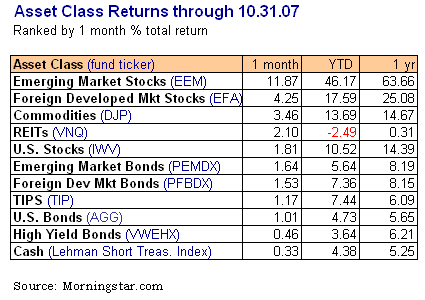
What’s extraordinary here is the persistence of bull markets in everything. In fact, it’s downright amazing. On a 1-year basis, everything’s up, and the same can be said when reviewing longer term records as well. The lone case of loss shows up only in REITs in the year-to-date column. But that’s hardly a calamity, given the potent rise in the asset class for the better part of the past seven-plus years.
Meanwhile, the Federal Reserve is doing what it can to keep the bulls happy. Yesterday’s 1/4 point cut in Fed funds received a warm welcome in the stock market. The S&P 500 rallied 1.2% yesterday, reaffirming once again that the equity crowd loves liquidity.
The sentiment’s a bit more complicated in the bond market. The initial reaction to the Fed’s cut among the fixed-income set was to sell first and ask questions later. As a result, the yield on the benchmark 10-year Treasury popped by the close of yesterday’s trading, rising to 4.48%, the highest in nearly two weeks. But no one should confuse the 10-year’s yield as excessive. A 4.48% rate is roughly the lowest in the past two years.