Who Wins and Who Loses In Prediction Markets? Evidence from Polymarket
Pat Akey (ESSEC Business School), et al.
April 2026
We study pricing efficiency in decentralized prediction markets by comparing marketimplied probabilities from Polymarket with benchmarks derived from option-implied riskneutral distributions extracted from the derivatives market. We study Bitcoin and Ethereum prediction bets and find that, although Polymarket prices broadly track option-implied benchmarks, they show systematic price differences driven by behavioral factors and market frictions. Price differences are most pronounced in tail events, during periods of high volatility, and in response to major macroeconomic shocks, and they reflect the influence of sentiment, attention, and blockchain-specific risks. These results reveal both efficiency and behavioral distortions in prediction markets.
Author Archives: James Picerno
Global Energy Shock Sends Stock Markets on Divergent Paths
The Iran conflict has triggered “the biggest energy security threat in history,” according to Fatih Birol, head of the International Energy Agency (IEA), speaking on CNBC yesterday. Yet the impact will not be felt uniformly, a disparity that likely plays a role in the varied responses in global stock markets to date.
March Retail Surge Hides Warning Signs for Consumers
US retail sales rose in March, beating expectations and posting the strongest increase in more than three years, but a significant portion of the spending was driven by gasoline sales—an effect of the spike in energy costs due to the Iran war. The results raise a warning flag for the consumer sector at a time when a return to pre‑war energy costs appears unlikely in the near term.
A War Drifting Toward Talks, and a World Bracing for the Fallout
The war with Iran appears headed for some form of negotiated settlement. The main uncertainties are timing and details. But the longer the conflict lasts—and the longer the Iranian regime survives—the outlook, as interpreted by The Capital Spectator, is that a decisive US victory, defined as capitulation by Tehran, becomes less likely. The implication of this forecast: a messy, uneven, and protracted period of de‑escalation on the road to a settlement may continue to disrupt the global economy for the foreseeable future.
Stock Market At Record High as Iran Crisis Deepens
The US stock market closed at a record high on Friday (Apr. 17), but a few days ago is ancient history when the firehose of war news can reshape investor sentiment by the hour. Right on cue, the trading week ahead has plenty of fresh shape-shifting headlines to process and decide if last week’s optimism revival still resonates.
Book Bits: 18 April 2026
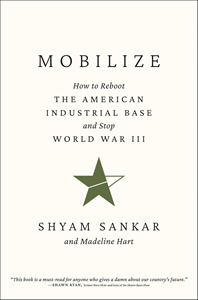 ● Mobilize: How to Reboot the American Industrial Base and Stop World War III
Shyam Sankar and Madeline Hart
Review via The Wall Street Journal
Shyam Sankar is a Silicon Valley Paul Revere. The chief technology officer of the software company Palantir, Mr. Sankar comes at us with warnings of imminent danger, although not on a galloping steed. Instead, he delivers his hair-raising message—that we’re staring at “a humiliating and bloody defeat” if we go to war with China—in a jaunty, clever and sometimes breathless book.
“Mobilize,” written with the assistance of Madeline Hart, a strategist at Palantir, intends to jolt us out of our national-security slumber. “Complacency in peacetime can lead to war,” Mr. Sankar writes. (The book went to print before the U.S.-Israeli use of force against Iran.)
Crisis in Transit: War’s Economic Fallout Is Only Beginning
Markets are pricing in higher odds that the war with Iran has ended, but even if that proves true, the economic effects of the conflict will linger for months, if not years.
Whiplash Rally: Stocks Hit New High Just Days After Sharp Drop
In another display of resilience, the stock market rebounded to a record high on Thursday following the recent correction. The drawdown wasn’t particularly unusual, or unexpected, given the geopolitical risk lurking in the background. But the recovery from the low was notable for its speed.
Against the Odds: US Is Relatively Resilient Despite Global Turmoil
How much policy uncertainty and geopolitical risk can the US economy absorb without derailing its expansion? More than many analysts expected.
In 2026’s Wartime Markets, Risky Debt Outshines Treasuries
Bonds are prized for offering stability in an asset‑allocation strategy, providing an offset to the higher risk in stocks, particularly during periods of market stress. But since the Iran war began, fixed‑income securities have had a rough ride as markets struggle to assess whether the conflict’s main threat is higher inflation, slower growth (if not recession), or some mix of both.